
When sourcing privacy fence panels with gate for residential developments or commercial properties, procurement teams quickly discover that catalog images tell only half the story. A privacy fence system must perform as one integrated assembly, and the gate is where most onsite failures begin. In twelve years of engineering metal fencing systems, I have reviewed specifications for hundreds of projects across different climates and code environments. The gap between what a product sheet promises and what arrives on site comes down to a handful of specification details most buyers overlook. This guide walks through those details so your next order delivers a system that fits, functions, and holds up.
What Makes Up a Privacy Fence Panel and Gate System
A complete privacy fence panel system is not just a set of panels. It is an engineered assembly where every component affects the performance of everything else. The three main elements are the infill panels, the load-bearing posts, and the gate assembly.
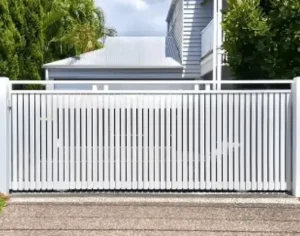
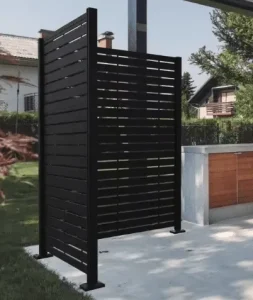
Privacy fence panels themselves come in several configurations. Vertical slat panels use closely spaced aluminum extrusions running top to bottom, providing full visual screening with clean lines. Horizontal slat panels run the extrusions side to side and create a more contemporary look. Blade fence panels use angled louvers that block sight lines from one direction while allowing airflow, a practical choice for pool equipment enclosures or HVAC screening where ventilation matters as much as privacy. Screen fence panels use laser-cut aluminum sheets with decorative perforation patterns, offering partial screening with an architectural finish.
The post system carries all wind loads and panel weight. Most factory-supplied privacy fence systems use aluminum posts with a powder coated finish, although some heavy-duty commercial specifications call for galvanized steel posts. Post dimensions, wall thickness, and anchorage method determine whether the fence stays plumb through seasonal ground movement and wind events.
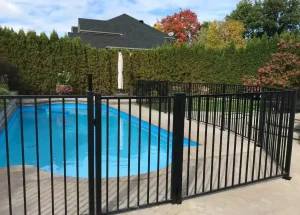
The gate assembly is the most mechanically active part of the system. A single leaf gate for pedestrian access and a double leaf gate for vehicle access each require rated hinges, a latch mechanism, and often a drop rod or cane bolt for the inactive leaf. Gate frame construction, whether welded aluminum sections or bolted assembly, directly affects long-term sag resistance.
Material Selection: Aluminum vs Steel for Privacy Fence Systems
Choosing between aluminum and steel for a privacy fence panel system involves more than comparing upfront cost per linear foot. The decision affects shipping weight, installation labor, corrosion behavior in the project environment, and maintenance obligations over the service life.
| Factor | Aluminum Privacy Fence | Steel Privacy Fence |
|---|---|---|
| Corrosion resistance | Naturally forms protective oxide layer; rated for coastal and humid environments | Requires hot-dip galvanizing or protective coating; vulnerable at cut edges and welds |
| Weight per panel | Approximately one-third of steel equivalent | Heavier; increases shipping cost and requires stronger posts |
| Maintenance cycle | Minimal; powder coat resists UV and salt spray for 15 to 20 years | Periodic touch-up needed where coating is compromised |
| Gate frame rigidity | Adequate for pedestrian and light vehicle gates up to 1.5 m width | Preferred for wide double-leaf gates and high-traffic commercial entries |
| Cost per linear foot | Higher material cost, lower total installed cost due to lighter handling | Lower material cost, higher freight and labor cost |
For most residential and light commercial privacy fence applications, aluminum provides the better long-term value once installation labor and maintenance are factored in. Steel becomes the stronger candidate where gate spans exceed 1.8 meters or where vehicle impact resistance is a project requirement.
Specifications That Matter When Ordering Privacy Fence Panels with Gate
The difference between a system that installs smoothly and one that generates change orders lies in the specification sheet. In factory-direct ordering, the buyer owns the specification review. Here are the details I check on every project.
Panel dimensions must match the post spacing, not just the aesthetic preference. A 1800 mm wide panel requires posts at 1800 mm centers plus post width. If the panel uses a bracket mounting system, the bracket offset must be added to the clear opening. Specifying panel height is straightforward, but check whether the manufacturer measures from ground line or overall panel height. A 1500 mm panel with a 50 mm ground clearance gives 1450 mm of visual screening above grade.
Post specifications need equal attention. For aluminum privacy fence panels up to 1800 mm tall, we recommend 60 mm by 60 mm posts with a minimum wall thickness of 2.0 mm in standard wind zones. Coastal or high-wind sites should move to 80 mm by 80 mm posts or reduce post spacing. The post anchorage method, whether embedded in concrete, surface-mounted with base plates, or spiked into soil, must be specified before fabrication because post lengths are cut accordingly.
Gate integration is where I see the most specification gaps. A gate leaf in a privacy fence panel system needs to match the panel infill exactly for visual continuity. The gate frame must be specified separately from the panel: frame material and section size, hinge type and quantity, latch and lock compatibility, and whether the gate is pre-hung at the factory or assembled on site. For double-leaf gates, confirm that the manufacturer supplies a drop rod and receiver for the inactive leaf, as these are sometimes omitted from standard gate kits and must be ordered as accessories.
Powder coating specifications are worth confirming in writing. We use a minimum 60-micron polyester powder coat on all aluminum privacy fence panels, applied after a chromate conversion pretreatment. This combination passes 1000-hour salt spray testing to ASTM B117 without blistering or creep at the scribe. If your project is within 5 km of breaking surf or in an industrial zone with airborne contaminants, request a marine-grade coating specification and ask for the test report.
If your program involves coastal installation or a custom gate configuration with specific hardware requirements, it is worth confirming the coating specification and frame design directly before finalizing your bill of materials. Reach out at sales01@yulongkeji-ch.com with your project parameters.
How to Order a Complete Privacy Fence System from the Factory
Ordering privacy fence panels with gate directly from a manufacturer follows a different sequence than buying from a local distributor. The factory needs complete information upfront to generate an accurate quotation and production schedule.
Start with a dimensioned site plan or a linear meter count for each fence run, noting corner posts, end posts, and gate locations separately. Gate openings should be marked with width, swing direction, and whether single or double leaf. If the site has elevation changes, indicate the slope or stepped panel requirements. Rackable panels that follow a slope use different hardware than standard panels installed in stepped sections.
Minimum order quantities vary by product line and customization level. Standard aluminum slat fence panels in stock colors typically carry an MOQ of 50 to 100 linear meters. Custom colors, nonstandard panel heights, or blade fence configurations with specific louver angles may require higher minimums because the extrusion runs and powder coating batches are set up for each order. Confirm the MOQ before developing detailed specifications to avoid engineering a custom solution that falls below production minimums.
Lead times for aluminum privacy fence panel orders typically run four to six weeks from deposit receipt, depending on factory loading and the complexity of the order. Custom gate fabrication adds one to two weeks if the gates require welded assembly and separate quality inspection. Ocean freight to destination ports adds transit time that varies by route. Factor in port clearance and inland trucking when setting project delivery dates.
Requesting a pre-production sample is standard practice for first-time factory orders. A sample panel section and a gate corner detail allow you to verify the profile, color, coating quality, and fabrication standard against your specification before full production begins. For larger projects, we recommend an inspection visit or third-party quality audit during production rather than relying on final shipment photos alone.
If your project specification includes nonstandard dimensions, a custom RAL color, or specific hardware requirements, share your part numbers and quantities. We will confirm stock availability and production feasibility before quoting. Send your project details to sales01@yulongkeji-ch.com or call +8619086315193.
Common Questions About Ordering Privacy Fence Panels with Gate
Can I order fence panels and gates separately from different suppliers?
You can, but I recommend against it for privacy fence systems where gate and panel must share the same infill profile. Different extrusion dies create slightly different slat geometries, and the visual mismatch at the gate-to-panel junction is immediately noticeable. Even if both suppliers claim the same RAL color, batch-to-batch powder coating variation can produce a visible difference at the transition. Ordering panels and gates from one manufacturer ensures profile continuity and color consistency across the entire run.
How are privacy fence panels shipped, and what does freight cost?
Most factory-direct privacy fence panel orders ship in plywood crates or steel-framed bundles with protective edge wrapping. Panels are stacked with interleaving material to prevent coating abrasion during transit. Freight cost depends on total cubic volume and weight, not just linear meters ordered. Aluminum panels load more panels per container than steel because of the weight difference. A 20-foot container typically holds 400 to 600 linear meters of aluminum privacy fence panels depending on panel height and packaging configuration. We provide freight estimates based on your full bill of materials and delivery port.
What is the expected service life of an aluminum privacy fence system?
A properly specified aluminum privacy fence system with a 60-micron polyester powder coat over chromate pretreatment should deliver 15 to 20 years of service in normal urban and suburban environments with minimal maintenance. Coastal installations may see the coating reach its service limit closer to 12 to 15 years due to salt aerosol exposure, though the aluminum substrate itself will not rust. The mechanical components such as hinges, latches, and gate closer hardware typically require replacement or servicing within 8 to 12 years depending on usage frequency and exposure. Specifying stainless steel gate hardware extends the service interval on moving parts.
Do I need a structural engineer to specify the post foundations?
For standard residential privacy fence installations under 1800 mm height on level ground with moderate wind exposure, the manufacturer’s standard post specification and embedment depth are generally sufficient without a separate structural review. Commercial projects, fence heights above 2000 mm, installations on retaining walls or elevated decks, and sites in hurricane-prone wind zones should involve a local structural engineer who can calculate wind loads per ASCE 7 or the applicable local code and specify post size, spacing, and foundation details accordingly. Share the panel weight, solidity ratio, and post section properties with the engineer. Your manufacturer should be able to provide these values from their product data sheets.
What happens if panels or gates arrive damaged?
Pre-shipment inspection and proper crating prevent most transit damage. Every shipment from our facility is photographed during loading, and the packing list with crate numbers is shared before the container is sealed. If damage is found upon arrival, document it with photographs showing the crate condition, labeling, and specific damaged items. Notify us within three working days of delivery. We handle claims through either replacement production at no charge for manufacturing defects or freight insurance claims for carrier-handling damage. Ordering a small overage, typically 3 to 5 percent extra panels and an additional post or two, gives you buffer stock so a few damaged pieces do not delay site installation. Share your project requirements and we will confirm the replacement policy details and recommended overage percentage for your order.
If you’re interested, check out these related articles:
Aluminum Fencing for Coastal & Humid Environments
Order Custom Aluminum Fencing from China: A Strategic Guide
Steel Fence vs Wrought Iron: Modern Options for Durable Fencing
Steel Fencing for Parking Lots: Maximizing Car Park Security
Aluminum vs Wood Fence: Cost, Care, and Lifespan Compared