
Getting aluminum panel fence dimensions right before placing an order determines whether installation goes smoothly or hits costly delays. Standard panel sizes cover straightforward perimeters, but any slope change, tight corner, or gate integration requirement pushes the project into territory where off-the-shelf dimensions stop fitting. At Yulong, we stock panel heights from 900 mm to 2200 mm and widths up to 2400 mm, with custom dimensions available for projects that fall outside standard ranges. The question every procurement manager faces is not whether a factory can cut a different panel size, but whether the factory adjusts its frame engineering, slat count, and post spacing to match the new dimensions properly. This guide covers the standard dimensions that handle most orders and the custom sizing process that handles everything else.
Standard Panel Heights and Where Each Works
Aluminum panel fence heights follow common increments because they align with post profiles, gate hardware, and the extrusion tooling already in production. The five standard heights we manufacture daily cover the vast majority of residential and commercial orders.
| Height | Typical Application | Privacy Level |
|---|---|---|
| 900 mm | Front boundary decoration, low garden division | Low |
| 1200 mm | Side yard privacy, pool equipment screening | Moderate |
| 1500 mm | Rear garden privacy, apartment terrace enclosure | Moderate-High |
| 1800 mm | Full residential privacy, commercial lot boundary | High |
| 2200 mm | High-security commercial, utility compound, multi-family | Complete |
The 1200 mm and 1500 mm heights account for roughly two-thirds of residential orders we ship. At 1500 mm, the panel sits above eye level for most seated positions on a patio without making a garden feel walled in. Moving to 1800 mm changes the structural requirement, the post needs a heavier wall thickness and deeper embedment because wind load climbs sharply after 1500 mm.
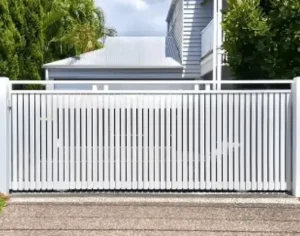
For pool fencing, local codes often mandate minimum 1200 mm with no climbable horizontal rails on the outside face. Standard panel designs meet this easily, but the gate must also self-close and latch from 1500 mm height, which affects the gate frame width and hinge selection. Specifying the full panel system with matched gate hardware avoids compliance gaps later.
Panel Width Ranges and What They Mean for Post Spacing
Standard panel widths run 1200 mm, 1800 mm, and 2400 mm center-to-center. The width dictates post spacing, the number of intermediate vertical supports in the frame, and how the panel handles wind load across the span.
A 2400 mm panel needs a heavier top and bottom rail profile than a 1200 mm panel because the longer span puts more bending moment on the horizontal members. On most standard orders, 1800 mm hits the balance point between fewer posts and manageable frame profiles. Narrower 1200 mm panels produce more post holes per linear meter but allow thinner rail extrusions without sagging, which matters on sloping ground where each panel steps independently.
The slat count changes with panel width as well. A vertical slat panel at 1200 mm wide might carry 16 to 18 slats depending on the spacing and privacy target. At 2400 mm, the count doubles, and the slats themselves may need a slightly thicker wall to stay straight over the longer clear span. None of this shows in a catalog photo, but it changes the material cost and the panel weight noticeably.
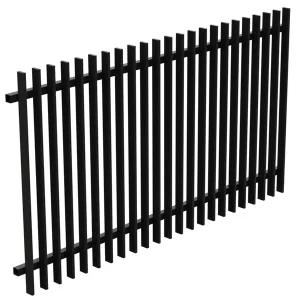
When ground slopes more than 3 degrees, rackable panel frames become necessary. Rackable panels can pivot at the rail-to-post connection to follow the grade while keeping slats vertical. Standard fixed panels on a slope leave triangular gaps underneath, which defeats privacy and creates a trip hazard for pets. If your site has any elevation change across the fence line, specify rackable frames at the quoting stage rather than discovering the mismatch when panels arrive.
If your program involves multiple post spacings across a single project, it is worth confirming the frame profile engineering for each width before finalizing your BOM. A 1200 mm panel designed for ornamental use may not use the same rail extrusion as a 2400 mm privacy panel from the same product family, and the post brackets differ as well. Reach out at sales01@yulongkeji-ch.com with your layout dimensions and we will verify the correct profiles per section.
What Changes When You Move to Custom Dimensions
Custom panel sizing is not simply cutting extrusions to a different length. The frame engineering adjusts at several points, and each adjustment must be confirmed before production starts.
The rail extrusions carry the vertical load of slats and the horizontal wind load transferred through the slat-to-rail connections. Changing panel height means the slats get longer, adding weight. If the height increase exceeds 15% over the nearest standard size, we typically move to the next wall thickness in the rail profile. A panel jumping from 1800 mm to 2100 mm may share the same rail as the 2200 mm standard panel, meaning the tooling exists and the change is straightforward.
Changing width is more involved. A 2700 mm wide custom panel needs a deeper top rail section or an additional intermediate horizontal stiffener to prevent visible bowing under wind load. The slat profile may also need to go up one wall thickness if the slat spacing remains tight. All of this gets calculated during the engineering review before we confirm the quote, so the customer receives a panel that performs, not just one that fits the measured gap.
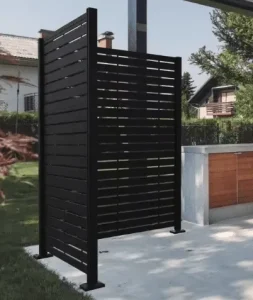
Post sizing scales with panel size as well. A 60 mm x 60 mm post that works for a 1200 mm x 1800 mm panel may be undersized for a 2200 mm x 2400 mm custom panel. We check post section modulus against the projected wind load at the installation site using basic engineering calculations, and recommend upsizing when necessary. For coastal or high-wind sites, this step is essential and should be flagged during inquiry.
Making Gate Dimensions Work with Panel Fence Heights
Gates introduce their own sizing constraints because the frame must carry its own weight plus the infill across a clear opening without a bottom track. A single gate wider than 1200 mm puts heavy load on the hinge post, and the frame needs internal corner gussets or welded reinforcement at the hinge side. Double gates split the load but require a meeting stile that aligns precisely at center, plus a drop rod or surface bolt to anchor the inactive leaf.
Gate height should match the adjacent panel height for a continuous sight line. At 1800 mm panel height, the gate frame measures the same 1800 mm to the top rail, but the bottom clearance adds about 50 mm to 75 mm for swing clearance over grade. Procurement teams sometimes order a gate height equal to the panel height without accounting for ground clearance, and the gate ends up shorter than the panels visually. The correct specification is panel height for the gate frame with bottom clearance noted separately.
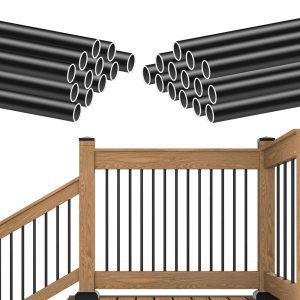
Double gates on a driveway need electric operator compatibility considered early. The gate leaf width, weight per leaf, and hinge configuration determine which operators can drive them. A pair of 1800 mm leaves at 2200 mm high in aluminum panel construction weighs significantly less than the same size in steel, which opens up more operator options and reduces motor strain over time. Provide the full gate dimensions and panel weight when sourcing operators to ensure matched specs.
Specifying Custom Sizes During the Ordering Process
Ordering custom aluminum panel fence dimensions from a factory requires clear documentation upfront so the engineering team can confirm feasibility before cutting any material. The information we need at quoting stage covers five points.
Panel height, panel width center-to-center, the number of panels at each size, the slat orientation and spacing if different from the standard catalog spec, and the post dimensions including wall thickness and embedment method. With these five data points, our engineering team can confirm whether the custom size falls within our existing extrusion profiles or requires tooling adjustments, and the quote comes back accurate rather than provisional.
Lead times for custom-sized panels typically add 7 to 12 working days over standard production time. The additional time covers drawing approval, extrusion length adjustments, and frame welding jig setup for non-standard dimensions. Orders over 200 linear meters of custom fencing may benefit from dedicated tooling setup, which increases the upfront timeline but reduces per-panel cost. We work through these tradeoffs with each customer during the quoting process, and the final production schedule is confirmed before the deposit stage so both sides are aligned on delivery dates.
After the dimensions are confirmed, we produce a set of shop drawings showing post centers, panel elevations, gate swing details, and any special corner or end post conditions. Signing off on these drawings locks the dimensions and starts production. Any changes after drawing approval restart the engineering review and affect the delivery date, so it is worth verifying site measurements twice before submitting them.
Common Questions About Aluminum Panel Fence Dimensions
What happens if the actual site dimension is slightly shorter than the ordered panel width?
Panel width is fixed once the frame is welded. If site measurement comes up 40 mm short across a run, the options are field-cutting the panel and re-welding the end rail, or adjusting the post center at that location if post holes are not yet poured. Neither is ideal. Sending accurate center-to-center measurements at ordering stage avoids this entirely. For projects with uncertain boundary lines, we recommend ordering one or two spare narrow filler panels in advance.
Can aluminum panel fences be shortened in the field?
The panel frame is a welded assembly, so shortening height requires cutting the vertical slats and the side stiles, then re-welding the bottom rail at the new height. This destroys the factory powder coat at the cut points and requires touch-up coating on site. For a few panels on a large order, field modification is manageable. For systematic height adjustment across a whole order, requesting the correct factory height from the start costs less and preserves the finish warranty.
Does custom sizing affect the powder coat warranty?
No, provided the custom dimensions use the same aluminum alloy and surface treatment process as our standard panels. The powder coat warranty covers adhesion and color stability regardless of panel size because the coating process itself is unchanged. What changes with custom sizes is the structural performance, and our engineering review confirms that the adjusted frame design meets the same wind load and deflection criteria as the standard product line.
Why are some panel widths not available in certain heights?
The extrusion profiles that form the rails, stiles, and slats are designed around specific load ranges. A rail profile optimized for 1500 mm high panels may deflect unacceptably if stretched to 2200 mm without a thicker wall section. Rather than ship a panel that performs poorly, we restrict certain height-width combinations to the profiles that can handle them. When a customer needs a combination outside the standard matrix, we engineer a solution using the next heavier profile and quote accordingly.
How do I measure a sloping site correctly for panel ordering?
Measure the horizontal distance between post centers at each panel position using a tape measure held level, not following the slope. The panel width specified to the factory is the horizontal center-to-center distance. The panel frame is then built to that width and installed with rackable brackets that allow the panel to step down the slope. Sending slope angle or rise-over-run for each panel section helps the factory verify that the rackable hardware range will cover the site conditions.
If your project has complex boundary geometry, mixed panel heights, or multiple gate widths across a single order, share the site plan and we will produce a panel-by-panel sizing schedule as part of the quotation. Send your dimensions and specifications to sales01@yulongkeji-ch.com or reach us at +8619086315193. We will confirm the engineering feasibility and return the quote with production lead times.
If you’re interested, check out these related articles:
Custom Aluminum Gates: OEM & ODM Solutions for Global Projects
Steel Fence Gauge: Optimal Thickness for Perimeter Security