
Aluminum handrail pipe selection for OEM projects should start with wall thickness and alloy temper before outside diameter. I have seen order packages built around diameter alone produce rails that deflect in the field because the tube wall was too light for the post spacing and fastener loads. This article explains standard aluminum handrail pipe sizes, how to choose wall thickness for structural loads, surface finish and alloy tradeoffs, and how to specify an OEM order so the pipe arrives cut, finished, and ready to install. From our work on municipal and residential railing systems, the single most avoidable problem is an underspecified wall.
Aluminum Handrail Pipe Standard Sizes
Most aluminum handrail pipe used in OEM railing packages falls into three outside diameter groups: 1.25 in (32 mm), 1.5 in (38 mm), and 2.0 in (50 mm). The 1.5 in size is the most common top rail section for commercial and residential guardrails because it matches standard brackets and bends. Wall thickness runs from 1.2 mm to 3.0 mm, with 1.6 mm and 2.0 mm carrying most structural specifications. Standard commercial lengths are 5.8 m or 6.0 m, and we cut to project length before packing.
| Nominal Outside Diameter | Common Wall Thickness | Typical Application | Notes |
|---|---|---|---|
| 1.25 in (32 mm) | 1.2 mm to 1.6 mm | Stair handrail grip sections and secondary rails | Light duty; verify bending radius |
| 1.5 in (38 mm) | 1.6 mm to 2.0 mm | Top rails, level rails, and guardrail assemblies | Most common OEM option |
| 2.0 in (50 mm) | 2.0 mm to 3.0 mm | Mid rails, structural rails, long-span or high-wind conditions | Requires larger brackets and fittings |
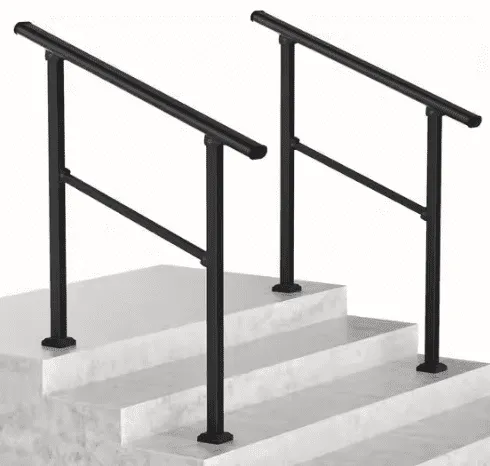
For custom work, the outside diameter must match the bracket bore and the hole pattern in the posts. I have seen mismatch appear when a designer sizes the pipe from a catalog without checking the actual extrusion tolerance. Aluminum extrusion tolerance normally permits a few tenths of a millimeter of variation on diameter and wall, so the bracket should be specified from the same drawing as the pipe.
Wall Thickness Selection for Structural Loads
Wall thickness is not a finish detail. It controls deflection, fastener bearing surface, and how the rail responds to point loads. For a 1.5 in pipe at 1.2 m post spacing, 1.2 mm may pass a light residential look, but I would not specify it for any project that must meet commercial loading or a guard code. The reason is simple: a thin wall leaves little material for self-tapping screws to bite into, and the top rail can rotate under hand pressure. In one project review, a contractor replaced a 1.2 mm extruded pipe after the top rail showed visible sag and the screws loosened within the first year. The section was carrying a 2.0 m span, and the failure showed up first at the mid-span splice.
A 1.6 mm wall works for most residential and light commercial handrail pipe under standard post spacing up to roughly 1.5 m. When the span moves beyond 1.5 m, or when the rail is installed in a high-wind area, I move the specification to 2.0 mm or thicker. The thicker wall also gives more bearing area for rivets, through-bolts, and sleeved connections, which matters when the railing is assembled on site rather than welded in the factory.
If your project involves post spacing above 1.5 m or wind exposure on a rooftop terrace, it is worth confirming wall thickness and alloy temper before finalizing your bill of materials. You can reach me at sales01@yulongkeji-ch.com or +8619086315193.
Surface Finish and Aluminum Alloy Grade
For aluminum handrail pipe, the two alloy families I specify most often are 6063 and 6061. 6063-T5 extrudes cleanly and takes anodizing or powder coating well, which makes it the default for architectural handrail sections. 6061-T6 carries higher tensile and yield strength, so it is the better choice when the pipe is part of a structurally loaded guardrail frame or when the section has deep profiles that need extra strength.
Powder coating is the finish I recommend for most exterior aluminum handrail pipe because it gives a uniform film over cut ends and drilled holes. Anodizing produces a thinner, harder surface and keeps the metallic appearance, but edge coverage and color consistency require tighter process control. For coastal or humid environments, I specify a marine-grade powder coating and a sealed edge profile. The pipe surface must be cleaned and chromate-treated before coating, or the finish will fail at the bracket contact points first.
OEM Aluminum Handrail Pipe Ordering Specifications
A complete OEM aluminum handrail pipe order specifies the following: outside diameter, wall thickness, alloy and temper, length with tolerance, cut end condition, hole pattern, bend requirements, finish type and color, and quantity per length. Do not stop at diameter and section shape. The most expensive change order we see is a pipe that arrives at the right diameter but the wrong wall, because the buyer copied a standard catalog line without checking the application loads.
We also need the post spacing and design load from the project drawings. That lets us flag a section that is too light before cutting begins. Our engineering team reviews the pipe against the railing assembly, not just the extrusion drawing, because handrail pipe rarely fails alone. It fails at the connection.
I know that getting a wall thickness or tolerance wrong creates rework after the container lands, which is the last thing an OEM buyer wants. At Hubei Yulong Building Materials Co., Ltd., we review your drawings against section properties, span conditions, and finish requirements before cutting begins. Send your part number, target diameter, wall thickness, and quantity to sales01@yulongkeji-ch.com or call +8619086315193, and we will confirm stock and tooling lead time.
Common Questions About Aluminum Handrail Pipe Orders
What is the minimum wall thickness for an exterior aluminum handrail pipe?
For most exterior residential and light commercial handrails, 1.6 mm is the minimum I specify. A 1.2 mm wall can work for a low-use stair grip section with short spans, but it leaves too little bearing material for field-installed fasteners and bends. The deciding factor is not the pipe alone. It is the combination of span, post spacing, and whether the rail must resist a concentrated load at the top. If the project must meet a building code for guardrails, I would not go below 1.6 mm without a structural review.
Can I order aluminum handrail pipe cut to exact lengths?
It depends on how your installer works. We cut pipe to length, deburr it, and bundle it by section marker when the project drawings are stable. If the site still has measurement variations, we ship full 5.8 m or 6.0 m lengths and let the installer cut on site. The tradeoff is labor and scrap on one side, or rework risk if dimensions shift before installation on the other. For most OEM packages, cutting to length works when you are repeating a proven railing design across multiple buildings or phases.
Should I choose anodized or powder-coated handrail pipe?
A common assumption is that anodizing is always better outdoors, but powder coating often gives more consistent color on cut edges and threaded holes. Anodizing keeps a metallic finish and resists abrasion well, but color matching across batches is harder and the film is thin. Powder coating offers thicker coverage and a wider color range. For coastal or humid sites, I specify powder coating with a sealed edge treatment. Anodizing works when the design calls for a natural aluminum look and the project accepts slight batch-to-batch color variation.
What information do you need for an OEM handrail pipe quote?
In the quote packages I prepare, the shortest path to an accurate price starts with the outside diameter, wall thickness, alloy and temper, finish, length tolerance, and quantity. We also ask for the post spacing and design load because the right pipe often shifts once those numbers appear. If you have a drawing set, that is even better. We can review the sections and mark up any place where a lighter wall creates a risk before you commit to the order. Share your drawings and target quantity, and we will confirm compliance documentation and lead time.
If you’re interested, check out these related articles:
Wholesale Steel Garden Fence Panels: Distributor Pricing & Supply
Chain Link Pool Fence: Codes, Heights, Gates & Pricing Guide
Powder Coating: Shielding Aluminum Fences from Corrosion