
An aluminum panel gate kit gives you a complete gate system in one package, but what actually arrives on the pallet and how the ordering process works from a factory perspective is something most buyers only discover after their first purchase. As an engineer who has supported hundreds of gate specification and procurement projects, I can tell you that the difference between a smooth installation and a frustrating one often comes down to knowing exactly what is included and what needs to be confirmed before the order is placed. This article walks through the components, specification options, and ordering steps so you can buy with confidence.
Standard Components in an Aluminum Panel Gate Kit
When you order an aluminum panel gate kit from a manufacturer, you receive a pre-engineered package designed to be assembled on site. The standard kit includes the gate frame, typically constructed from heavy-gauge aluminum extrusions with welded or mechanically fastened corner joints. The frame carries the structural load and determines the overall dimensions of the gate.
The infill panels make up the visible face and usually consist of vertical aluminum slats or blade-style panels that match the adjacent fence sections. These panels slide into frame channels or attach with concealed fasteners, depending on the design. Most factories include all necessary panel-to-frame connection hardware in the kit.
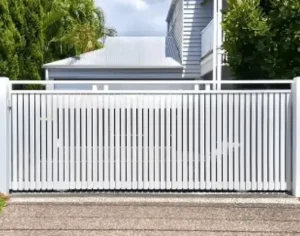
Hardware is another core component. A standard kit includes adjustable hinges rated for the gate’s weight, a latch or lockable handle set, and any required strike plates or receiver posts. For double-swing gates, drop rods and a center catch are typically included as well. The gate posts themselves may or may not be part of the kit. Some manufacturers bundle posts with the gate, while others price them separately because post requirements vary by installation condition. We recommend confirming this during quotation since it affects both pricing and freight volume.
The last standard element is the installation manual and, for factory-finished gates, touch-up paint or a powder coat repair kit. This small detail matters. Aluminum gates with architectural powder coating can be scratched during transit, and having the correct repair material from the same production batch ensures color consistency on site.
| Component | Included in Standard Kit | Notes |
|---|---|---|
| Gate frame | Yes | Welded or mechanically assembled aluminum extrusion |
| Infill panels | Yes | Vertical slats or blade panels matching fence design |
| Adjustable hinges | Yes | Weight-rated for the gate leaf |
| Latch and handle set | Yes | Lockable options available on request |
| Gate posts | Confirm with manufacturer | Often priced separately due to variable site conditions |
| Touch-up repair kit | Yes | Powder coat repair material from the production batch |
Custom Gate Configuration Options: Sizes, Colors, and Hardware
Standard gate kits cover common residential and light commercial openings, typically ranging from 900 mm to 1500 mm for single-leaf gates and up to 4000 mm for double-leaf configurations. Most factory orders involve at least some degree of customization, and understanding where flexibility exists helps you specify correctly from the start.
Gate height is the first variable. Residential pedestrian gates commonly sit at 1200 mm to 1800 mm, matching the adjoining fence line. Driveway gates for vehicle access run taller, often 1800 mm to 2400 mm. The panel arrangement within the frame also changes: some projects need full-privacy vertical slats from top to bottom, while others call for a mixed design with an open upper section and solid lower panel. Sending a drawing or reference photo at the inquiry stage eliminates guesswork and prevents production from proceeding on assumptions.
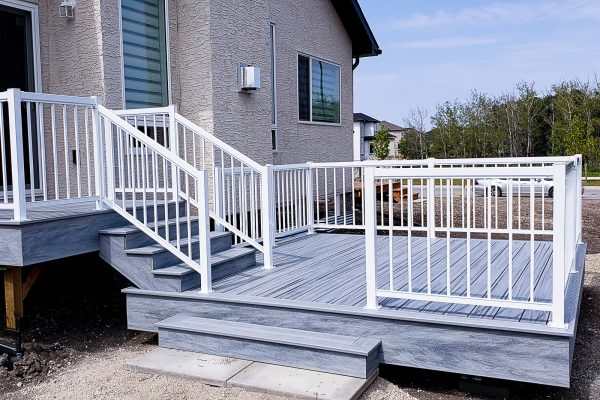
Powder coat color is a factory-level decision, not an afterthought. Standard RAL colors such as RAL 9005 jet black, RAL 7016 anthracite grey, and RAL 9016 traffic white are commonly available from stock formulations. Custom colors require color matching and a minimum order quantity, which varies by production line. The coating specification itself also matters. Architectural-grade powder with UV stabilizers and a minimum cured thickness of 60 to 80 microns delivers better outdoor performance than basic polyester coatings. We apply a multi-stage pretreatment process, including degreasing, chromate conversion coating, and electrostatic powder application, before the curing cycle. This sequence matters because shortcuts in pretreatment show up as adhesion failures within the first two years, particularly in humid or coastal environments.
Hardware upgrades are another area where specification makes a real difference. Standard zinc-plated steel hinges are adequate for most installations, but coastal or high-humidity environments benefit from stainless steel hardware. Self-closing hinges, magnetic latches, and keyed-alike lock systems are available as upgrades. If your project involves automated gate openers, the gate frame may need reinforcement plates and specific hinge geometry to accommodate the motor mounting. This should be specified during the quotation phase rather than after production, because retrofitting a finished gate for an opener is significantly more expensive than building the reinforcement into the original fabrication.
Gate Specification Requirements Before Ordering
Getting an accurate quotation and avoiding supply gaps starts with a clear specification. Over the years, I have seen projects delayed because a single missing detail was not flagged early in the conversation, and the cost of correcting a specification error after production is orders of magnitude higher than the time it takes to get it right upfront.
Start with the opening dimensions. Measure the clear width between existing posts or walls where the gate will be installed. The gate leaf width is typically 50 to 100 mm narrower than the opening to allow for hinge clearance and latch engagement. If posts are not yet installed, decide on the post size and factor it into the total opening calculation. For double gates, specify whether you need equal leaf widths or an asymmetric configuration with a fixed pedestrian leaf and a larger vehicle leaf.
Next, confirm the hinge side and swing direction. This sounds basic, but gates ordered with the wrong swing direction cannot be fixed on site. Specify whether the gate swings inward or outward when viewed from the outside face, and whether the hinges are on the left or right side. For double gates, confirm which leaf carries the active latch and which leaf is secured by drop rods. A simple sketch with these details marked is worth more than a long written description.
Frame and panel material specifications should include the aluminum alloy grade, typically 6063-T5 or 6061-T6 for structural gate applications, the wall thickness of the frame extrusions, and the panel profile dimensions. If the gate will be installed in a corrosive environment, such as within 5 km of the coast, request a note in the production file for enhanced pretreatment and thicker coating. This is not a standard inclusion and must be communicated before production scheduling.
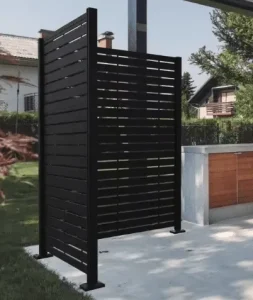
Finally, list any accessories that need to ship with the gate. Post caps, matching fence panels, gate stops, and ground sockets are commonly ordered together but are separate line items. If you need the gate to integrate with an existing fence system from a different supplier, provide the fence profile dimensions so the gate frame and panel alignment can be verified during production planning.
If your gate project involves automated openers or non-standard opening widths, confirming the frame reinforcement requirements and hinge geometry with the manufacturer before finalizing your specification can prevent costly rework. Send your opening dimensions and automation plans to sales01@yulongkeji-ch.com for a technical review before quotation.
The Factory Direct Ordering Process from Inquiry to Delivery
Ordering an aluminum panel gate kit from a Chinese manufacturer follows a defined sequence, and understanding each step helps set realistic timelines for your project.
The process begins with an inquiry that includes your specifications and, ideally, drawings or reference images. A detailed inquiry yields a more accurate initial quotation. We typically respond with a formal quotation within one to two working days that covers unit pricing, estimated freight cost based on your nearest port, and the production lead time. At this stage, you may need to adjust specifications or quantities to meet your budget or container utilization target. This back-and-forth is normal and expected. It is far better to refine the specification during quotation than to discover a mismatch after production is complete.
Once the proforma invoice is confirmed and the deposit is received, usually 30 percent of the order value with the balance before shipment, the order enters production scheduling. Standard aluminum gate kits typically require 25 to 35 working days of production time, depending on the order volume and the complexity of the custom specifications. During production, quality control checks occur at multiple stages: incoming material inspection, dimensional verification after cutting and machining, weld integrity checks where applicable, and a final surface quality inspection after powder coating. Each stage has defined pass criteria, and non-conforming items are reworked or rejected before the order moves forward.
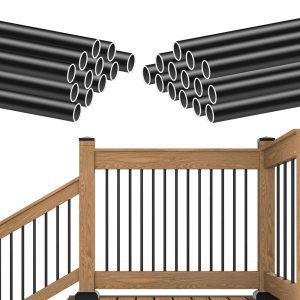
Before shipment, each gate is wrapped in protective foam, packed in reinforced cartons or wooden crates, and labeled with your order reference and handling instructions. We photograph the packed goods and share the images for your confirmation before loading. Shipping by sea freight to major ports in North America, Europe, or Australia typically takes 20 to 40 days, depending on the destination. Air freight is available for urgent orders but significantly increases the per-unit cost and is rarely economical for gate kits due to their weight and dimensional volume.
Documentation includes the commercial invoice, packing list, and bill of lading. If your country requires specific test reports, such as coating adhesion test results or material certificates, request these during the quotation phase so they can be prepared alongside production rather than retroactively.
Getting the Right Gate Kit for Your Project
Even with a detailed product page and specification sheet, every project has unique conditions that affect what you need from a gate kit. Post foundation type, existing fence integration, automation requirements, and local wind load conditions all influence the right specification. The cost of getting a detail wrong, a gate that binds, a coating that fails early, or hardware that corrodes in the first wet season, is far higher than the time it takes to confirm your requirements before production begins.
When you reach out to us with your project details, we review your specifications against our production experience and flag anything that needs attention before the order is locked. You can send your opening dimensions, preferred gate style, and any site-specific requirements directly to sales01@yulongkeji-ch.com or reach our engineering team at +8619086315193 for a technical discussion before quotation.
Common Questions About Aluminum Panel Gate Kits
Do aluminum panel gates hold up in windy conditions?
Yes, but the design matters more than the material. The solid infill of a panel gate does increase wind load compared to an open picket design. For exposed locations, we recommend specifying a heavier frame section and verifying with the manufacturer that the hinge and post system is rated for the gate’s sail area at your site’s expected wind speeds. In projects we have supported along coastal areas, upgrading from standard 2.5 mm frame wall thickness to 3.0 mm and adding a mid-rail reinforcement made a measurable difference in long-term stability without requiring a complete redesign.
The choice between assembled and welded frames depends on what you prioritize
Welded frames provide a rigid, permanent connection at the corners and are the standard for heavy or wide gates where structural stiffness is the priority. Assembled frames use mechanical corner connectors and are typically specified for smaller pedestrian gates or where the gate needs to be flat-packed for container optimization. Both approaches are valid, but if your gate exceeds 1500 mm in width or will carry an automatic opener, a welded frame is the safer choice because repeated opening cycles put more stress on corner connections than most buyers expect.
Narrow the single versus double gate question to two practical factors
Instead of asking which type is better, ask whether your opening exceeds 1500 mm in width and whether you have level ground for the full swing arc. A single gate for an opening wider than 1500 mm becomes heavy and places significant load on the hinges and post, so a double gate is usually the better solution beyond that width. Double gates require more level ground for the swing arc and depend on consistent post alignment. If your driveway has a slope or limited setback, a single sliding gate may actually outperform a double swing gate, and that is worth discussing with the manufacturer before committing to a kit configuration.
In projects we have supported, installation capability varies more than the kit complexity
A mechanically inclined contractor or experienced homeowner can install a single pedestrian gate kit with standard tools, but driveway gates are heavier and require precise post setting, hinge alignment, and latch adjustment. The gate’s weight, typically 30 to 60 kg for a single pedestrian leaf and 60 to 120 kg for a driveway leaf, means that even small alignment errors create binding and premature hinge wear. For double driveway gates, we recommend professional installation. If you are ordering for a project where installation support is limited, ask the factory about pre-assembled gate and post packages with alignment templates, which reduce on-site adjustment work considerably.
Many buyers assume the gate kit arrives ready to hang with no inspection needed
In practice, opening the packaging within 48 hours of delivery is essential. Check the frame for any transit damage, verify that the panel count and hardware kit contents match the packing list, and confirm the dimensions against your order confirmation. If powder coat touch-up material was included, keep it in a cool, dry place for future maintenance. Notify the manufacturer immediately of any discrepancies with clear photos so you preserve your options for replacement parts or freight claims. For your next order, sharing your specification requirements and project timeline with us at sales01@yulongkeji-ch.com or +8619086315193 helps us prepare the right documentation and production schedule from the start.
If you’re interested, check out these related articles:
Steel vs Aluminum Fencing: Budget, Durability, and Value
Steel Fence vs Wrought Iron: Modern Options for Durable Fencing