
Commercial aluminum privacy fences do three jobs that most residential fencing never needs to handle: withstand sustained wind loads across large perimeters, restrict unauthorized access without creating a fortress look, and screen mechanical equipment or service areas while maintaining airflow. The mistake we see in roughly half the commercial specifications that reach our engineering desk at Hubei Yulong is treating wind performance and security as secondary checks rather than primary design drivers. A privacy fence on a commercial site is not a garden barrier scaled up; it is a structural system that has to hold its own through seasonal storms and daily operational stress without visible degradation. The following sections cover how to select a fence that does all three jobs, starting from material fundamentals and moving into the engineering details that keep panels straight and secure over the long haul.
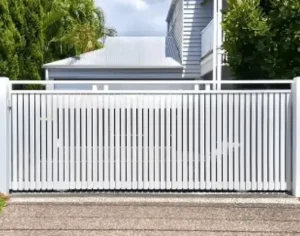
Why Aluminum Outperforms Other Materials for Commercial Privacy Fencing
Aluminum is worth considering for a commercial privacy fence because its inherent properties match the outdoor durability and low-involvement maintenance profile that commercial property managers look for. The 6063-T6 alloy we use for extruded fence sections carries a yield strength around 170 MPa, well above what a typical 6-8 foot fence post sees in service, yet the material is roughly one-third the weight of a comparable steel post. That lower weight reduces handling time during installation and, more important for coastal or high-humidity locations, aluminum does not rust. The oxide layer that forms on aluminum is self-passivating; it stops at the surface. Combined with a polyester powder coat applied to a chromium-free conversion film, the coating system protects the metal through tens of thousands of hours of QUV-B cyclic testing. For commercial sites near saltwater or with chemical exposure, this is a meaningful economic advantage: no periodic repainting and no corrosion-related panel replacement.
From a structural standpoint, the section geometry matters as much as the material. Extruded aluminum fence posts and rails are hollow with internal reinforcement ribs that keep the weight down while pushing the section modulus into a range where deflection under wind load stays manageable. In our project work, we often switch from standard 2.5-inch square posts to 5-inch deep channel sections when the fence height passes 8 feet or the basic wind speed exceeds 110 mph. Material alone does not fix a slender post; the section has to match the load envelope.
How Wind Load Controls Fence Panel and Post Design
Wind is the load case that dictates post size, embedment depth, and panel attachment for almost every commercial aluminum privacy fence over 6 feet tall. A solid panel fence is effectively a vertical cantilever beam continuously loaded by wind pressure, which increases with the square of velocity. At 90 mph, the stagnation pressure on a solid panel is roughly 21 psf; at 130 mph it climbs past 44 psf. Those pressures translate into thousands of pounds of total lateral load across a 100-foot fence run, and the load paths run from the panel into the rails, into the post brackets, and finally into the soil or the concrete pier.
The most practical way to bring those numbers down is to let air pass through the fence. Vertical slat fences with a 10 mm gap between slats reduce the net pressure area by 15-20 percent depending on slat width, while blade fences with a fixed louvers angle can cut the drag coefficient further by directing flow around the blades rather than blocking it outright. The table below gives an approximate comparison for a 6-foot-high fence panel.
| Panel Type | Gap Ratio | Approx. Drag Coefficient | Relative Lateral Load at 115 mph |
|---|---|---|---|
| Solid aluminum panel | 0% | 1.2 | 100% (baseline) |
| Vertical slat, 10 mm gap | ~15% | 0.9 | 80-85% |
| Blade fence, 45° angle | ~30% | 0.7 | 60-70% |
| Open screen (laser-cut, 40% open) | 40% | 0.5 | 45-55% |
These ratios are direction-dependent; wind parallel to the fence line produces lower loads, and wind at 45 degrees can generate higher local suction on blade faces. In practice, we engineer for the worst-case yaw angle unless site-specific wind tunnel data is available, which is rarely the case for commercial fence projects.
Post design follows from the panel load. A single 2.5-inch aluminum post in a 42-inch concrete embedment might safely hold a 6-foot solid panel in a 90 mph zone, but the moment at the base rises so quickly with height and wind speed that an 8-foot panel in a 120 mph zone demands either a 4-inch post section or a double-post cluster with a moment-resistant base plate. We typically specify high-strength aluminum castings or welded base plates for those conditions rather than relying on a simple post-in-concrete detail.
If your program involves a tall perimeter in a high-wind region, it is worth confirming the post and embedment specification before finalizing your bill of materials. Reach out at sales01@yulongkeji-ch.com with the fence height and project location and we can verify the load path.
Making Privacy Work with Security Requirements
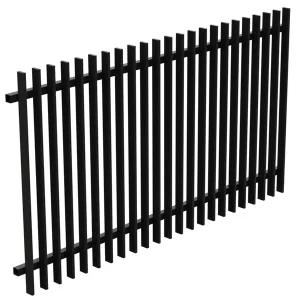
Commercial security does not mean the same thing as prison yard security. For most office parks, logistics centers, and municipal buildings, the goal is to delay forced entry long enough to trigger an alarm or a response, while keeping opportunistic trespass out. Aluminum privacy fences serve this role differently from steel security fences. They are not rated for anti-cut protection in the way a 12-gauge chain link fence with barbed wire is, but a well-designed aluminum panel with closely spaced slats removes the visual and physical handholds that casual climb attempts rely on. Vertical slats spaced at no more than 100 mm center-to-center prevent a foot from gaining purchase, and panels assembled with tamper-resistant fasteners and internal rail clips make panel removal non-trivial even for someone with basic tools.
The decision point comes when the commercial site needs privacy plus equipment screening. A utility area or rooftop HVAC enclosure needs to block line of sight but must not trap heat. This is where blade fences or laser-cut screen panels solve a conflict that solid panels cannot: angled blades maintain airflow while blocking sightlines from street level; a 40% open-area screen panel breaks up the view while letting cooling air through. In several logistics park projects we have supplied, the same perimeter used an 8-foot vertical slat fence for the public-facing security line and a 6-foot open screen fence inside the site boundary to hide service bays from customer parking areas. Two privacy levels from one aluminum system, sharing the same post family and hardware.
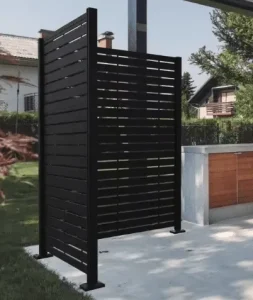
Access control is the third layer. A privacy fence loses its security value if the gate is an afterthought. Every commercial aluminum fence order from our factory includes matching aluminum gates built on the same extrusion system, with heavy-duty hinges and lockable latch boxes. For drive-through entries, we frequently supply double-leaf gates up to 20-foot clear opening widths, using internal diagonal tension cables to prevent sag. The gate frame depth and hinge post diameter are calculated from the gate weight and width, not chosen from a standard menu; a 250-pound gate leaf on a 2.5-inch post will sag within a year, no matter how tight the hinges.
Getting a Commercial Aluminum Fence Specified and Ordered
Commercial privacy fence projects tend to move differently from residential orders. They usually start with a design drawing or a performance specification: fence height, linear foot total, wind zone, gate quantities, and any custom screening requirements. From that point, the specification process involves three decisions that lock in the structural performance and appearance.
First, post type and spacing. We stock square, rectangular, and round post profiles in multiple wall thicknesses, but the post spacing is a structural choice, not a style preference. Full-width panels typically span 6 to 8 feet between posts; pushing spacing to 10 feet to save posts increases panel deflection and transfers more moment to the post connections, which then demand thicker brackets and stronger rail sections. The cost trade-off rarely works in the project’s favor once installation labor and long-term durability are included.
Second, coating and color. Polyester powder coating in standard RAL colors accounts for the bulk of commercial orders; textured matte black and dark bronze RAL 9005 and RAL 8017 are the most common choices in 2025 because they hide dust buildup on busy roadsides. For coastal environments, we apply a marine-grade pretreatment and a topcoat with UV stabilizers that extends color retention past the standard 10-year warranty period.
Third, gate hardware. Commercial gates need continuous hinges, not residential strap hinges. We specify gravity or spring-loaded latch systems that interface with electric strikes for sites that integrate access control keypads. Specifying this at the fence order stage prevents the frustrating retrofit of mechanical hardware later.
A typical commercial project ranging from 500 to 2,000 linear feet with custom gates moves through production in four to five weeks, after which export packaging and shipping add time depending on destination. For bulk buyers, a conversation early in the design phase saves downstream delay. Share your project outline and wind zone at sales01@yulongkeji-ch.com or call +8619086315193 and we will quote against your exact specification. For a deeper look at managing the international procurement process, see our article on Importing Aluminum Fence from China: 5 Questions to Ask.
Common Questions About Commercial Aluminum Privacy Fencing
Does aluminum really hold up in high-wind commercial sites?
It does when the engineering accounts for it. I have seen installations fail not because the aluminum was too weak, but because a 6-foot panel was mounted on a 2-inch post 30 inches into sandy soil with no concrete collar. The material was capable, but the support system was not. Properly sized aluminum posts (3-inch square for 6-foot panels in 100 mph zones and 4-inch or deeper channel sections for taller or windier conditions) handle the bending moments just fine. The lower elastic modulus of aluminum compared to steel means deflection under load is larger, so we pay more attention to deflection limits than to ultimate strength. For most commercial sites, a post spacing of 6 feet with a 3.5 mm wall thickness keeps the top-rail deflection under L/175, the point where most people begin to notice a lean.
Can I get full privacy and security from one aluminum fence design?
You can get effective visual privacy combined with a meaningful delay barrier, but no single aluminum fence panel provides maximum privacy and maximum forced-entry resistance at the same time. A zero-gap solid panel gives total privacy and no handholds, but it catches more wind and offers no airflow. A blade panel with close-set angled louvers blocks sightlines while letting air through, but the blades themselves could be twisted with a bar if someone is determined. The more useful approach is to define the security objective first: deter trespass, delay entry by one minute, or integrate with electronic surveillance? From there we configure the panel type, post reinforcement, and fastener system around that requirement. For most commercial applications, the combination of 6-inch-deep blade or slat panels with concealed fasteners and a 4-inch post family meets the practical security need.
How much does a commercial aluminum privacy fence cost compared to steel?
Installed cost for a 6-foot commercial aluminum privacy fence typically runs about 15-25% higher than a powder-coated steel fence of the same height when comparing material only, but the gap narrows or reverses over a 15-year lifecycle. Aluminum eliminates the repainting or rust repair that steel fences inevitably need in humid or coastal climates. Our galvanized steel fences carry a zinc coating that delays corrosion, but once the coating is scratched through on site, the steel starts oxidizing. Aluminum oxide is self-sealing. In total cost of ownership calculations we have modeled for waterfront distribution centers, the break-even point for aluminum over galvanized steel arrives around year seven to nine.
Can I get custom laser-cut patterns on aluminum privacy panels?
Yes, custom laser-cut screen panels are a standard option for commercial fences that need equipment screening or architectural branding. We can cut designs from a 2D CAD file, with a practical minimum open area of roughly 30% to keep the panel structurally sound. For a consistent architectural look, we recommend a symmetrical repeating pattern that maintains the same cut percentage across the full panel. Turnaround time for custom-cut panels adds about two weeks to the production schedule. If your project calls for a unique cut pattern, share your drawing and we will confirm the manufacturability and a delivery date at sales01@yulongkeji-ch.com.
If you’re interested, check out these related articles:
Importing Aluminum Fence from China: 5 Questions to Ask
Source Steel Fencing from China: An Expert Import Guide
Aluminum Fences: School & Playground Safety Compliance
Hot-Dip Galvanized vs Powder-Coated Fence: Performance & Value