
Most fence buyers start with the wrong question. They ask whether they want privacy or security, but the fence that actually works depends on what they need to hide, slow down, or control. A privacy fence vs security fence decision usually comes down to three site conditions: sightlines, delay time, and access points. A closed aluminum slat panel can screen a patio, but it will not stop a determined climber. A tall chain link fence with small mesh will delay entry, but it leaves the space visible. The practical approach is to define the threat and exposure first, then match the panel, posts, and hardware to that condition.
Privacy Fence Choices Are Driven by What You Want Hidden
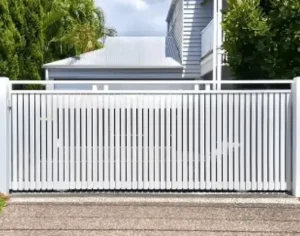
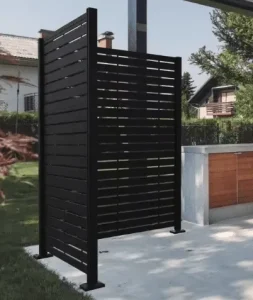
A privacy fence is a sightline barrier first. It works by controlling angles of view, not by resisting force. In residential work, the common request is an aluminum vertical slat fence with tight spacing or a louvered panel whose blade angle blocks the direct view from a neighboring window or street while still letting air pass. That is a useful distinction: privacy and airflow can coexist, but privacy and attack resistance are separate specifications. Aluminum privacy screen panels also hide mechanical equipment, storage, and outdoor seating without turning the space into a closed wall. The weak point is usually the gate line or a gap at grade, where a sliver of visibility remains.
Security Fence Design Starts With The Delay You Can Achieve
A security fence is not defined by its material or color. It is defined by how many seconds or minutes it can delay a person who has already decided to cross it. Height matters, but so do the top treatment, mesh size, picket spacing, and post schedule. A 1.8 meter steel fence with a flat top is easier to climb than a 1.5 meter fence with narrow vertical bars and a pointed or rounded top that offers no foothold. For industrial and municipal perimeters, small mesh chain link or zinc steel panels with anti-climb geometry slow cutting and climbing long enough for lighting, cameras, or staff to respond. The design intent is not secrecy; it is time.
Choosing a Privacy Fence vs Security Fence Depends on the Threat Model
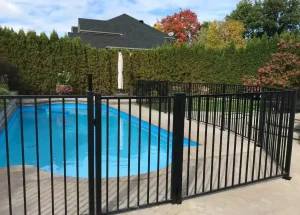
The most reliable way to approach a privacy fence vs security fence decision is to name what the fence is controlling. A patio visible from a sidewalk needs visual screening. A warehouse receiving dock exposed from a rear alley needs delay and deterrence. A pool or roof edge needs a safety barrier that limits access and meets code. When a project mixes these conditions, the better solution is often one perimeter with two fence types, not a single system expected to do both poorly.
| Site condition | Fence must do | Better starting point | Likely weak point |
|---|---|---|---|
| Street-facing patio or balcony | Block sightlines and soften wind | Aluminum slat or screen privacy panel | Gate line or panel bottom gap |
| Warehouse or industrial perimeter | Delay climbing, cutting, or forced entry | Zinc steel anti-climb panel or small mesh chain link | Post spacing and gate hardware |
| Pool, school, or rooftop edge | Restrict access and satisfy safety code | Code-compliant aluminum or steel with self-closing gate | Latch, closer, and gap below panel |
If your site has a public frontage and a secure rear perimeter, the specification is two zones, not one product. Confirming the zone boundary and the required delay or privacy level before ordering avoids paying for security grade where a sight screen is enough. Send your site plan or required delay rating to yloongfence@gmail.com and we can check the post schedule, coating, and gate hardware against the actual exposure.
Gates and Posts Fail Before Panels Do
In programs we have supported, the panel gets the attention while the gate hardware causes the callbacks. A fence panel has few moving parts, but a gate is a repeated load problem. Hinges carry weight, a closer absorbs swing cycles, and a latch must hold without jamming. For security installations, the gate and its frame should be at least as stiff as the adjoining panels, and the post embedment must suit the soil and frost depth rather than a generic rule. Privacy systems fail more quietly: the gate drifts, the latch catches, or a gap opens at the hinge side and the clean sightline is lost. Post spacing, embedment, and hardware selection decide long-term performance more than panel thickness does.
A Clear Site Brief Prevents Most Specification Errors
Most specification errors happen because height, visibility, and attack risk get decided at different times. The fix is a short site brief: total linear meters, exposure conditions, gate locations, local code, and whether the fence must screen, delay, or both. From that, we match the material, coating, post schedule, and gate hardware to the real requirement. If you are not sure whether the project needs a privacy fence vs security fence or a hybrid of the two, send your site dimensions, gate locations, and the performance level you need to yloongfence@gmail.com or call +8619072006155.
Most Buyers Ask These Questions Before Finalizing a Fence System
The same privacy fence vs security fence questions come up on most mixed-use projects. These are the ones worth clarifying before you commit to a panel system or post schedule.
Can a privacy fence also work as a security fence?
Only if the panel system and hardware were specified for both functions at the same time. A closed aluminum slat fence blocks view, but a typical residential panel is easy to climb and can be cut with common tools. A security fence adds anti-climb geometry, stronger posts, a hardened gate frame, and often a steel or zinc-coated structure. If your project must deliver both functions, specify a closed-panel security system instead of treating a privacy screen as perimeter protection.
How high should a security fence be?
Height matters less than the total climb path. A 2.4 meter fence with horizontal rails and wide picket spacing can be easier to scale than a 1.8 meter fence with narrow vertical bars and no usable footholds. For casual intrusion, 1.8 meters is usually enough to redirect foot traffic. For determined intrusion at an unsupervised perimeter, 2 meters or more helps only when mesh size, top treatment, and post spacing are also hardened. Check the complete system, not just the dimension.
Does a chain link fence give any privacy?
By itself, almost none. The open mesh is selected for visibility and security, not screening. Privacy can be added with slat inserts or screen fabric, but those change wind load and may trap debris depending on exposure. The result is still a chain link structure, which means the post and tension wire system remains the structural part of the fence. If visual screening is the main goal, an aluminum slat or solid screen panel is usually a cleaner fit.
Which material holds up better around coastal or industrial exposure?
In coastal programs we have supported, corrosion appears at the contact points and hardware before the panel does. Aluminum resists atmospheric corrosion without relying on a coating, but sharp scratches and mixed metal contact still need attention. Zinc steel offers higher tensile strength where impact or cutting resistance is required, and its coating quality determines service life. For salt spray, chemical washdown, or high humidity, the correct pairing of material, coating, isolators, and stainless hardware matters more than the panel choice alone. Send your location and exposure conditions to yloongfence@gmail.com and we can confirm the right coating and hardware pairing for the project.
If you’re interested, check out these related articles:
Frameless Glass Balustrade: Designs for Stairs, Pools & Balconies
Aluminum Pool Fence Safety: Standards, Heights, & Supplier Guide
Commercial Steel Fencing: Top Options for Retail Parks and Offices
Steel Pool Fence Codes: Essential Safety & Supplier Selection Guide
Commercial Aluminum Fencing: 5 Key Business Applications