
Laser-cut aluminum screen fence panels deliver a design precision that stamped or perforated alternatives cannot match. As an architectural metal products engineer with over twelve years in fencing systems, I have seen how fiber laser cutting turns detailed CAD patterns into clean, repeatable metal components, from intricate geometric lattices to flowing organic forms. However, that flexibility has engineering boundaries. Ignoring material thickness ratios, cut-edge quality, or coating adhesion requirements leads to panels that look good on a screen but fail under real wind loads or corrode within two seasons. This article walks through the process constraints that determine whether a design will perform, not just for the portfolio shot but for a decade of outdoor exposure.
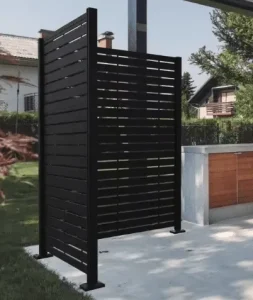
What Design Flexibility Means for Laser-Cut Aluminum Screen Fences
When architects and landscape designers talk about laser-cut aluminum screen fence panels, they are typically looking for three things: the ability to render any vector-based pattern into metal, the freedom to vary openness ratio without changing the panel frame, and the option to mix structural borders with fine decorative infill. A fiber laser cuts 6063 aluminum sheet exactly as drawn, so repeating geometric patterns maintain symmetry across a 2.4-meter panel length, and custom motifs such as a corporate logo or a botanical silhouette become production-ready parts, not costly one-off casting.
This level of control also changes how privacy screens interact with light and air. By adjusting the kerf width and the percentage of material removed, a single panel can transition from near-solid at the bottom to an open trellis at the top, creating sight-line privacy while allowing ventilation. In projects I have supported, we have produced panels where the lower third blocks 90% of direct vision and the upper section opens to 40% openness, simply by varying the cut geometry within the same aluminum blank. None of this requires changing tooling or switching between perforating dies, which is the main reason laser cutting has become the default method for high-end architectural fencing.
How the Laser Cutting Process Shapes Aluminum Screen Panels
The production sequence starts with a flat aluminum sheet, typically 1.5 mm to 3.0 mm thick in 6063-T5 temper. The factory loads the customer’s CAD file into a CNC fiber laser system, which follows the vector paths using a focused beam with an assist gas, usually nitrogen or compressed air, to eject molten material and keep the cut edge clean. Cutting speed, laser power, and focal position are adjusted for the sheet gauge to minimize the heat-affected zone and to avoid burr formation on the reverse side.
From an engineering standpoint, the critical variable is edge condition. A laser cut that is too aggressive creates a hardened oxide layer along the cut line that reduces the adhesion of the subsequent powder coat. A slower, controlled cut with the right gas flow leaves a microscopically smooth edge that accepts chromate conversion coating and polyester powder without edge pull-back. I have inspected panels where the edge looked sharp but clean under 10x magnification, and panels where a visible dark burn line appeared. Only the first type passed a 1,000-hour salt spray test without filiform corrosion spreading from the cut edges. That is why we specify cut parameters by alloy and thickness, not by machine default.
If your design includes micro-fine details, for instance a filigree pattern where the web between adjacent cutouts is under 4 mm, those parameters must be validated on a test coupon before full production. Reach out to our engineering team at sales01@yulongkeji-ch.com with your panel thickness and minimum web dimension so we can confirm feasibility and coating adhesion results before you lock in the cutting file.
Engineering Limits That Every Laser-Cut Design Should Respect
Not every pattern that a CAD operator can draw survives as a functioning fence panel. The first constraint is the ratio of open area to remaining metal. A panel with 60% openness looks airy but loses significant bending stiffness compared to a 30% openness design of the same outside dimensions. In my own calculations for a 2,000 mm × 1,200 mm panel in 2 mm 6063 aluminum, reducing the solid area from 70% to 40% drops the section modulus enough that the wind load rating can fall from 1.0 kN/m² to under 0.6 kN/m², depending on the pattern orientation and stiffener ribs.
The second constraint is sharp internal corners. A laser beam can trace a 0.2 mm radius, but a decorative pattern with dozens of acute angles concentrates stress at each vertex. Under cyclic wind loading, those corners become crack initiation points. We counter this by adding a minimum fillet radius of 2 mm in all cut geometry and by orienting the stiffener ribs parallel to the primary wind direction.
| Panel Thickness | Recommended Max Openness (without additional stiffening) | Typical Post Spacing |
|---|---|---|
| 1.5 mm | 40% | 1.5 m |
| 2.0 mm | 50% | 1.8 m |
| 3.0 mm | 60% | 2.0 m |
A third design limit that rarely appears in marketing brochures is the relationship between cut density and coating coverage. When a panel contains a high percentage of cut edges, the total edge length that must be coated increases dramatically. Powder spray reaches large flat areas easily, but it struggles to build uniform film thickness deep inside narrow slots. For panels where the total edge length exceeds 3 meters per square meter of panel face, we often recommend an additional pre-treatment step, either a dip conversion coating or an anodized layer, before the final powder topcoat. This adds cost but is the difference between a panel that keeps its finish and one that shows edge rust marks within two years in a coastal environment.
Specifying Laser-Cut Aluminum Screen Fence Panels for a Reliable Project
What lifts a screen fence project from a sample board exercise to a lasting installation is the technical specification that accompanies the CAD drawing. The most common oversight I encounter is providing only the visual design without panel dimensions, alloy callout, or coating standard. A complete RFQ package for a laser-cut aluminum screen fence panel should include the following:
- A DXF or DWG file showing the cut pattern at 1:1 scale, with minimum web width and corner radii clearly dimensioned.
- Panel overall dimensions, including thickness, and whether the panel is framed, flush, or slotted into posts.
- Alloy and temper: 6063-T5 for general use; 6061-T6 when higher strength is required, noting that 6061 cuts slightly slower and may need adjusted laser parameters.
- Surface finish specification: pretreatment method (chrome-free conversion, anodizing) plus powder coat type (polyester or super durable polyester), color RAL code, and gloss level.
- Quantity and acceptable panel size tolerance; typically we hold ±1.5 mm on overall dimensions.
Handling the specification early avoids surprises. On one commercial project, the original design called for a 70% openness pattern in 1.5 mm sheet, but the wind load requirement for a rooftop location was 1.2 kN/m². By working through the numbers before cutting, we upgraded to 2.5 mm material and added a mid-height horizontal stiffener rib, which brought the panel performance within code without changing the visual design. That kind of adjustment is only possible when the engineering review happens before the production file is set.
Common Questions About Laser-Cut Aluminum Screen Fence Performance
Do laser-cut edges reduce the panel’s corrosion resistance?
Only if the edge treatment is skipped. Aluminum itself does not rust, but the cut surface is more reactive than the mill finish. The standard sequence we apply is a chrome-free conversion coating across the entire panel after cutting, which passivates the cut faces, followed by a 60–80 micron polyester powder coat that flows into the cut edges. This combination has consistently passed neutral salt spray testing exceeding 1,000 hours in our quality checks.
Can a highly perforated panel withstand strong winds without deforming?
It can, provided the engineering matches the location. A panel with high openness must compensate with either thicker material, closer post spacing, or integrated stiffener ribs. We commonly run finite element simulations for projects in hurricane-prone regions. The table earlier gives a safe baseline, but for any project exceeding 2 meters in post spacing or with a design wind pressure above 1.0 kN/m², I recommend a structural check against the specific pattern geometry.
How should I prepare a design file for laser cutting if I am not an engineer?
Supply a vector file in DXF or Adobe Illustrator format with closed paths at a 1:1 scale. Mark the panel edge limits clearly and indicate which lines are cut lines and which are fold or reference lines if applicable. Our engineering team analyzes the file for minimum web thickness, corner radii, and panel flatness, and we return a marked-up drawing for approval before cutting. This step typically adds two working days to the lead time and prevents costly production errors.
What lead time should I expect for a custom laser-cut screen fence panel order?
A standard order of 50 to 200 panels with an approved CAD file can ship in four to five weeks, depending on the coating line queue. Complex or high-volume orders where we need to run test coupons first may extend to six weeks. The most effective way to compress the schedule is to align on all specifications, including RAL color and post system, before the first test cut. Share your timeline and panel quantity with us at sales01@yulongkeji-ch.com, and we will confirm the current production slot and provide a compliance documentation package for your import records.
If you’re interested, check out these related articles:
Frameless Glass Balustrade: Designs for Stairs, Pools & Balconies
Aluminum vs Vinyl Fence: Maximizing Longevity and Value
Aluminum Fencing: Property Measurement Buyer’s Guide