
Aluminum screen fence for equipment screening is the most practical long-term choice when a project demands hiding HVAC units, pool equipment, or utility boxes without creating a future maintenance headache. Unlike wood enclosures that swell and rot or vinyl panels that grow brittle under UV exposure, a properly engineered aluminum screen fence balances concealment with essential airflow and service access. I have seen too many installations where a poorly planned enclosure trapped heat, blocked a technician’s access panel, or corroded within three years because the material was never matched to the site conditions. This article lays out the design factors, material specifications, and ordering decisions that separate a durable, code-compliant equipment screen from a recurring problem.
Why Aluminum Screen Fence Is Right for Equipment Enclosures
Screening mechanical equipment is not the same as zoning a garden. The enclosure lives next to heat sources, vibration, and sometimes aggressive chemical environments like pool chlorine or de-icing runoff. Aluminum brings three things that matter in these conditions.
First, the base metal itself is rust-free. Steel, even galvanized, will eventually sacrifice its coating at cut edges and scratches. Aluminum forms a tenacious oxide layer that stops corrosion in its tracks, which is why we have specified 6063 aluminum alloy for equipment screens in coastal resort projects where salt spray would consume a steel panel within five years. Second, the strength-to-weight ratio means tall panels can be fabricated without becoming too heavy for a crew to handle safely on a rooftop or narrow utility corridor. Third, powder coating over chromate pretreatment locks in both color and weather resistance, a combination ASTM B117 salt fog testing can validate to 1,000 hours or more. Those are numbers that matter when the screen is supposed to look like a planned architectural element, not a service-yard disguise.
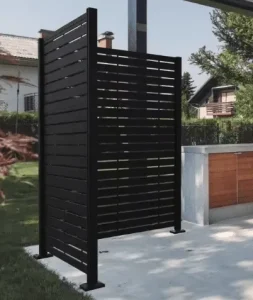
Design Factors: Ventilation, Visibility, and Access
Equipment screening asks for three things that sometimes pull in opposite directions: enough open area for air to move, enough visual density to hide the equipment, and enough clearance for a technician to work safely.
Louvered and slatted blade panels are the most common configurations because they allow you to dial in the openness ratio. A typical louver angle of 30 to 45 degrees blocks direct sight lines from ground level while still passing enough air to avoid overheating a condenser unit. In one municipal water treatment project we supported, the specification called for a minimum 40 percent open area calculated across the panel face, which we achieved with a wide-spacing slat design while still delivering full privacy from the adjacent public pathway.
Access is the non-negotiable that gets overlooked in early design. If a screen wraps around all four sides, someone has to get in to swap filters, read gauges, or drain a line. This is why we recommend at least one gate panel built into the enclosure—hinged, with a padlock tab if required—or a removable panel that two people can lift out without tools. Bolting a solid framed panel across the front of a heat pump might hide it perfectly, but it also guarantees the service tech will show up with a wrench and a complaint.
Material Specifications and Corrosion Resistance
The baseline aluminum grade for structural fence components is 6063-T5, selected for its balance of extrudability, surface finish, and mechanical properties. Minimum wall thickness for the main frame profiles should be 1.5 to 2.0 mm, with infill slats or louvers typically at 1.2 to 1.5 mm depending on wind load requirements. These numbers may seem modest, but a properly engineered section with internal ribbing is stiffer than a heavier flat bar.
Corrosion resistance is carried primarily by the pretreatment and powder coating system. A six-stage pretreatment that includes degreasing, etching, and a chromium-free conversion coating provides the adhesion anchor for the topcoat. The coating itself should meet AAMA 2604 or 2605 specification for architectural finishes, which define gloss retention and color stability over a service life measured in decades. For equipment screens near chemically aggressive environments—pool equipment pads, industrial cooling towers—we move to a marine-grade powder formulation and specify increased edge coverage because cut edges and drilled holes are where failures start.
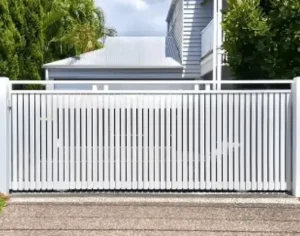
Custom Sizing and Installation Considerations
Standard panel lengths work for straight property lines, but equipment screens almost always need custom widths. A heat pump with a 34-inch width does not fit neatly into a 72-inch standard panel without looking off-balance, so we routinely produce panels in 2-inch increments to center the equipment visually. Height is equally critical: a screen that is 48 inches tall might hide a ground-level condenser base, but a rooftop unit on a 12-inch curb needs at least 60 inches to block sight lines from a neighboring building.
Post anchoring depends on the substrate. On an existing concrete pad, base-plate mounted posts with mechanical expansion anchors or chemical anchoring capsules are the standard solution. If the screen is being installed before the pad is poured, embedded post anchors give a cleaner finished look. One detail we insist on in the shop drawings is minimum clearance around the equipment—typically 18 to 24 inches on the access side and 12 inches on the other three sides—to meet the clearance diagram in the equipment installation manual. Failing that, the installation defeats its own purpose.
Ordering and Supplier Vetting for Project Needs
Not every aluminum screen fence is built to the same standard, and the differences live in the details that are easy to skip when comparing line-item prices. Ask for coating thickness measurements, not just a generic “powder coated” claim. A specification of 60 to 80 microns is realistic for architectural grade; anything thinner is a cost-cutting shortcut that will show its age early.
Ask about the pretreatment process. If the factory cannot describe the stages—degrease, rinse, etch, rinse, conversion coat, rinse, drying oven—then you are probably getting a single-stage wash-and-shoot that will peel. Ask for salt spray test results to ASTM B117, ideally extending past 1,000 hours with no under-film corrosion. These are standard tests for high-quality aluminum fencing, and a factory that routinely runs them will have the data on file.
Finally, factor in lead time and shipping logistics. Custom screen orders with RAL color matching and non-standard panel widths typically run 4 to 8 weeks from approved drawings to ex-works, plus ocean transit. If your project has a fixed commissioning date, confirm the factory schedule early. If your program involves specific ventilation calculations, custom hinge locations, or requires a particular powder formulation for a corrosive environment, it is worth confirming those details directly with the factory’s engineering team before finalizing your BOM. Reach out at sales01@yulongkeji-ch.com or call +8619086315193.
Common Questions About Aluminum Screen Fence for Equipment Screening
Will an aluminum screen fence trap heat and damage my equipment?
It can, if the panel design does not account for airflow. The equipment manufacturer’s installation manual will state minimum clearance distances and sometimes specify a maximum static pressure drop across the enclosure. In our experience, a louvered panel with 40 percent or greater open area, combined with the recommended standoff distance, rarely creates thermal problems for residential and light commercial equipment. For high-output commercial chillers, a mechanical engineer should review the enclosure design alongside the unit’s rated airflow.
Is aluminum strong enough to survive accidental impact from groundskeeping or vehicles?
Yes, when the post system is sized for the load. A 2.5-inch square aluminum post with a 2.0 mm wall in T5 temper will handle incidental impacts from a mower or light cart. For locations that face vehicle risk, such as a parking lot edge, we move to a 3-inch or larger post, embed it deeper, and sometimes fill the post with a concrete grout core. The panel itself will show a dent before the overall structure fails, which is an intentional design behavior; it absorbs energy rather than collapsing.
Can I get the fence color matched exactly to my building’s trim color?
Yes. RAL color matching is a standard service on custom powder coating lines. We have run hundreds of color-matched batches, and the key is to submit a physical sample early rather than trying to match from a screen. A 4-inch by 4-inch swatch of the trim material sent to the powder supplier lets them formulate the exact polyester blend. Minor batch-to-batch variation can occur, but a serious factory will hold the Delta E under 1.5, which is indistinguishable to the eye.
How long does a factory-direct aluminum screen fence last?
With proper powder coating, the structural aluminum itself will last decades. We warranty our architectural coating to 15 years against film integrity failure, and field experience suggests the coating commonly lasts 20 to 25 years in normal environments before noticeable chalking or fading. Coastal installations may show earlier change, but the metal underneath remains intact, unlike steel which rusts structurally.
Do I need a permit to put up an equipment screen fence?
This depends entirely on local zoning and building codes. Many municipalities treat freestanding equipment screens under 6 feet as accessory structures not requiring a building permit, but some require setbacks, height restrictions, or even architectural review if the screen faces a public right-of-way. It is always cheaper to check with the local planning department before ordering. If you need stamped engineering drawings for a permit submission, confirm with your supplier early whether they can provide PE-certified calculations for wind and seismic loading. For projects that require documentation, sharing your requirements at sales01@yulongkeji-ch.com can clarify what our engineering team can supply.
If you’re interested, check out these related articles:
Aluminum Gate Hardware: Hinges, Latches, and Lasting Security
Decorative Aluminum Gate Panels: Modern Home Design Solutions
Chain Link Pool Fence: Codes, Heights, Gates & Pricing Guide
Commercial Steel Fencing: Top Options for Retail Parks and Offices