
Aluminum blade fence systems are often chosen for their modern look and clean sightlines, but the angle of the blades is what actually controls how much privacy you get and how the structure holds up under wind load. Most design discussions treat blade angle as a simple aesthetic choice; in practice, the angle determines sight-blocking geometry, air permeability, and the wind pressure the fence transmits into its posts and footings. Choosing the wrong angle for a site can mean a fence that looks fine on a calm day but rattles loose or fails after one storm season. This article explains the engineering relationship between blade angle, privacy, and structural performance, drawing on our work at Hubei Yulong producing blade fence systems for international projects with varying wind exposure and sight-line requirements.
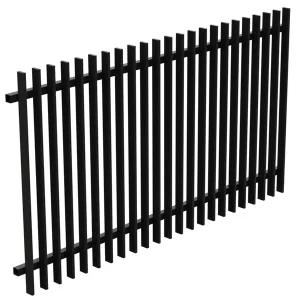
How Blade Angle Determines Privacy and Airflow
A blade fence panel is essentially a series of parallel aluminum profiles set at a fixed angle within a frame. The angle relative to the vertical plane dictates two things simultaneously: the width of the visual gap between blades when viewed straight on, and the open area available for lateral airflow. Blades set near 90 degrees — nearly perpendicular to the fence plane — create a narrow gap and block most direct sight lines from the front. The same position, however, acts like a solid wall to the wind, transferring the full dynamic pressure into the panel structure. As blade angle flattens toward 0 degrees, the visual opening widens and privacy drops, but air passes through more freely, reducing the wind load on the fence. We test this in our own assembly by measuring both the sight-blocking zone and the wind pressure coefficient at different angles. For a typical 6‑foot residential application, a blade angle between 60 and 75 degrees gives excellent privacy at street level while still allowing cross‑breeze, because the human eye at a distance of 10–15 feet cannot resolve the sliver of opening when the angle is steep.
What blade angle offers the best privacy?
The best privacy comes from a blade angle of 75 to 85 degrees when the observer is at ground level and the fence is 5 to 6 feet tall. At that angle, the line of sight from a standing adult intersects the blade surface, not the gap, up to a distance of about 20 feet. Larger gaps and flatter angles quickly expose the space behind the fence. If the fence is on a raised patio or overlooks a descending slope, even an 85‑degree angle may not be enough; we often recommend a taller panel or a double‑offset blade layout for those sites.
How does blade spacing affect airflow?
Blade spacing — the center‑to‑center distance between blades — sets the total open area, while blade angle sets the effective aerodynamic opening. Tighter spacing at the same angle reduces airflow, which can trap heat and moisture in a garden enclosure. Wider spacing improves ventilation but reduces privacy proportionally. In our engineering reviews, we usually balance the two by starting with the privacy‑first angle the client needs, then adjusting blade spacing to achieve a minimum 30% open area for wind relief, which is a practical threshold for most suburban locations.
Wind Load and Structural Stability: Why Angle Matters
Wind applies pressure to every square inch of exposed surface. On a solid fence, that pressure transfers entirely into the posts and footings. On a blade fence, the angle determines how much of the wind is caught and how much slips through. A blade set at 60 degrees catches roughly 70% of the wind that a solid panel of the same size would, because the airflow separates and passes through the gaps, while a blade at 85 degrees catches over 95%. The structural concern is not just the peak load during a storm but the repeated cyclic loading — every gust pushes and releases the panel, which works connections loose over time. We have seen installations where a visually steep angle was chosen for privacy at a coastal site, and within two years the self‑tapping screws at the blade‑to‑rail connection had elongated their holes, causing vibration noise and eventual failure of the bottom rail. That failure chain started with the angle decision, not a material defect.
| Blade Angle (degrees) | Relative Wind Load on Panel | Visual Privacy (at 15 ft) |
|---|---|---|
| 30 | 0.35 | Low |
| 45 | 0.50 | Moderate |
| 60 | 0.70 | Good |
| 75 | 0.85 | Excellent |
| 85 | 0.95 | Near Total |
Can blade fence angles reduce wind damage?
Yes, reducing blade angle is one of the most effective ways to lower the wind load on a fence without changing the overall height or post spacing. Flatter angles allow more air to pass through, which directly reduces the drag force. The trade‑off is less privacy. In regions with hurricane‑force gusts, we often specify a 45‑degree blade angle combined with deeper, wider posts and thicker aluminum profiles to keep the structure sound. The blade angle works together with the post embedment depth: less wind on the panel means the footing can be slightly smaller, which can simplify installation in rocky soil. This is an engineering trade‑off we evaluate project‑by‑project, not a one‑size solution.
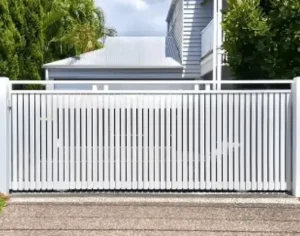
Selecting the Right Blade Angle for Your Climate
Climate dictates which performance variable — privacy or wind survival — takes priority. In hot, still climates, privacy and shade matter most, and a steep 80‑degree angle works well because wind is minimal. In temperate coastal zones with year‑round breezes, a 60‑degree angle often gives the best balance of moderate privacy and reliable wind pass‑through. For high‑wind corridors such as ridgelines or open plains, we reduce blade angle further to 45 degrees and increase the blade thickness and post frequency. The decision also influences long‑term maintenance: panels that constantly resist high wind see more powder‑coat micro‑cracking at connection points, so a lower angle reduces maintenance costs over a 15‑year life.
How do windy conditions influence blade angle choice?
Windy conditions shift the design priority from privacy optimization to structural survivability. When 3‑second gust speeds exceed 90 mph as defined in ASCE 7‑10, we recommend staying at or below 50 degrees of blade angle unless the fence is supported by a reinforced steel post system and continuous bottom channel. At that angle, the open area is sufficient to depressurize the wind‑facing side, and the aluminum profiles deflect less, which protects the finish. We verify this with site wind data provided by the client or with local building code hazard maps.
Blade Fence Systems: Integration and Performance Factors
A blade angle specification only works if the surrounding system — posts, footings, and splices — is designed to match the expected loads. We often get requests for extremely steep blades on a standard residential post footing and have to explain that the post will simply fail at the base before the blade angle can deliver the promised privacy. Post spacing, embedment depth, and the connection method between the blade and the horizontal rail all interact with blade angle. A welded‑assembled panel, for example, holds its blade alignment better over time than a panel with mechanical fasteners, which matters when blade angles are steep and wind vibration is constant. For a commercial aluminum blade fence project, we typically recommend a fully welded frame and through‑fastened blade attachments to prevent angle degradation.
Is post spacing more critical than blade angle?
They are equally critical, but post spacing determines how much of the wind load from the blades each post must carry. Wider spacing means each post takes more bending moment. If you combine wide post spacing, high blade angle, and a tall fence in a windy site, the post will be the first failure point. We generally run a quick load‑transfer calculation: for a 6‑foot fence with 75‑degree blades and 8‑foot post centers, the post must resist roughly 240 lb‑ft of moment at the base. That number doubles if blade angle increases to 85 degrees because the wind surface nearly doubles. So adjusting blade angle can let you keep wider post spacing without upgrading footings, which often saves material.
Specifying Blade Fence Requirements for Your Project
When you prepare a fence specification or RFQ, the blade angle should be stated as a required performance parameter, not left to the supplier’s default. We see many inquiry sheets that include color, height, and panel width but omit blade angle entirely. That omission means the supplier will either use their standard 45‑degree blades or ask later, which delays the order. Include the intended blade angle, the design wind speed per local code, and the privacy expectation (such as “no direct line of sight at 10 feet”). With those three data points, a competent manufacturer can size the blade profile thickness, post spacing, and footing requirements correctly. If your site has a slope or a stepped layout, the blade angle must be evaluated section by section because the viewing angle changes with the ground.
When performance matters, blade angle selection is not guesswork
We design and produce aluminum blade fence systems for sites ranging from wind‑exposed coastal resorts to dense urban backyards. Getting the angle right from the start avoids loose panels, wave‑distorted sightlines, and early‑life corrosion at stressed connections. If your project has specific wind‑load requirements or demands a precise balance of privacy and airflow, submit your site data and intended fence dimensions to our engineering team. We provide a custom blade‑angle specification and panel build‑up at no charge. Reach us at sales01@yulongkeji-ch.com or call +8619086315193.
Common Questions About Blade Fence Angles and Performance
Can I change the blade angle after installation?
In most fixed‑blade fence systems, the blades are welded or riveted at a set angle during manufacturing, so field adjustment is not possible without cutting and re‑welding. Some systems use adjustable brackets that allow a small angular range, typically ±5 degrees, but these are uncommon in high‑wind environments because the joint is weaker than a fixed connection. If you may need to adjust privacy later, discuss it before production.
Is a steeper blade angle always better for privacy?
Not necessarily. Once the blade angle passes about 80 degrees, additional steepness adds little privacy gain but sharply increases wind load. The sweet spot for privacy versus wind is typically between 70 and 80 degrees for most sites. Beyond that, the fence behaves almost like a solid wall, with all the structural headaches that implies.
Does the blade angle affect the fence height measured by code enforcement?
The structural frame height is what code enforcement measures, not the blade angle. However, a very steep blade angle can sometimes create a visual impression of a taller barrier because the top blade may project slightly above the frame. If local codes are strict, confirm that the top‑of‑blade elevation does not exceed the permitted fence height, even if the frame stays within limits.
How do blade angles affect the cost of the fence?
Steeper blade angles require wider blades to maintain the privacy gap, which uses more aluminum and increases material cost. They also add wind load, which may require thicker posts and larger footings. The total system cost can increase by 15–20% when moving from a 45‑degree to a 75‑degree angle, once you account for upgraded posts and hardware. It is worth asking your supplier to quote the difference before locking in the design.
Are there standard blade angles for aluminum fence panels?
Most manufacturers default to 45 degrees because it is the easiest to produce and minimizes wind load, but it gives the least privacy. Some offer 60 and 75 degrees as optional standards. We produce blade panels at any angle from 30 to 85 degrees to match site conditions, so there is no technical reason to settle for the default. Share your site wind zone and privacy requirement with us at sales01@yulongkeji-ch.com, and we will confirm the blade angle, post layout, and profile gauge needed for a lasting installation.
If you’re interested, check out these related articles:
Steel Fencing for Parking Lots: Maximizing Car Park Security
Aluminum Fence Grades: Understanding T5 and T6 Strength
Decorative Iron & Ornamental Steel Fence: Residential & Commercial Solutions