
Choosing noise reduction fence materials means solving three problems at once: surface mass, sealed joints, and an unbroken run from grade to top rail. Most buyers compare metal type before those details, which is why many strong fences still perform badly against road noise. I have spent twelve years working on aluminum and steel fencing systems, and the failures I see are usually gaps, not weak materials. A solid aluminum panel can outperform an open steel picket fence. This guide explains which materials block sound best and what to specify before ordering.
Why Most Fences Fail at Noise Reduction
Sound moves through any opening. A fence with visible gaps between pickets, under panels, or at post connections is not a barrier; it is a partial screen. The panel material may be dense, but the openings let high frequency traffic hiss and most speech level noise through. This is why ornamental open bar fencing usually disappoints when the goal is lower perceived sound.
Mass is the second factor. Denser surfaces reflect more sound, but only when the barrier is continuous. A thin aluminum sheet with open slats loses its advantage because the gaps dominate the result. The buyer sees a solid looking fence, but the ear still receives the source. That mismatch is common in residential projects where style leads and acoustic performance is assumed.
Which Materials Block Sound Best for Residential and Commercial Projects
Once a fence is continuous, weight per square meter becomes the best predictor of sound blocking. Concrete masonry is the strongest common option because it combines high mass with a solid face. Solid timber panels perform well but need sealing against shrinkage. Steel panels with solid infill add stiffness and mass. Aluminum is the lightest practical metal option, so it depends more on panel design for useful mid and high frequency reduction.
| Material | Sound Blocking Performance | Main Limitation |
|---|---|---|
| Concrete masonry | Strong broadband reduction | Heavy, needs foundation |
| Solid timber panel | Good for mid and high frequencies | Weather movement and upkeep |
| Steel panel with solid infill | Good when stiff and fully sealed | Thin steel can vibrate |
| Aluminum slat or screen panel | Moderate, depends on tight joints | Less effective at low frequencies |
| Open picket metal fence | Weak, lets noise through gaps | Not suitable for noise control |
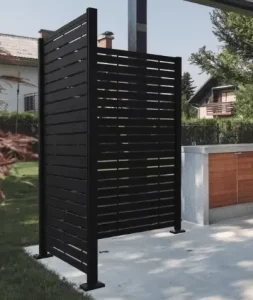
For aluminum and zinc steel systems, panel design changes performance more than the metal itself. A closely slatted aluminum screen with interlocking edges creates a much better barrier than a standard picket fence. Buyers should ask for panel weight and slat spacing instead of comparing material names alone.
How Panel Design and Gaps Affect Sound Transmission
The weakest point is rarely the panel face. It is the joint between panel and post, the clearance under the bottom rail, and any opening that develops as panels move with temperature. In projects I have reviewed, a fence with a solid face but an unsealed bottom clearance still let low traffic rumble pass underneath. The mass was present, but the path was open.
This is where aluminum and steel construction details matter. Overlapping slats should close tightly. Posts should be set close enough to panels to avoid vertical slots. The bottom rail should sit near grade, with drainage considered separately. Without those details, adding a heavier material raises cost without adding much sound reduction.
If your project faces continuous traffic or mechanical noise and you are comparing panel types, confirm the as built edge gaps and panel weight per square meter before finalizing your bill of materials. Email yloongfence@gmail.com with the fence height and noise source, and we can review where sound is most likely to pass through.
What Should Buyers Specify for Aluminum and Steel Noise Barrier Fences
Start with panel construction. For aluminum, a solid or tightly slatted panel with a stiff frame and powder coated finish works better than a lightweight ornamental style. For steel, zinc steel panels with solid infill or closely spaced vertical bars add mass, but the cut edges and fasteners need corrosion protection to keep the system stable.
Then specify installation tolerances. Panels should be positioned so vertical joints remain closed after thermal expansion. Ask the manufacturer for panel weight, slat spacing, and post connection details. When acoustic test data exists, confirm which standard was used and whether the test included flanking paths. This information matters more than color or decorative pattern when noise reduction is the project goal.
A fence that does not block noise becomes a visible mistake every time a truck passes. If you are sourcing aluminum or steel fence panels for a noise sensitive site, send your site plan, the main noise source and direction, and your target fence height to yloongfence@gmail.com or call +8619072006155. We can compare panel weights, joint details, and coating options before you commit to a bulk order.
What Do Buyers Ask Before Specifying a Noise Barrier Fence?
Can an aluminum fence really reduce noise?
Mid and high frequency traffic noise can be reduced by an aluminum fence when the panel face is solid or closely slatted and the edges are closed. Aluminum is light, so it will not match concrete masonry for low frequency rumble. The real result depends on panel weight per square meter, overlap at vertical joints, and clearance below the bottom rail. When those details are controlled, an aluminum slat or screen panel is a reasonable choice for residential streets and commercial courtyards. Buyers with heavy truck exposure should consider a denser core or a taller continuous barrier.
Is a heavier steel fence always better for sound blocking?
Not always. A thick steel fence blocks more sound only when the panel face is solid and installed without gaps. An open ornamental steel fence can perform worse than a well sealed aluminum slat panel because sound travels through the openings rather than through the metal. Compare panel construction instead of material name alone. Steel offers extra mass when used as a solid infill panel, which matters for low frequency noise. Aluminum offers less mass but easier handling and stronger corrosion resistance in humid or coastal sites.
How important is the gap under a fence?
It depends on how low the noise source sits. A continuous barrier works from grade to top rail. A small clearance under the panels will lose much of the acoustic value regardless of material. If the bottom rail can sit near grade and posts are set tightly to the panels, aluminum or steel can perform well. If drainage requires a large ground clearance, expect lower sound reduction or add a dense lower section. Material choice is secondary to closing that path.
What is the first thing to check on a noise fence?
In projects I have worked on, the most common weak point was the joint between panel and post, not the panel material. Even a small vertical opening let traffic noise pass clearly, and the owner assumed the fence was defective. Once the joint was closed and the bottom rail adjusted, the perceived noise dropped. That experience shapes my recommendation: before spending more on denser material, confirm every gap is sealed. Share your fence height and noise source at yloongfence@gmail.com, and we can check which panel design will close those paths.
If you’re interested, check out these related articles:
Wrought Iron vs Ornamental Steel Fence: Cost & Alternatives
Hot-Dip Galvanized vs Powder-Coated Fence: Performance & Value
Decorative Iron & Ornamental Steel Fence: Residential & Commercial Solutions