Factory trade integration removes an intermediary from the fencing and railing supply chain, which directly reduces procurement cost and improves technical control. When buyers compare factory direct purchasing with trading company sourcing, they are comparing a manufacturer’s price with a manufacturer’s price plus a resale margin. As a metal fencing systems engineer, I have evaluated this decision on both sides, and the engineering case for factory integration is just as strong as the commercial one. Savings show up in unit pricing, specification handling, quality accountability, and lead time visibility. The rest of this article explains where those savings actually sit and how to verify you are capturing them.
The Cost Structure Behind Factory Trade Integration
A trading company sits between the buyer and the factory. It finds a manufacturer, buys production capacity, adds its operating margin, and resells the product. On simple consumer goods, that layer can be invisible. On engineered fencing and railing, it is not. A fence order is not a single SKU. It includes aluminum alloy and wall thickness, panel height, post section, gate hardware, surface treatment, packaging, and loading requirements. When those parameters change, the buyer pays the trading company to ask the factory, and then pays again when the factory quotes the revision. Factory trade integration removes that round trip.
The price difference is most visible on container level orders. A factory quote reflects raw material, tooling, production time, coating, packaging, and margin once. A trading company quote reflects all of those costs plus a second commercial layer. It is not that the trading company adds technical value; it adds coordination. That coordination can be useful, but the buyer should know that it is being priced in.
| Factor | Trading Company Sourcing | Factory Trade Integration |
| Price basis | FOB price plus resale margin | Factory cost and quotation |
| Change requests | Forwarded to a third party | Sent directly to engineering |
| Quality data | Limited to supplied reports | Direct access to process records |
| Lead time visibility | Dependent on intermediary updates | Visible from production schedule |
| Accountability | Split between seller and maker | Single manufacturer responsibility |
What Factory Trade Integration Actually Means for Fence Buyers
Factory trade integration is not only a lower price. It means the same organization that quotes the order also plans the extrusion, welding, coating, assembly, and export inspection. For aluminum fencing, that engineering control starts with alloy selection. A 6063 T5 aluminum profile behaves differently in bending and cutting than a recycled heavy silicon alloy, and the factory that runs the line knows which tolerance is realistic. A trading company normally cannot verify that distinction; it can only repeat what the factory says.
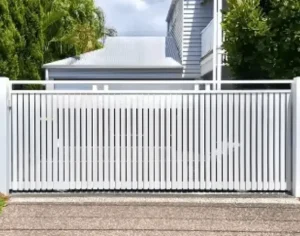
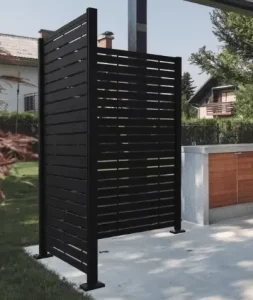
This matters when an order combines multiple product families. A buyer may need aluminum slat fence panels, a double leaf driveway gate, and matching railing posts. An integrated factory can check whether the post section, gate frame, and panel picket profiles share the same coating batch and hardware package. A trading company has to collect three separate replies and reconcile them at the account level. The result is slower change control and a higher chance of mismatched parts arriving on site.
Technical Risks That Trading Companies Cannot Resolve Directly
The most expensive fencing failures are rarely discovered at the factory. They appear after installation, when powder coat delaminates at a cut edge, a gate sag occurs because the hinge post section was underestimated, or a baluster spacing fails a local code review. A trading company can receive the complaint and forward it. It cannot walk the production line, inspect the pretreatment records, or revise the post reinforcement on the spot.
An integrated manufacturer can. That difference changes what happens after a fault. If a batch shows adhesion failure, the factory engineer checks degreasing, pretreatment chemical balance, curing temperature, and profile roughness at the same location where the parts were coated. The trading company sends an email and waits for the factory to reply. In project delivery, that time gap is a cost even when the replacement is free.
If your program includes mixed panel heights or a custom RAL color, it is worth confirming coating batch control and lead time impact before finalizing your bill of materials. Share your part drawings and target quantities with yloongfence@gmail.com and we can confirm the production route against your budget before you commit.
How to Verify a Supplier Is an Integrated Factory
A supplier can claim factory trade integration without owning a single production line. The verification is not complicated. Ask for the manufacturer operating scope and confirm it lists fabrication or production, not only trading and export. Request a live video of the relevant line for your product family, not a showroom. Check that the quotation, quality documents, and export documents all use the same factory name. Request a preproduction sample and ask which coating line code will run the bulk order. Ask whether the technical contact can access the production schedule or only the sales file.
These checks protect the buyer from the worst form of double margin: paying a factory direct price to an intermediary that does not control the factory at all. Once the supplier passes them, the buyer can actually use factory integration as a cost and quality tool rather than a marketing claim.
How to Apply Factory Trade Integration to Your Next Fence Order
The hesitation most buyers have is not about price. It is about losing the coordinator who used to chase the factory for them. That hesitation is reasonable on the first order, but it disappears when the manufacturer assigns a single technical contact who can review the drawing, confirm the coating standard, and report the production schedule. Hubei Yulong Environmental Protection Building Materials Technology Co., Ltd. runs automated production lines and surface treatment in house, with engineering and export coordination connected directly to production planning. That structure lets a site revision go directly to the people planning the cut list.
Send your panel heights, finish code, post sections, gate dimensions, and target quantity to yloongfence@gmail.com or call +8619072006155. We will confirm the production route, coating specification, and lead time before you place anything.
Common Questions About Factory Trade Integration
Is factory trade pricing always cheaper than trading company pricing?
Yes, for specifications that are genuinely the same. A trading company must recover the factory price plus its own operating margin, so the buyer pays for two commercial layers. That does not make trading companies useless; they can consolidate small orders and offer local logistics convenience. But on container level or project level fence orders, the cost gap usually widens because packaging, freight, and margin are already visible in a factory quote. The key is comparing identical alloy grade, coating system, and accessory scope, not just the same product photo.
Does factory direct buying require me to manage quality control alone?
In projects I have supported, buyers who moved to factory trade integration did not lose quality oversight; they gained direct access to preshipment records. The fear comes from not knowing which checks to request. An integrated factory can send powder coat curing logs, welding inspection sign-offs, and packaging photos itself. A trading company can only forward these documents. You should still ask for a preshipment inspection, but that inspection becomes more useful when the people who resolve findings are in the same building as the production line.
What happens when a design change is needed after the order starts?
After order start, it depends on the production stage. If the change comes before material has been cut or extruded, a direct factory can typically adjust without significant rework. If panels are already powder coated, any change introduces recoating or remanufacturing cost. In a trading company chain, the evaluation of that stage is slower and often less accurate because it passes through an account manager. Factory integration shortens the feedback loop, which matters most when a site measurement changes mid order.
How do I know which factory trade supplier can handle mixed fence and railing programs?
The useful question is not whether a factory is integrated, but whether its engineering and production scheduling sit on the same team as its sales function. Mixed fencing and railing programs fail when the buyer is ordering formed panels, welded gates, and baluster assemblies from three different logic chains inside one supplier. Ask for one technical contact who can confirm both the product drawings and the line schedule. If your project pairs aluminum slat panels with a custom gate opening and specified RAL finish, share those specifications and quantities and we will confirm the production route against your delivery window.
If you’re interested, check out these related articles:
Steel Fence Quality Control: Essential Pre-Shipment Checks
Frameless Glass Balustrade: Designs for Stairs, Pools & Balconies
Aluminum Fence Panels: 2025 Wholesale Price Per Foot Guide
Steel Fence Gauge: Optimal Thickness for Perimeter Security