
Ordering a custom decorative screen fence means committing to a panel that does not yet exist. The process promises a product tailored to your project, but the path from a digital design file to a finished, coated panel is where cost and quality are earned or lost. In more than twelve years of working with aluminum fencing systems, I have seen that the most successful outcomes start with the buyer understanding what happens between file submission and packaging. This article traces that manufacturing sequence, from the material options and file requirements that launch the work, through laser cutting and CNC routing, to the powder coating and inspection stages that decide whether the panels arrive ready to install or require rework.
Custom Decorative Screen Fence Capabilities and Material Choices
Most decorative screen fence panels exported today are built from aluminum alloy. The default we use at our facility is 6063-T5, with 6061-T6 brought in when the panel needs higher tensile strength for wind load or security requirements. These alloys start as extruded sheets, typically 2 mm to 3 mm thick, though panels wider than 2000 mm sometimes go to 4 mm for stiffness. Buyers specifying dimensions should check whether the supplier quotes net panel size or overall frame dimensions, a point that regularly causes confusion when matching posts and mounting hardware.
Panel size limits are set not by design but by the cutting table and coating line. Our laser cutting beds accept sheets up to 1500 mm × 3000 mm, so any single panel must fall within that envelope. When a project calls for a pattern that repeats across a longer run, we split the visual field across multiple panels with indexed registration. The joint between panels is invisible from two metres away when the fastening rail alignment is tested during pre-assembly. Material recyclability adds a practical advantage: aluminum scrap from the cutting process goes directly back into extrusion billets, keeping waste low and supporting the environmental performance claims that many municipal and commercial projects now require in their procurement criteria.
Preparing Your Design File for Production
The gap between a visually appealing design and a manufacturable panel usually lives in the file format and layer structure. We ask for vector files, DXF or Adobe Illustrator format, with closed polylines on a single dedicated layer per panel. Open paths are rejected by the nesting software because they do not define an area to cut. I have lost at least a dozen production days over the years while clarifying whether a designer intended a line as a score mark or a full cut. The cleanest workflow is to supply a black and white artwork file where black areas represent solid metal and white areas represent voids, accompanied by a dimensioned PDF clearly stating panel width, panel height, and any panel-to-edge margins. The minimum slot width we can reliably laser cut is 3 mm in 2 mm thick aluminum. Designers who push finer detail must accept that 1 mm and 2 mm slots are better handled by CNC routing, which brings a different cost and lead time.
File review is where we confirm that the cutter head path can actually navigate the artwork. We use SigmaNEST software to check for islands, unsupported floating pieces inside cutouts that would fall out once the surrounding material is removed. Every island must be tied to the main panel body with a bridge at least 2 mm wide, and those bridge locations should be indicated in the file or left for the factory to add, which then requires formal approval before cutting. The most frequent file rejection at our facility is a design where the desired void ratio exceeds 55%, leaving the remaining metal skeleton too weak to survive handling and powder coating oven temperatures. A good target for structural integrity is 40% open area on a 2 mm panel, adjusted downward if the pattern includes long unsupported spans.
From Digital File to Physical Panel: Cutting and Machining
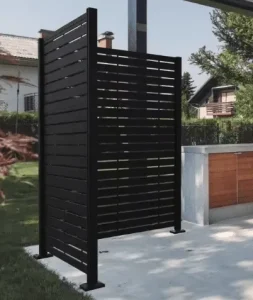
Once the file is approved, the production sequence moves to the cutting table. For decorative screen fence panels, a 1500-watt fiber laser is the standard tool. The laser beam follows the polyline paths at a cutting speed calibrated to the material thickness, typically 8 to 12 metres per minute for 2 mm aluminum. The cut edge emerges with minor oxidation that is removed in the next stage. Laser kerf, the width of the material removed by the beam, is approximately 0.15 mm, which is invisible on most designs but relevant when the pattern uses hairline tolerances.
Panels with slot widths below 3 mm or internal right-angle corners that a round laser spot cannot render sharply go to a CNC router. The router uses a carbide end mill, 1 mm to 2 mm diameter, spinning at 18,000 RPM and making multiple passes. CNC routing is slower, roughly 2 metres per minute, so a single complex panel can take 45 minutes of machine time compared to 8 minutes on the laser. Buyers on a tight budget need to understand that the most intricate designs, the ones that look best in architectural renderings, carry the longest production cycle. Immediately after cutting, every panel goes through a manual deburring station where operators remove sharp edges with rotary files, a step that cannot be automated without risking damage to thin webs but is non-negotiable for safety and coating adhesion.
Finishing Options that Determine Long-Term Performance
The cut panel has no corrosion resistance beyond the natural aluminum oxide layer, which is insufficient for outdoor use. Powder coating locks in long-term performance. The process starts with a pre-treatment tank line: alkaline degreasing to remove cutting oils, a clean water rinse, then a chrome-free conversion coating that etches the surface at a microscopic level to give the powder something to grip. The coated panel then moves through a drying oven at 120°C before entering the electrostatic spray booth.
We primarily apply polyester-based powder because it holds colour in UV exposure better than epoxy-based alternatives, which tend to chalk within two to three years in direct sun. The most common RAL colours our export clients specify are RAL 9005 jet black, RAL 7016 anthracite grey, and RAL 9016 traffic white, though we maintain an in-house colour matching service that can blend custom RAL shades with a minimum order quantity of 500 square metres. After spraying, the panels pass through a curing oven at 200°C for 10 to 12 minutes. The finished coating thickness is measured at six control points per panel with a digital gauge, and we hold a tolerance of 60 to 80 microns. Below 50 microns, corrosion resistance drops measurably. Above 100 microns, edge chipping becomes more likely during transport. This is the kind of single-digit tolerance that separates a panel that still looks untouched after five years in a coastal environment from one showing blistering and flaking at year two.
Quality Checks Before Your Panels Ship
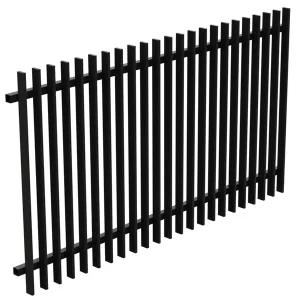
The last in-factory stage is not packaging but inspection, and I argue it is the highest-value time in the entire timeline. Every custom decorative screen fence panel we produce passes through three checkpoints. The dimensional checkpoint confirms that panel width, height, and diagonal measurements match the approved drawing within ±1 mm. The visual checkpoint under 500-lux lighting looks for coating defects, orange peel texture, or foreign particle inclusion. The third checkpoint is a destructive adhesion test on a sample panel from the same batch, using the cross-hatch method per ISO 2409, where we score a grid pattern through the coating and apply tape to check that no squares lift. A passing result is classification 0 or 1, meaning less than 5% of the coating is removed.
Packaging after inspection follows a specific protocol for decorative panels because the open cutout areas are vulnerable to bending. We interleave panels with 5 mm foam sheets, stack them on a wooden pallet, and secure the stack with polyester strapping at four points. The entire pallet is then wrapped in heavy-gauge polyethylene with a desiccant pack inside. The last thing a buyer needs is to open a container and find salty condensation sitting on raw cut edges. That packaging step, plus the pre-treatment quality mentioned above, is the reason we can confidently ship to coastal destinations in Southeast Asia and the Gulf region without corrosion claims.
Questions That Come Up When Ordering Custom Screen Fence Panels
The finished panel weighed more than we expected. What drove the weight difference?
Weight surprises almost always trace back to the alloy assumption and the panel thickness. 6063 aluminum has a density of approximately 2.70 g/cm³, and a panel that is 3 mm thick will weigh 50% more than a 2 mm panel even if the outer dimensions are identical. Buyers should request a calculated weight as part of the design approval form, not after production, because air freight costs on decorative panels can swing hundreds of dollars based on this number alone.
We received panels with minor coating scratches. Is that normal?
A scuff on the coating is not normal if the packaging protocol was followed, but it can still happen when a strapping band shifts during container transport. The more practical question is whether the scratch can be remedied. We include a small touch-up kit with each order, containing matching polyester liquid paint and a fine brush. For scratches down to bare metal, the area should be cleaned with isopropyl alcohol, touched up, and allowed to cure at ambient temperature for 24 hours. That repair will not match the factory finish exactly but will seal the metal from moisture.
How do I know the design file confidentiality is protected?
The concern is legitimate because the panel design often represents months of architectural work. We operate on signed non-disclosure agreements before the first file transfer. Our internal server keeps client project files on access-controlled directories, and only the project manager and head of production can retrieve the original artwork. After manufacturing, the cut files are archived and not reused without written client release.
What is the most common mistake buyers make when ordering custom screen panels?
From my experience, the most expensive mistake is providing the design file without specifying the panel orientation relative to the mounting frame. A pattern that is cut vertically reads as horizontal when the fastening rails are installed in the opposite direction, and by the time the container arrives, the only fix is to remount the entire fence run. Confirming “top of panel” and “mounting edge” notes on the drawing prevents that kind of expensive correction. If your project includes panels that must mate with existing posts or gate openings, include those measurements in the same file package. For panel orders where the design interacts with specific site conditions, sharing a dimensioned elevation drawing alongside the vector file helps our team confirm all cutting templates before production starts. We can be reached at sales01@yulongkeji-ch.com or by phone at +8619086315193 with your file and quantity requirements.
If you’re interested, check out these related articles:
Frameless Glass Balustrade: Designs for Stairs, Pools & Balconies
Powder Coating: Shielding Aluminum Fences from Corrosion