
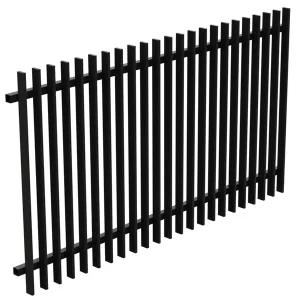
Blade fence for pool areas demands more from a fencing system than most installations. The combination of chlorinated water exposure, safety code requirements, and the need for both privacy and visibility creates a specification challenge that standard residential fencing cannot address. Over twelve years of engineering aluminum and steel fencing systems has shown that blade fence succeeds in these conditions when three factors are specified correctly: aluminum alloy grade, powder coating chemistry, and blade angle geometry. Getting any one of these wrong compromises the installation. Getting all three right produces a pool enclosure that handles chemical exposure, meets code, and maintains the clean sightlines that make blade fencing worth specifying in the first place.
How Blade Fence Satisfies Pool Safety Codes
Pool fencing codes share a common core regardless of jurisdiction: barrier height, gap limitations, and gate requirements. Blade fence addresses these with structural characteristics that simplify compliance.
The International Swimming Pool and Spa Code requires a minimum barrier height of 48 inches for residential pools. Our standard blade fence panels ship at 1,200 mm, 1,500 mm, and 1,800 mm finished heights, covering the most common code requirements across North American and Australian markets. More important than the nominal height is what happens at the bottom rail. Codes typically mandate no more than 4 inches of clearance between the bottom of the fence and grade. Blade fence panels with integrated bottom channels eliminate the gap uncertainty that site-built fencing introduces.
The gate requirement is where many pool fence specifications fall short. Self-closing hinges and self-latching mechanisms must engage from any open position. We ship aluminum blade fence gates with adjustable hydraulic self-closing hinges rated for continuous use in humid environments, and the latch assembly positions at the code-required height of 54 inches or higher depending on jurisdiction. These are not afterthought hardware items; the gate frame extrusion accepts them as native components, which means the installer is not drilling and weakening the aluminum section on site.
Aluminum Blade Fence in Chlorinated and Humid Environments
Pool chemicals create a microenvironment that accelerates corrosion in ways that general outdoor exposure does not. Chloramines, the compounds formed when chlorine reacts with organic matter in pool water, off-gas into the air immediately above the pool surface. In still conditions, these compounds linger and settle on nearby surfaces. A fence positioned within the splash zone or prevailing wind path from the pool gets regular contact with chemically active moisture that is more aggressive than rain.
This is why alloy selection matters. We specify 6063-T5 aluminum for blade fence extrusions destined for pool installations. The 6063 alloy provides a tight grain structure that accepts architectural powder coating with excellent adhesion, while the T5 temper delivers the stiffness needed for blade profiles that must resist wind load and incidental contact without permanent deformation. A lower-grade extrusion alloy with a looser grain structure will develop coating micro-fractures at blade edges over time, and pool chemicals find those entry points quickly.
The blade profile geometry itself contributes to corrosion resistance. Unlike tubular sections that trap condensation internally, blade profiles are open extrusions that drain freely. There is no internal cavity where chlorinated moisture can accumulate unseen. When we review failed fencing around pools, internal corrosion of hollow sections is one of the most common root causes. Blade fence eliminates that failure mode by design.
Blade Angle Geometry for Privacy and Airflow
The defining characteristic of blade fence is the angled profile that provides visual screening while allowing air movement. Getting the angle right for a pool enclosure involves a trade-off that is worth understanding before specifying.
At a blade angle of 30 degrees from vertical, a person standing at typical viewing distance on the outside sees overlapping blades that prevent direct sightlines into the pool area. Privacy is maintained without the closed-in feeling of a solid wall. At the same 30-degree angle, approximately 55 to 60 percent of the panel face remains open for airflow. This matters for two reasons. First, air movement across the pool deck carries away chloramines that would otherwise concentrate at breathing height. Second, the airflow prevents the heat buildup that turns solid-walled pool enclosures into uncomfortable spaces on summer days.
If your pool area sits in a wind corridor or faces prevailing afternoon winds, a blade angle of 20 degrees reduces the open area to roughly 40 percent while still providing adequate ventilation. The narrower angle shifts the balance toward wind reduction without creating a solid barrier. These angles are built into the extrusion die, not adjusted on site, which means the specification must be locked before manufacturing. We keep standard dies at 20, 30, and 45 degrees, and custom angles can be cut for volume orders. The decision point most buyers miss is matching the blade angle to the site’s actual wind pattern rather than defaulting to the steepest angle available.
If your pool enclosure involves a specific wind condition or sightline requirement that standard blade angles cannot resolve, sharing the site orientation and prevailing wind direction during specification lets us confirm the right angle before tooling begins. Reach our engineering team at sales01@yulongkeji-ch.com to discuss your site’s specifics.
Powder Coating Standards for Long-Term Poolside Performance
Powder coating is not a single process. The difference between a coating that lasts five years and one that lasts fifteen in a pool environment comes down to pretreatment chemistry, powder formulation, and cure control.
Our blade fence panels go through a seven-stage pretreatment before powder application. The critical stages for pool environments are the degreasing rinse and the chrome-free conversion coating. The degreasing stage removes extrusion lubricants and handling contaminants that would prevent coating adhesion. The conversion coating creates a chemically bonded layer on the aluminum surface that both inhibits corrosion and provides mechanical keying for the powder. Skipping or reducing dwell time in either stage produces panels that look identical off the line but begin delaminating at blade edges within two to three years of poolside exposure.
The powder itself is a polyester TGIC-free formulation specified for exterior architectural use. We qualify powders to withstand 3,000 hours of salt spray testing per ASTM B117 without blistering or adhesion loss. This is beyond what general-purpose architectural powder achieves and is closer to marine-grade specifications. The TGIC-free chemistry also eliminates a compound that several jurisdictions now restrict in building materials, which matters for projects pursuing green building certification.
Cure temperature and dwell time are the final control points. Undercured powder looks fine initially but lacks the cross-linking density to resist the chemical micro-attack that pool chlorine compounds deliver over years. Our production line monitors both oven zone temperatures and line speed continuously, and every batch gets a cured-film solvent resistance test before panels enter packaging.
Blade Fence vs Louvered and Glass Pool Fencing
Pool fence buyers frequently compare blade fence against louvered fence panels and frameless glass systems. Each has a place, but the differences in long-term poolside behavior are significant.
| Feature | Blade Fence | Louvered Fence | Frameless Glass |
|---|---|---|---|
| Privacy level | High, fixed angle | Adjustable | None without film |
| Airflow | 40 to 60 percent open area | Zero to 100 percent, manual | Zero |
| Corrosion resistance | Excellent with 6063-T5 plus architectural powder coat | Mechanism dependent; moving parts in louver pivots add failure points | Stainless hardware only; glass etching from pool chemicals over time |
| Maintenance | Washdown only | Lubricate louver pivots annually | Frequent cleaning to prevent water spots and mineral buildup |
| Code compliance | Fixed geometry simplifies gap compliance | Adjustable louvers can create unintended gaps below 4-inch code limit | Requires careful post spacing and glass panel sizing |
Louvered fence offers the advantage of adjustable privacy, and in non-pool applications that flexibility is genuinely useful. Around a pool, the mechanical complexity becomes a liability. Louver pivot mechanisms operate in a chlorinated, high-humidity environment, and even stainless steel pivot pins eventually develop surface corrosion that makes adjustment difficult. I have inspected louvered pool enclosures where half the blades were frozen in position after three seasons.
Glass pool fencing provides an unobstructed view that blade fence cannot match, and for high-end residential projects where the view is the priority, frameless glass remains the right choice. The trade-off is maintenance. Glass panels within the splash zone develop a film of pool chemical residue that requires frequent cleaning. In hard-water regions, mineral deposits add another layer of upkeep. Glass also does nothing for privacy, which is increasingly a concern in denser residential developments where pool areas face neighboring properties.
Common Questions About Blade Fence Pool Enclosures
Can blade fence panels be cut to fit irregular site dimensions?
Blade fence panels are manufactured to fixed module widths, typically 2,200 mm for standard panels. Site irregularities are handled through custom-width panels ordered to exact dimensions, not by cutting standard panels on site. Cutting a blade panel in the field exposes raw aluminum at the cut edge, which bypasses the factory powder coating and pretreatment system and creates an immediate corrosion entry point. We manufacture custom-width panels to the nearest 50 mm increment as part of the same production batch, so every edge carries the full pretreatment and coating protection. The lead time for custom widths adds roughly five to seven working days to a standard order.
Does blade fence block enough wind to make a pool deck comfortable?
The wind reduction depends on blade angle and the fence’s position relative to prevailing wind. A 20-degree blade angle reduces wind speed immediately behind the fence by roughly 50 to 70 percent over the first three to four meters, which covers the typical pool deck width. The fence does not create a dead-calm zone the way a solid wall does, but it takes the edge off wind that would otherwise make poolside seating uncomfortable. For sites with strong prevailing winds, orienting the fence perpendicular to the wind direction and specifying the narrowest available blade angle produces the best result. If wind is a primary concern, sharing your site’s wind data during specification allows us to recommend whether blade fence alone is sufficient or whether supplementary wind screening is warranted.
How close to the pool edge can blade fence be installed?
Building codes typically require a minimum setback from the pool waterline to any permanent barrier, commonly 1,000 mm to 1,200 mm depending on jurisdiction. Blade fence does not change this requirement. The practical consideration beyond code is splash zone exposure. We recommend keeping the fence outside the direct splash zone wherever possible, not because the aluminum or coating cannot handle water contact, but because constant wet-dry cycling concentrates pool chemicals on the surface and shortens the cleaning interval. A setback of 1,500 mm or more keeps the fence in the secondary spray zone where rainfall handles most of the rinse cycle naturally.
What color options work best around pools?
Darker colors absorb more solar radiation and run hotter to the touch, which matters for a fence that people may lean against or children may grab. Black and dark bronze blade fence panels in direct summer sun can reach surface temperatures above 60 degrees Celsius. Lighter colors reflect more heat and stay cooler; white and light grey are the practical choices for pool areas in hot climates. Our white powder coat uses the same polyester TGIC-free chemistry as darker colors and carries identical corrosion resistance ratings. The aesthetic case for darker colors around pools is strong, and the heat issue can be managed by specifying blades at a steeper angle that reduces direct solar exposure on the visible face. If your design calls for a dark color, discuss the orientation with us and we will advise whether the blade angle and panel position will keep surface temperatures manageable. Send your color reference and site photos to sales01@yulongkeji-ch.com for a practical assessment.
If you’re interested, check out these related articles:
Commercial Steel Fencing: Top Options for Retail Parks and Offices
Frameless Glass Balustrade: Designs for Stairs, Pools & Balconies