
Aluminum blade fence wholesale pricing often grabs the initial attention, but experienced buyers know that MOQ, lead time, and shipping logistics are the true determinants of project cost and schedule. Behind these numbers are manufacturing realities most procurement guides do not explain: the extrusion die that shapes each blade, the blade angle that controls both privacy and packing density, and the production scheduling that ties your order volume to factory throughput. Getting accurate quotes requires understanding these factors, not just comparing unit prices from different suppliers.
How MOQ Is Determined in Aluminum Blade Fence Manufacturing
Aluminum blade fence panels are not off-the-shelf items. Each blade profile starts as an aluminum billet pushed through a precisely machined extrusion die. The die defines the cross-section shape, wall thickness, and the mounting channel geometry. Creating a new die takes time and costs money. For a factory to justify setting up a production run, the order volume must cover the die preparation and extrusion line changeover. That floor is the practical MOQ.
Standard Blade Profiles and Lower MOQ
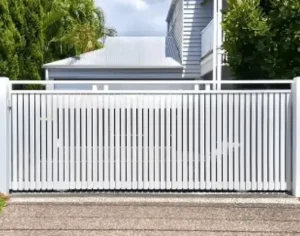
Standard blade profiles, like a 100 mm wide flat blade with a 45° angle, are common in the market. If a supplier already stocks dies for those shapes, the MOQ can be as low as 50 to 100 panels, sometimes even for mixed heights. This is because the die is ready, and the extrusion team only needs to load the billet and begin pushing. I have seen orders as small as 60 panels ship when the profile matched an existing die exactly.
Custom Dies and Higher Order Minimums
If your project demands a proprietary blade shape, a non-standard angle, or a specific edge detail, a new die must be built, and the MOQ will rise to 200 panels or more to spread that upfront cost. Custom die development can take two to three weeks and adds roughly $800 to $1,200 to the project’s tooling line. Communicating your blade specification early, with dimensioned drawings if possible, lets the manufacturer confirm feasibility before you commit. When negotiating MOQ, ask whether the blade profile comes from an existing die set or requires a new build. This single question shifts the conversation from price haggling to production planning.
Production Lead Time for Aluminum Blade Fence Orders
Once the order is confirmed and the die is verified, production moves through a predictable sequence. Below is a typical timeline for a 200-panel order using an existing die.
| Production Stage | Duration (working days) |
|---|---|
| Extrusion and aging | 5–7 |
| Cutting and machining | 3–4 |
| Surface treatment (powder coating) | 3–5 |
| Quality inspection and packing | 2–3 |
| Total production time | 15–20 |
This schedule assumes no die fabrication. When a new die is required, add 10–15 working days for die design, CNC machining, and trial extrusion. Lead time then moves to 30–40 working days. In the month before Chinese New Year, extrusion lines run at full capacity, and these timelines can extend by another week. Planning your order submission well ahead of that window keeps your project on track.
If your timeline is tight or your blade profile requires a new die, confirming the die specification during the inquiry stage saves weeks. Share your blade drawing or desired angle with sales01@yulongkeji-ch.com to get a lead time estimate matched to your schedule.
How Blade Angle Affects Shipping and Container Load
Blade angle is not just a design choice for privacy, it directly affects how many panels you can pack into a shipping container, which controls your per-unit freight cost.
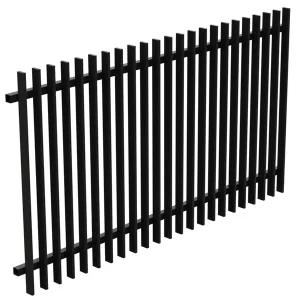
Steeper blade angles provide more visual privacy but reduce nesting density. A panel with 30° blades can be stacked more tightly than one with 60° blades. The table below shows the approximate number of standard 1800 mm × 1800 mm panels that fit in a 40-foot high-cube container under typical flat-packing.
| Blade Angle | Panels per 40ft Container | Privacy Level |
|---|---|---|
| 30° | ~320 | Moderate |
| 45° | ~280 | High |
| 60° | ~240 | Very High |
A buyer importing a container of 45° blade panels might pay a per-panel ocean freight cost roughly 14% lower than someone shipping 60° panels, simply because more units share the fixed container cost. Small differences in stacking design, like flipping every other panel or using slim interleaving sheets, can gain another 5% to 10% capacity. Our packaging team runs container load simulations before finalizing any new blade profile because the savings show up immediately in the landed cost.
The Wholesale Ordering Process from Inquiry to Delivery
Ordering aluminum blade fence from a Chinese manufacturer follows a straightforward path when both sides communicate clearly.
- Submit inquiry with specifications. Include panel dimensions, blade angle, color code (RAL or powder coat number), quantity, and target delivery port.
- Receive quotation. The factory returns a proforma invoice with unit price, tooling charge if applicable, MOQ, lead time, and shipping terms (FOB or CIF).
- Sample approval. For large orders, we recommend a pre-production sample of 10 to 20 panels. This confirms the blade finish and fit before full production begins.
- Production and inspection. The factory runs the extrusion, fabrication, and powder coating. A pre-shipment inspection checks dimensions, coating thickness, and packing quality.
- Shipping and documentation. The container is loaded, and you receive the bill of lading, packing list, and certificate of origin.
At each stage, confirm the next step’s timing with your contact person. Delays usually come from delayed color approval or missing port information, not from production.
Strategies to Reduce Shipping Costs for Bulk Fencing
Freight is often the largest single variable in an aluminum blade fence wholesale order, and buyers control more of it than they think.
Packaging configuration matters. Flat-packed panels that stack tightly without unnecessary gaps reduce cubic meter usage. Avoid shipping assembled frames with exposed blades when a knock-down kit achieves the same product and costs less to move.
Choose the right freight forwarder. A forwarder who handles project cargo regularly can consolidate multiple supplier loads into one container, which is useful if you also source gates or posts separately.
FOB gives you cost control. On FOB terms, you select the forwarder and negotiate ocean freight directly. CIF adds convenience, but the factory includes a freight buffer. For single-container orders, the difference is small. For three or more containers, FOB almost always yields a better rate.
When we pack blade fence panels for export, we use reinforced cartons with foam separators and steel-strapped pallets that weigh under the forklift limit. This design has cut in-transit damage claims to near zero for the containers we handled last year.
Common Questions About Aluminum Blade Fence Wholesale
What is the minimum order quantity for aluminum blade fences?
Most standard blade profiles can be ordered with an MOQ between 100 and 200 panels. If the profile matches an existing die, smaller quantities down to 50 panels are sometimes possible by mixing heights. Custom blade shapes that need a new die push the MOQ to 200 panels or higher. Ask the factory whether the die is ready before you assume a minimum.
Can I order a sample before placing a bulk order?
Yes. We regularly ship sample panels via air courier, or small production runs of 10 to 20 panels by air freight so you can verify the blade profile, coating color, and assembly fit. Note that the sample order does not reduce the bulk MOQ, which is tied to die and extrusion line setup.
How long does ocean shipping take from China?
Transit time depends on the destination port. To the US West Coast, expect 15 to 20 days; to the East Coast, 30 to 35 days. European ports typically take 30 to 40 days. Factor in an additional 3 to 7 days for customs clearance and inland delivery after arrival.
Which blade angle gives the best privacy?
A 60° blade angle offers near-total visual privacy. A 45° angle balances privacy with airflow and remains the most popular choice for residential and commercial projects. A 30° angle yields moderate privacy but allows tighter container loading and lower per-unit shipping cost. The right angle depends on your site requirements and budget targets.
Can the factory arrange shipping, or do I need my own forwarder?
You can use your own freight forwarder, or we can coordinate door-to-port shipping through our logistics partners. We provide quotes under both FOB and CIF terms so you can compare total landed cost. For first-time importers, we always recommend working with a forwarder experienced in construction materials to avoid port delays.
Share your project specifications, blade angle, and target quantity, and we will prepare a complete quotation including MOQ, lead time, and shipping cost. Reach us at sales01@yulongkeji-ch.com or call +8619086315193.
If you’re interested, check out these related articles:
Stainless Steel Vertical Cable Railing: Design, Specs, & Factory Pricing Guide
Selecting the Right Aluminum Driveway Gate for Durability
Steel Pool Fence Codes: Essential Safety & Supplier Selection Guide
Industrial Aluminum Fences: High-Security for Factories & Warehouses
Industrial Steel Security Fences: Anti-Climb & Anti-Cut Protection