
Modern aluminum blade fence panels are a practical choice for projects where clean architectural geometry must meet dependable privacy. As a structural engineer working with aluminum and steel fencing systems every day, I focus on what the panel delivers over its service life, not just how it looks in a brochure. The right panel balances blade profile, surface finish, and attachment hardware so the fence stays straight, resists corrosion, and integrates with the surrounding elevation. This article explains the design options, color availability, and pricing structure behind aluminum blade fence panels, based on how we manufacture and configure them for international orders.
How Blade Design Affects Privacy, Light, and Airflow
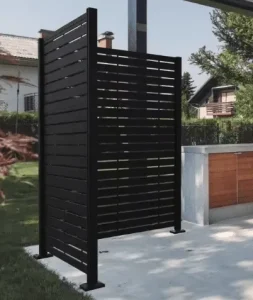
Blade fence privacy is controlled by three variables: blade width, blade pitch angle, and the spacing between blades. A wider blade obviously blocks more line of sight, but the angle at which the blade is set decides whether visibility is reduced from head-on, from low angles, or from the side. In our manufacturing, we default to a blade width of 100 mm to 120 mm and pitch angles between 15° and 25° for most residential privacy applications; for commercial screening, we increase blade width up to 150 mm and tighten angle to 10°–15° to maintain visibility from inside while blocking direct exterior sightlines.
This interplay directly affects airflow and light transmission. A 25° angle with moderate spacing lets through enough cross-breeze to keep a patio or balcony cool while maintaining 80 percent visual privacy. If the site experiences strong prevailing wind, reducing the angle to 15° and increasing blade overlap reduces wind pressure loading on the posts and brackets, which can matter for tall installations. When we review project drawings, we check wind load data to recommend the right blade geometry, because changing the angle also changes the post spacing calculation.
Color Choices and Powder Coating Performance
Color is where the architectural conversation often starts. For aluminum blade panels we stock a standard palette that matches popular RAL and architectural coating series: matte black (RAL 9005), anthracite grey (RAL 7016), white (RAL 9016), and a silver metallic effect. Custom colors are available through our in-house powder coating line, and we routinely match customer-supplied samples in quantities above 200 square meters. The coating itself is a polyester-based super-durable powder applied after a chrome-free pretreatment that improves adhesion and corrosion resistance.
| Color Series | Typical RAL Reference | Best Application |
|---|---|---|
| Matte Black | 9005 | Modern residential, commercial perimeters |
| Anthracite Grey | 7016 | Mixed-material facades, stone accent walls |
| White | 9016 | Coastal settings, bright courtyard surrounds |
| Metallic Silver | 9006 | Architectural contrast elements |
Black continues to be the highest-volume order in our factory, especially for blade fence profiles where the dark color deepens the perceived depth between blades. In coastal environments, we often recommend the marine-grade powder formulation, which includes additional UV stabilizers and salt-spray resistant pigments. This grade passes 1,500-hour neutral salt spray testing without blistering, and we can provide test reports when your project needs documentation for warranty or compliance.
If you are specifying for a coastal development with direct salt exposure, it is worth confirming the coating chemistry before finalizing the order. Our team can check compatibility with local environmental conditions; send your site details and project scope to sales01@yulongkeji-ch.com and we will recommend the appropriate series.
Custom Blade Panel Dimensions and Structural Specs
Standard panel dimensions don’t fit every site, so we manufacture to order. The aluminum used is 6063-T5 alloy, which provides a good balance of extrudability and yield strength for fencing components. Frame rails are typically 40 mm × 40 mm or 50 mm × 25 mm box sections; blades are hollow extrusions with a wall thickness of 1.2 mm to 1.5 mm, which keeps weight manageable without losing rigidity.
Panel height is flexible from about 1.2 meters up to 2.0 meters in finished assemblies; width per panel is usually set to 2.0 meters to align with post centers, but we can widen or narrow this to fit your layout. One detail we insist on is that every panel is factory-assembled with stainless steel self-drilling screws through pre-punched rails into the blade ends rather than relying on adhesive or snap-in clips. This secures each blade under wind load and prevents the kind of mid-panel sag that cheaper clip-on designs show after a few seasons.
Post options are either 80 mm × 80 mm square aluminum with base plates or core-drilled round aluminum with buried installation. For sites with irregular ground, we supply post spacers and adjustable brackets that allow fine grading without reshaping the panel itself.
What Determines Factory Pricing for Aluminum Blade Fences
When customers ask for price lists, the most useful answer is a cost breakdown by component rather than a flat per-meter price that won’t hold at different quantities. Aluminum ingot cost is the largest variable; blade extrusion profiles with complex interior webs consume more billet and run at slower extrusion speeds, which raises per-kilo cost. A simple flat blade will cost noticeably less than a shaped profile with reinforcing ribs, even if the face width is the same.
After extrusion, the three main cost drivers are powder coating, fabrication, and packaging. Super-durable polyester powder runs about 15 – 20 percent higher than standard polyester on a per-square-meter basis, and custom color matching adds a one-time setup charge that we amortize across the order volume. Fabrication labor for drilling, tapping, and assembling a blade panel is higher than for a simple vertical-slat panel because each blade requires indexed positioning to maintain the pitch angle and reveal. Packaging for export uses reinforced steel pallets with foam separators between panels; for blade widths over 120 mm we often need wider pallets that affect container utilization, which shows up in the landed cost.
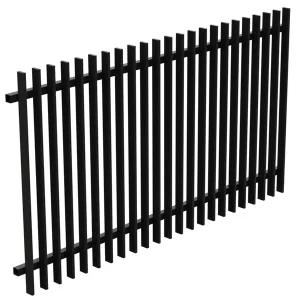
For a rough reference, a standard 1.8 m × 2.0 m panel in matte black RAL 9005 with a 100 mm blade at 20° pitch typically falls in a factory price range of $85 – $110 per panel at container quantities, excluding post hardware and freight. That range shifts upward if you move to custom blade profiles or require wider panels that increase material take. We prepare a formal quote only after we see a panel elevation drawing and volume estimate, because small changes in blade count or frame thickness can move the price 10 – 15 percent in either direction.
If your program involves a site with unusual wind exposure or specific building-code requirements, it is worth confirming load calculations and material thicknesses early. Reach out with your drawings and we will provide a preliminary structural check alongside the quotation — sales01@yulongkeji-ch.com is the quickest path.
Comparing Blade Fences to Louvered and Slat Panel Systems
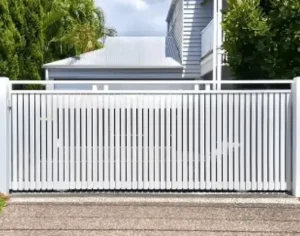
A question that comes up in nearly every tender: what’s the practical difference between a blade fence, a louvered fence, and a vertical slat panel? Blade fences and louvered fences both use horizontal oriented members, but louvered panels often fix blades at a steeper angle, typically above 30°, which prioritizes ventilation and light control above privacy. Blade fence panels, with shallower angles and wider extrusions, are generally specified when the dominant need is blocking sightlines without closing off the view completely.
Vertical slat fences are a different category — they offer clean vertical lines and a different shadow behavior, but they rely on close spacing for privacy. In our factory, vertical slat panels use narrower members, around 60 mm, set at 10 mm to 15 mm spacing, creating a continuous screen. The structural behavior differs: blade panels carry wind load across each horizontal blade into the vertical rails, while slat panels direct load through each slat directly into the top and bottom rails. For the same post spacing, a blade panel can feel more rigid because each blade acts as a small structural member spanning horizontally, which stiffens the assembly.
Blade systems also have an advantage when terrain slopes. Because the blades are horizontal, they can follow the slope line in a racked installation without changing the blade geometry — the rails are cut at an angle and the blades remain horizontal. Louvered and slat fences require stepped panels that break the horizontal line and create visual gaps.
What Buyers Ask About Aluminum Blade Fence Panels
Do aluminum blade panels dent easily under impact?
The dent resistance depends on blade wall thickness, not the panel style. Our standard 1.2 mm wall thickness on a 100 mm blade profile resists normal garden-equipment bumps without deformation. For commercial installations where maintenance vehicles move nearby, we upgrade to 1.5 mm walls, and those panels routinely survive light vehicle contact without visible damage. The powder coat adds a degree of surface hardness that helps prevent minor scuffs.
Can I see the factory finish before production?
We send physical powder-coated swatches for color approval on custom orders, not images. The swatch is a 200 mm × 100 mm aluminum plate coated on the same line that will run your order, so you see the exact gloss level and texture. Most color disagreements between sample and finish come from judging color from a screen; physical swatches avoid that.
How does blade fence deal with ground slope?
Blade panels can be racked to follow the slope if the angle is under about 25°. The top and bottom rails are cut at the slope angle, but the blades remain horizontal. Beyond that, we recommend stepped panels with post extensions. In projects we have supported in hilly sites in Southeast Asia, racked installation eliminated the stepped gap problem and kept the fence line visually continuous.
What is the minimum order quantity?
Our standard minimum order for custom blade fence panels is 50 panels per size and color. For stock dimension panels in black or grey we can produce as few as 20 panels. If your pilot project needs a smaller batch to evaluate the product first, we can arrange a sample order of 5–10 panels at a slightly higher unit cost. Share your projected annual volume and target sizes, and we will suggest the most cost effective ordering path — reach us at sales01@yulongkeji-ch.com or +8619086315193.
If you’re interested, check out these related articles:
Aluminum vs Vinyl Fence: Maximizing Longevity and Value
Commercial Aluminum Fencing: 5 Key Business Applications