
Contractors comparing welded railing vs assembled railing kit systems usually start with cost, but the decision turns on tolerance control, field labor, and long term service. Welded railing gives a continuous load path and a clean look on complex geometries; assembled kits cut on site welding and speed installation. In our engineering support work, we recommend assembled systems as the default for most residential and light commercial programs, and welded systems only where continuous rails, heavy traffic, or custom stair transitions justify the extra field work. The real difference is not quality. It is how much adjustment and risk you can accept at the job site.
Welded Railing Suits Continuous Runs and High Abuse Sites
Welded railing performs best where the handrail must carry load across several posts without interruption. A continuously welded top rail distributes force along the entire length, so one weak joint does not become the first failure point. We specify this approach on balconies, elevated walkways, and stair towers where wind load and vibration act on the same rail every day. The connection between post and handrail becomes part of the structure itself rather than a fastened joint that can loosen.
Site welding is not only a cost line. It changes the finish schedule. A powder coated or anodized rail that is welded in place must be ground, cleaned, and touched up, and the repair will rarely match the factory finish perfectly. That creates inspection risk on visible residential work. Contractors who weld aluminum in the field also need qualified operators and hot work procedures, which becomes harder on occupied buildings.
In our work, we treat field welding as an engineering decision first. If a curved balcony rail or a stair stringer needs a continuous load path, welding is the correct method. If the layout is straight and modular, it usually adds hours without adding performance. That is the line our installation support team draws with contractors before ordering.
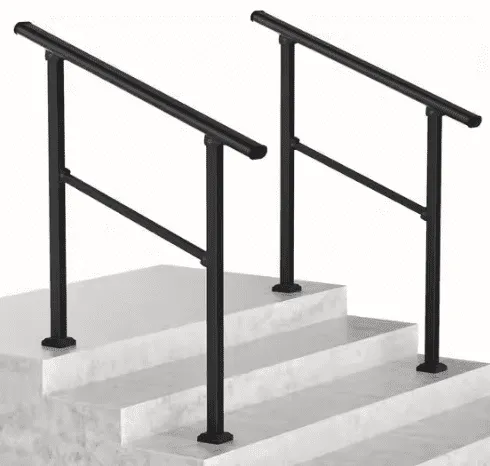
Assembled Railing Kits Keep Field Labor and Fasteners Predictable
An assembled railing kit shifts most of the complicated work back to the factory. Brackets, post bases, factory punched top rails, and factory cut balusters arrive in a coordinated package. On site, the crew sets posts, squares the lines, and fastens components in sequence. This works well for deck railings, balcony guardrails, and straight stair runs where site conditions are measured and the post spacing can be held within tolerance.
The main advantage is not just speed. It is repeatability. A kit with consistent extrusions and drilled holes removes much of the measuring error that causes gaps and misaligned balusters. We have seen installation crews produce uniform railing runs on multi building residential projects because the cutting was already controlled at the factory. The skill needed on site drops from welder plus finisher to installer with basic layout tools.
Assembled kits also make later replacement easier. A damaged top rail or baluster can be removed and replaced section by section without cutting the whole structure. On commercial properties that change use or need maintenance, this modularity keeps the long term cost down.
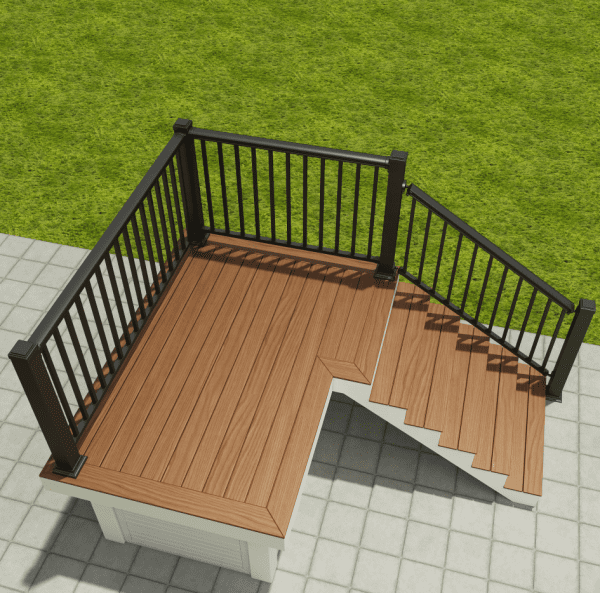
Cost Differences Depend on Tolerances, Freight, and Site Adjustments
Welded railing often looks cheaper at the material level because it uses fewer connectors. The field hours are what change the total. A crew that welds, grinds, and repairs finish on thirty balcony sections can spend more on labor than the connectors in an assembled system would ever cost. On short custom runs, welding may be less expensive because the setup is limited. On long repetitive runs, the assembled kit usually wins on installed cost.
Freight also affects the comparison. Assembled railing components often pack flatter and ship in more compact crates. Welded subassemblies take up more volume, especially when they are shipped fully assembled. Contractors should compare the freight class and crate dimensions, not just the unit price.
| Cost factor | Welded railing | Assembled railing kit |
|---|---|---|
| Factory labor | Lower for simple welded frames | Higher for pre cut and punched components |
| Field labor | Higher, includes welding and finish repair | Lower, mostly layout and fastening |
| Finish consistency | Depends on field touch up | Factory controlled on all visible surfaces |
| Packing and freight | Bulkier, often higher volume | More compact, easier to nest |
| Rework and adjustment | Requires cutting and re welding | Brackets permit minor site adjustment |
| Long term service | Harder to replace single sections | Easier section by section repair |
This table does not settle the decision. It shows where cost actually appears. A factory cannot remove all site variation, so tolerance planning matters more than the joining method. If your program includes long runs with repetitive post spacing, it is worth confirming bracket adjustment range and top rail pre drilling before finalizing your bill of materials. Send your drawings and site dimensions to sales01@yulongkeji-ch.com and we will confirm which system fits without field cutting.
Site Conditions Drive the Final Choice for Contractors
The site always has more authority than the budget. Coastal projects expose welded joints and fasteners to the same salt environment, but an assembled kit leaves fewer heat affected zones and keeps the factory coating intact. For high traffic commercial spaces, welded railing resists abuse from repeated impacts because the joints do not loosen as easily. Those two conditions pull in opposite directions, which is why we ask contractors to separate corrosion exposure from impact loading instead of treating them as one problem.
Stair transitions create another deciding factor. A straight stair can use an assembled railing kit with adjustable angle brackets. A winder or a curved stair usually requires welded sections or custom fabricated assemblies. The same applies to long balcony lines that must keep a continuous top rail profile. When site measurements show more than thirty minutes of cutting and adjustment per section, a welded system may actually be the more predictable choice.
Contractors should also check the governing code for their project. Railing height, baluster spacing, and concentrated load requirements apply the same way to both methods. The joining method does not change the guard rating, but it does change how the load is transferred. A bolted bracket connection must be checked for pullout and bearing on the post. A welded connection transfers force through the section. Both can meet code when they are detailed properly, but one cannot be casually substituted for the other on a stamped drawing.
Confirm Geometry, Finish, and Load Path Before Ordering
Before choosing between welded railing and assembled railing kits, contractors should resolve three items. First, confirm the true site dimensions at every post location. Second, decide whether the visible finish can tolerate field touch up or must remain factory only. Third, verify whether the engineer of record requires a continuous load path or accepts mechanically fastened joints. These three answers remove most of the guesswork from the quote.
We supply both welded railing and assembled aluminum railing systems, and the right choice usually becomes obvious once the drawings are marked up. If your project has mixed conditions, we can split the order: welded sections for curved runs and stairs, assembled kits for the straight sections. This avoids paying for field welding where it adds nothing.
Send your railing drawings, post centers, and finish requirements to sales01@yulongkeji-ch.com or call +8619086315193. We will confirm stock, bracket adjustment range, and whether the project needs welded subassemblies before you commit to a bill of materials.
Common Questions About Welded and Assembled Railing Systems
Does welded railing meet code loads better than an assembled kit?
Not automatically. Both systems can meet the same guard load requirements when they are detailed for the post spacing and railing height. A welded joint creates a continuous load path, which is useful on long spans or curved runs. An assembled kit relies on bracket fasteners and post sleeves, so the engineer must check bearing and pullout at each connection. The real difference appears in fatigue and vibration. In high movement locations, welded joints have fewer parts to loosen. In corrosion exposed locations, assembled systems avoid field repair of the factory finish.
Can assembled railing kits be adjusted on site when the layout is not square?
Yes, within the bracket range. Most good assembled systems include brackets with slotted holes or level washers that correct minor concrete variation. That correction is not a substitute for accurate layout. If a contractor expects adjustments beyond roughly ten to fifteen millimeters per post, the kit will still need shims or recutting. We tell installers to set the first and last posts, pull a line, and then adjust the intermediate brackets to that line before fastening.
Which system costs less on a long repetitive run?
It depends on the run length and local labor rates. On long straight runs, assembled railing kits usually cost less installed because field labor drops sharply. Welded railing carries less hardware but more site time for welding, grinding, and finish repair. On a single curved balcony, the opposite can be true. The volume of sections, freight dimensions, and labor rates matter more than the material price. Contractors should request an installed cost comparison for the actual run length rather than comparing per foot material prices alone.
How do we handle powder coat damage after field welding?
In projects we have supported, field touch up rarely disappears entirely on visible residential work. Cut back the damaged area, clean the heated zone, and apply a compatible repair coating after the weld cools. The repair will be functional but may look different under certain light. For visible residential railings, order a touch up kit from the original coating supplier and test it on an offcut before the crew goes to site. If the project cannot accept visible touch up, that is a signal to choose an assembled railing kit and keep the factory finish intact. If your project mixes straight and curved runs, send your drawings to sales01@yulongkeji-ch.com and we will confirm which sections can stay factory finished and which need field repair procedures.
If you’re interested, check out these related articles:
Industrial Aluminum Fences: High-Security for Factories & Warehouses
Selecting the Right Aluminum Driveway Gate for Durability
Steel Fence vs Wrought Iron: Modern Options for Durable Fencing
Steel Pool Fence Codes: Essential Safety & Supplier Selection Guide
Steel Fence Quality Control: Essential Pre-Shipment Checks