
Railing accessories become a source of callbacks when buyers treat them as a final checkbox instead of a system decision. Post caps, newel posts, and connectors carry the same weather exposure and structural load as the rail sections, but they are the easiest place for a quote to hide weak material or mismatched hardware. Over twelve years of working on fence and railing projects, I have seen the same failure pattern repeat: a well-specified rail panel undermined by a cap that traps water or a connector that cannot hold alignment under repeated loading. This guide covers what to check before ordering.
Railing Accessories That Seal the Post Crown
A post cap does two jobs. It closes the open extrusion end and sheds water away from the post wall. Buyers often select caps by silhouette first. The better sequence is to confirm material compatibility and fit tolerance before style. A cap that fits loosely enough to rattle lets water sit at the post crown. A cap that fits too tightly on anodized or powder-coated post can damage the finish during installation.
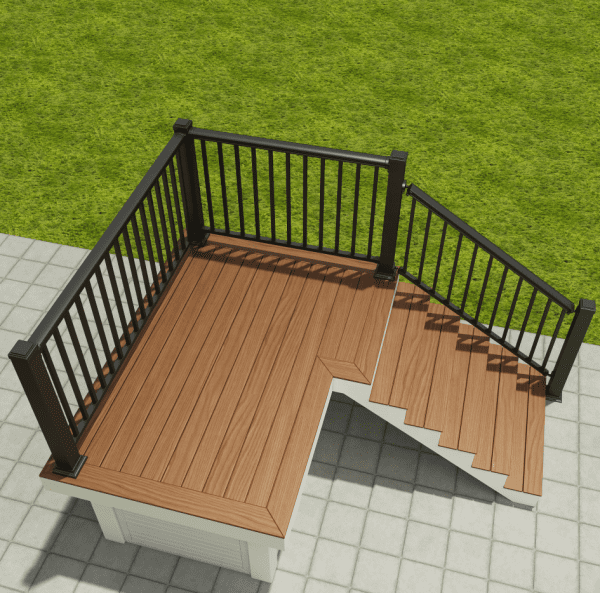
We specify aluminum post caps in 6063-T5 or 6063-T6 unless the railing system is steel, in which case a galvanized or powder-coated steel cap keeps thermal movement and galvanic behavior consistent. The cap material should match the post material to avoid a small anode-cathode corrosion cell at the top of the assembly. In coastal and industrial environments this matters more than many quotes reflect, because the interface between cap and post collects salt film and condensation even under a tight friction fit.
| Cap material | Best match | Key check |
|---|---|---|
| Aluminum 6063-T5 | Aluminum post | Inner dimension tolerance under 0.5 mm |
| Galvanized steel | Zinc steel post | Zinc coating coverage at cut edges |
| Powder-coated aluminum | Aluminum post with coating | Coating thickness 60 to 80 microns |
| Cast aluminum | Aluminum post, decorative | Internal drain hole or weep path |
A drain path or weep hole is not a defect. It is the difference between a cap that sheds water and a cap that stores it. We keep a small clearance at the post crown so the cap seats on the post wall rather than on a bead of trapped water. If a project uses post-mounted railing and the cap cannot achieve a stable interference fit, we recommend a mechanical fastener rather than relying on friction alone.
Newel Posts as Structural Anchors
Newel posts look like larger versions of balusters, but they carry the end load of a railing run and the point loads from stair transitions. A quote that lists a newel by outside dimension only leaves the most important variable unstated: the wall thickness and internal construction.
When do newel posts need internal reinforcement?
Internal reinforcement becomes necessary when the railing run exceeds 1.8 meters between anchor points, when the post carries a gate or a stair handrail return, or when the local loading standard requires a concentrated load at the top rail. In these cases we specify an internal aluminum or steel sleeve inside the newel post, and we extend the sleeve below the finished floor line to tie into the structure. A hollow newel post without a sleeve can still satisfy a dimensional drawing, but it will flex under the same load that a reinforced post absorbs.
The failure mode to watch is not outright collapse. It is permanent lean at the base plate or drift at the top connection. In projects we have reviewed, the newel post itself often meets the section size, but the base connector is undersized or the anchor bolts are set into a material that cannot hold the pull-out force. We ask suppliers for a section drawing before pricing a custom newel.
Connectors and the Cost of Mixed Hardware
Connectors are the lowest-cost line item in a railing accessories order and the most frequent source of site modifications. A rail connector that does not match the rail profile, the post face, or the fastener material creates three outcomes: visible gaps, accelerated corrosion, and a weaker load path.
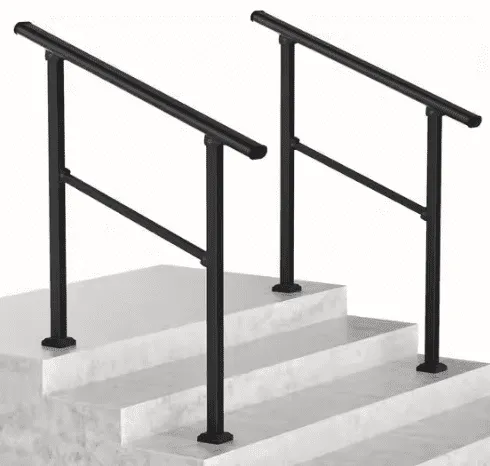
Mixed hardware is where the hidden cost sits. Aluminum rails paired with zinc-plated steel fasteners create galvanic activity in the presence of moisture. Stainless steel fasteners are the safer match in coastal air, but the torque values must be controlled so the harder fastener does not strip the aluminum profile. If your program mixes aluminum rails with stainless steel connectors or zinc-plated fasteners, it is worth confirming isolation details before finalizing your BOM. Send your connector list to sales01@yulongkeji-ch.com and we can check the pairings.
Which connector style holds alignment better?
For straight runs, a full-perimeter rail bracket with two or more fasteners holds alignment better than a single tab. For stair transitions, an adjustable angle connector is necessary because the rake angle rarely matches the standard extrusion slope. The connector should clamp the rail rather than rely on a through-bolt in the web, because the web is the thinnest section of many aluminum profiles.
Specifying Railing Accessories as a Complete System
Post caps, newel posts, and connectors fail as a group when each line item is sourced from a separate catalog without a shared specification. The cheapest post cap can undercut a good newel post, and the strongest newel post cannot recover from a connector that shifts under load. We ask buyers to send one of three things with an RFQ: a section drawing of the railing profile, the post outside dimensions and wall thickness, or a photo of an existing assembly. Without at least one of those, any quote is provisional.
The most useful accessory order includes the cap material and fit class, the newel wall thickness and reinforcement requirement, and the connector type with fastener grade. That information moves the conversation from price per piece to system compatibility. At Hubei Yulong, we review accessory RFQs against the railing system dimensions before quoting.
If your current BOM has unresolved cap fit, newel reinforcement, or mixed connector hardware, send the line items and post dimensions to sales01@yulongkeji-ch.com or call +8619086315193. We will confirm the compatibility and pricing against the railing profile you are using, not just the accessory dimensions.
Common Questions About Railing Accessories
Do post caps need to match the post material?
Yes in most installations. Aluminum caps should go on aluminum posts, and steel caps should go on steel posts. Matching the material keeps thermal expansion rates close and avoids a small corrosion cell at the contact between cap and post. The exception is a decorative cap that is fully isolated by a polymer sleeve or gasket, but that adds a maintenance item. If the cap has a drain path and a stable friction fit, the material match matters less in dry inland climates. In coastal or industrial air, the match is the safer specification. For railing accessories ordered as a retrofit, confirm the existing post material before selecting caps.
Can newel posts be ordered without internal reinforcement?
Many drawings show a hollow newel post and still meet the dimensional requirement, which leads buyers to assume the post is adequate. That assumption fails under concentrated end loads. A newel post without an internal sleeve can work in short, straight residential runs where the post is anchored into a solid substrate and the top rail is continuous. For longer runs, stair transitions, gate attachments, or any location with a concentrated load test, specify an internal aluminum or steel sleeve. The sleeve transfers load to the base connection instead of relying on the post wall alone. If the quote does not state wall thickness and reinforcement, treat it as incomplete.
What connector details do I need before requesting a quote?
It depends on whether the railing is new or already installed. For a new system, supply the rail profile drawing, the post dimensions, and the required bracket orientation. For an existing system, send a photo of the rail end, the post face, and any current connector. The two details that catch most orders are the rail profile type and the fastener material. Without the profile, a supplier can quote a connector that fits the general shape but not the exact web or groove. Without the fastener material, the quote cannot account for galvanic compatibility. We ask for those two details before pricing a connector package.
How do I avoid ordering railing accessories that do not fit my existing system?
In retrofit orders we have reviewed, the most common mismatch comes from measuring only the outside dimensions of the post or the visible width of the rail. Those measurements miss the internal profile that the cap or connector must engage. Before ordering, remove one cap or connector and measure the actual wall thickness, the internal opening, and the rail profile shape. A photo of the cross-section at the joint is more useful than a photo of the whole railing. If you already have a system and are adding or replacing accessories, send that cross-section photo and the profile dimensions to sales01@yulongkeji-ch.com and we will confirm compatibility before you commit.
If you’re interested, check out these related articles:
Custom Aluminum Gates: OEM & ODM Solutions for Global Projects
Importing Aluminum Fence from China: 5 Questions to Ask
Wrought Iron vs Ornamental Steel Fence: Cost & Alternatives
Industrial Steel Security Fences: Anti-Climb & Anti-Cut Protection