
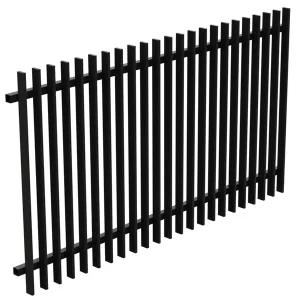
Black blade fence panels have moved from a niche architectural choice to the dominant specification in residential and commercial perimeter design over the past eighteen months. The shift is not purely aesthetic. After working with aluminum extrusion profiles and powder coating lines for over a decade, I have seen how a properly specified black finish interacts with the angled geometry of blade panels to produce visual depth that lighter colors simply cannot deliver. Architects and procurement managers who once hesitated over heat concerns or fading risks are now specifying black as their default, and for good reason. Modern polyester powder coating formulations combined with the inherent shadow-casting properties of blade profiles have resolved the durability questions that historically kept dark colors in the background.
What Makes Black Blade Fence Panels the Leading Design Choice
The preference for black blade fence panels in 2025 sits at the intersection of three practical factors that go deeper than a simple color trend. First, dark perimeter treatments create a visual recession effect. Where a white or light gray fence pulls the eye forward and defines the boundary line aggressively, a black fence recedes into the background. The landscape, the architecture, the planting, all come forward visually while the fence does its job quietly. Property developers working on high density residential projects have told us this matters more than most suppliers realize. When every square meter of visual space counts, a fence that disappears perceptually is a selling point.
Second, black offers the widest compatibility across mixed material facades. Contemporary architecture frequently combines stone, glass, timber, and metal cladding in a single elevation. A black blade fence panel does not compete with any of these. It sits neutrally against warm timber, cool stone, or reflective glass without creating the color conflict that even supposedly neutral grays can introduce. Third, from a maintenance visibility standpoint, black is forgiving. Surface dust, water spotting, and minor contact marks that show readily on white or bright silver finishes are far less noticeable against a dark matte or semi gloss black surface. Property managers who maintain multiple sites consistently report fewer cosmetic callbacks on black installations.
How Blade Angle Geometry Amplifies the Black Finish Effect
Blade fence panels are not flat sheets. The defining characteristic of this product category is the angled or louvered blade profile, typically set at 30 to 45 degrees from vertical depending on the desired balance of privacy and airflow. This geometry does something with black that it does not do with lighter colors. Each blade casts a shadow onto the blade below it. With a white or light gray panel, that shadow is present but low in contrast. With a black blade, the shadow merges into the blade surface itself, creating a continuous field of dark tone that reads as a single architectural plane rather than a series of individual slats.
The visual result is a fence that appears more solid than it actually is. A black blade panel with 40 degree blade angles and 15 millimeter spacing will deliver roughly 70 percent visual blockage while still passing significant airflow. A light colored panel with identical geometry delivers closer to 55 percent perceived blockage because the eye distinguishes each blade as a separate element. This is not marketing language. It is a function of luminance contrast between the lit upper surface of each blade and the shadowed recess behind it. Darker finishes compress that contrast range, and the brain interprets the result as a more cohesive surface. For specifiers who need to meet privacy requirements while avoiding the wind load penalties of a fully solid panel, black blade fence panels solve both problems simultaneously.
Powder Coating Technology That Keeps Black Looking New
The single most common objection I hear from first time buyers of black blade fence panels is concern about fading. It is a reasonable concern grounded in memories of black painted metal that chalked and whitened within three to five years of sun exposure. Today’s exterior grade polyester powder coatings are a fundamentally different material system. The resin chemistry has evolved substantially over the past fifteen years. Modern super durable polyester powders formulated for architectural aluminum use triglycidyl isocyanurate (TGIC) free or hydroxyalkylamide (HAA) crosslinkers, with UV stabilizer packages engineered to maintain color integrity through 10 to 15 years of direct tropical or desert sun exposure.
The key specification distinction is between standard polyester and super durable polyester. Standard polyester coatings, still widely used for interior applications and budget exterior products, rely on a resin system that degrades through photo oxidative chain scission when exposed to UV. The surface chalks, the color shifts, and the gloss drops. Super durable polyester uses a different resin backbone, typically incorporating isophthalic acid to improve hydrolysis resistance, paired with light stabilizer chemistry that interrupts the degradation cycle. For black blade fence panels destined for coastal or high UV environments, this is not an upsell. It is the difference between a finish that still looks intentional after a decade and one that needs replacement. At our facility, we apply super durable polyester as standard on all dark color architectural profiles, with a minimum coating thickness of 60 microns verified at multiple points on each production batch.
| Coating Type | UV Resistance | Typical Gloss Retention (5 Years) | Recommended For |
|---|---|---|---|
| Standard Polyester | Moderate | 30-50% | Interior, sheltered exterior |
| Super Durable Polyester | High | 70-85% | Direct sun, coastal, dark colors |
| PVDF / Fluoropolymer | Very High | 85-95% | Extreme UV, high spec architectural |
Factory Quality Control for Consistent Black Finishes
Producing black blade fence panels in volume with consistent appearance across an entire project order is harder than producing lighter colors. Black amplifies every surface irregularity. A 5 micron variation in coating thickness that would be invisible on a beige or gray panel can read as a perceptible shade shift on black. A slight orange peel texture that would go unnoticed on a light silver becomes a point of visual friction when the dark surface catches glancing light. Quality control for black finishes starts before the powder booth. The aluminum extrusion surface must be free of die lines deeper than approximately 0.1 millimeters, because the dark coating will not fill them. The chromate or zirconium pretreatment layer must be absolutely uniform. Any variation in the conversion coating thickness changes how the powder adheres during electrostatic application, and black shows the adhesion pattern.
We run black production batches through a sequence of post cure inspections that lighter colors do not always require. Each panel passes under a color temperature controlled viewing station at a fixed distance and angle. Two operators independently check for shade consistency against the master RAL panel, which for architectural black is typically RAL 9005 jet black or RAL 9004 signal black depending on the specification. Gloss level is measured with a 60 degree gloss meter, with tolerance held to plus or minus 3 gloss units across the full production lot. Panels that fall outside this window are re coated or rejected. For multi container project orders where panels from different production weeks will be installed adjacent to one another, we retain a retained sample from each batch and cross compare before the full shipment leaves. Black forgives nothing in manufacturing, and that makes the quality control process the single most important factor in whether a project looks premium or patchy.
Sourcing Black Blade Fence Panels: What to Specify
Ordering black blade fence panels from an overseas manufacturer requires more precision in the specification than lighter colors. If your inquiry simply says “black aluminum blade fence,” the factory will make assumptions about alloy grade, coating chemistry, gloss level, and quality tolerance that may not match your project requirements. Here is what we ask buyers to confirm before we begin production on any black blade panel order.
Start with the alloy and temper. For extruded blade profiles, 6063 T5 is adequate for most architectural applications in sheltered or moderate environments. For coastal installations or projects requiring higher mechanical properties, 6063 T6 or 6061 T6 provides better strength and corrosion resistance. Specify the alloy explicitly. Next, specify the powder coating system. “Super durable polyester, minimum 60 micron dry film thickness, RAL 9005 matte or semi gloss” tells the factory exactly what to apply. Saying “black powder coating” does not. Request the coating supplier name and product code. Quality powder manufacturers like AkzoNobel, Tiger, or Jotun provide traceable batch documentation that legitimate factories can share. If the factory cannot name their powder supplier, walk away.
Gloss level matters more than most buyers realize. A 10 gloss unit matte black and a 30 gloss unit semi gloss black are fundamentally different visual products even if the RAL number is identical. Specify the gloss range, not just “matte.” We recommend 20 to 30 gloss units at 60 degrees for blade fence panels. Below 15 gloss units, the surface begins to show handling marks and fingerprinting more readily. Above 40 gloss units, the panel reads as shiny rather than architectural. Request a retained sample panel to be shipped with the pre production sample approval. When the bulk order arrives, compare the retained sample against what was delivered. Black finishes make discrepancies visible that other colors hide.
| Specification Element | Recommended Value | Why It Matters |
|---|---|---|
| Alloy & Temper | 6063-T5 or 6063-T6 | Corrosion resistance, structural strength |
| Coating Type | Super Durable Polyester | UV and fade resistance for dark colors |
| Dry Film Thickness | 60 μm minimum | Coverage, edge protection, color depth |
| Gloss Level (60°) | 20-30 GU | Architectural appearance without handling marks |
| Color Reference | RAL 9005 or RAL 9004 | Standardized, verifiable color target |
Long-Term Value of Black Aluminum Blade Fencing
A black blade fence panel installation represents a higher upfront investment than standard color aluminum fencing in most markets, typically carrying a 5 to 8 percent premium for the super durable polyester coating system required to support the dark finish long term. The value equation becomes clear when you look at the full lifecycle. A correctly specified black blade fence will still look intentional and maintained after ten to fifteen years of direct exposure. A lighter color fence with standard coating may begin showing chalk, fade, or gloss loss after five to seven years in the same conditions. The replacement or recoating cost at that point erases any initial savings.
There is also a resale and property value dimension that architects and developers increasingly factor into material decisions. Black perimeter fencing photographs well against greenery, against sky, and against most hardscape materials. Real estate marketing teams in competitive markets push for black exterior metalwork because it reduces the amount of post processing required on listing photography. A silver or white fence against a bright sky blows out in photos and requires more editing work. Black reads cleanly against virtually any background. This is a minor point in a specification meeting, but it reflects a broader market reality. Black blade fence panels do not just perform well technically. They perform well in how the finished property presents to buyers and tenants, and that presentation value compounds over the years the installation remains in service.
If your project involves a coastal installation or an area with extreme UV exposure, specify the coating chemistry carefully and request accelerated weathering test data from your supplier. For any commercial or high end residential project where the fence is a visible architectural element, the 5 to 8 percent coating upgrade on black blade fence panels is one of the more straightforward value decisions in the specification process. The visual impact is immediate, and the durability of modern super durable polyester means the finish holds that impact far longer than what many buyers still assume based on older coating technologies.
Help with Your Black Blade Fence Panel Specification
Specifying the right black blade fence panel system means getting the extrusion profile, coating chemistry, and quality documentation aligned before production begins. A dark finish on an angled blade amplifies both the visual strengths of the product and any manufacturing shortcuts. We work with project buyers to confirm alloy grades, coating specifications, and batch level quality documentation before any order enters production.
Share your blade profile dimensions, preferred RAL reference, and project environment details, and we will provide a coating specification recommendation and sample panel for approval. Reach Zhang Wei and the engineering team at sales01@yulongkeji-ch.com or call +8619086315193 for technical specification support and current lead times on black blade fence panel orders.
Common Questions About Black Blade Fencing
Does a black blade fence absorb too much heat in summer?
Surface temperature on a black aluminum blade in direct summer sun will run 15 to 20 degrees Celsius hotter than an equivalent white panel. That is measurable and real. The question is whether this affects the fence or its surroundings. Aluminum dissipates heat rapidly, and the blade profile with its open spacing allows continuous air circulation across both surfaces of each blade, which prevents heat buildup from transferring to adjacent structures. In projects we have supported in Middle Eastern and Southeast Asian markets, surface temperature readings on black blades drop to within 5 degrees of ambient within minutes of cloud cover or shading because the thermal mass of an extruded aluminum blade is very low. If the fence is mounted near heat sensitive plantings, a 50 millimeter setback from the foliage line eliminates any radiant heat concern.
What RAL color gives the best black for blade fencing?
RAL 9005 jet black and RAL 9004 signal black are the two most commonly specified architectural blacks, and they produce noticeably different results on blade profiles. RAL 9005 is a deep, neutral black with very low reflectance across the visible spectrum. It reads as a true black in most lighting conditions. RAL 9004 has a very subtle warmth to it, a barely perceptible brown undertone that some architects prefer when the fence sits against warm stone or timber. For most blade fence applications, RAL 9005 in a 20 to 30 gloss unit semi matte finish delivers the most consistent architectural result across different viewing angles and lighting conditions.
Will a black powder coated blade fence fade unevenly?
Uneven fading on black powder coating almost always traces back to coating thickness variation or pretreatment inconsistency, not to the color itself. When the dry film thickness is consistent across the panel within a 10 micron tolerance band, and the pretreatment layer is uniform, the UV stabilizer package in a super durable polyester degrades at a predictable and even rate across the entire surface. The failures we have investigated in the field involved panels where coating thickness at edges or corners dropped below 40 microns while face surfaces were at 65 plus microns. The thin areas degraded faster because there was simply less coating to protect the substrate. This is a manufacturing control issue, not a color limitation. Specifying a minimum 60 micron dry film thickness with documented measurement at edges and corners prevents the problem before it starts.
Are black blade fence panels harder to keep clean than lighter colors?
The opposite is generally true. Black blade fence panels show less surface dust, water spotting, and casual contact marking than white, cream, or silver finishes. The contamination is still there, but the human eye detects it against a dark background far less readily. Occasional rinsing with plain water, which is all most installations need, is sufficient to maintain appearance. The one exception is hard water spotting in areas with very high mineral content. On a black surface, calcium residue can read as a light fog. In those environments, specifying a slightly higher gloss level, around 30 gloss units rather than a dead matte 10, makes the surface easier to rinse clean because the slightly smoother finish gives mineral deposits less mechanical grip. If your installation area has hard water conditions and you are considering black blade fence panels, share that detail when ordering so we can adjust the gloss specification accordingly.
If you’re interested, check out these related articles:
Aluminum vs Vinyl Fence: Maximizing Longevity and Value
Steel Pool Fence Codes: Essential Safety & Supplier Selection Guide