
Most stair railing installation problems begin offshore, in the fabrication stage, before the first bracket is fixed. An aluminum stair railing kit with adjustable angle hardware changes that sequence. Instead of forcing a welded panel to fit field conditions, the installer sets the angle, secures the brackets, and assembles rails in place. I have worked through enough angled stair projects to know that the difference between a one day install and a three day correction is almost always the connection design, not the installer’s skill. This article explains how to select, measure, and order an aluminum stair railing kit that fits an angled run without field cutting or rework.
Adjustable Angle Hardware Prevents the Most Common Stair Railing Failure
Fixed angle railing panels force the installer to make the staircase fit the product. When the field pitch differs from fabrication, crews cut the top rail, shim the brackets, or force the balusters out of plumb. Each correction weakens the connection and leaves visible gaps around the post mounting points. Adjustable angle hardware removes that failure point. The rail and baluster assembly pivots at the bracket, locks once the correct stair angle is set, and keeps the infill vertical while the rail follows the incline. I have watched installers recover in five minutes from a pitch mismatch that would have taken two hours to correct with a fixed welded panel. That is the practical difference between a product designed for the shop and a product designed for the site.
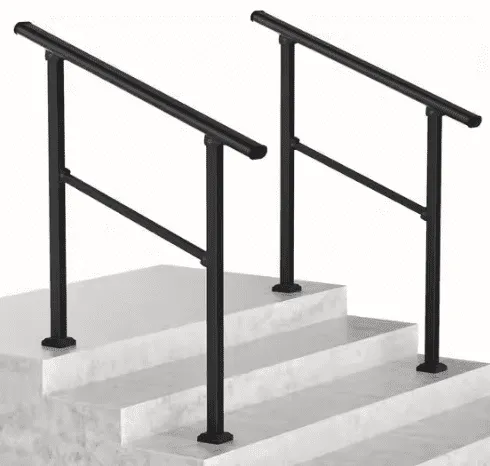
Aluminum Stair Railing Kits Remove Field Fabrication Risk
A complete kit carries precut top and bottom rails, balusters, adjustable brackets, post anchors, screws, and trim covers. The installer measures, sets the angle, and fastens components with ordinary tools. Factory cutting removes the two risks that dominate field fabrication: inconsistent rail length and damaged coating from saw cuts. Aluminum extrusions can be cut on site, but the exposed edge must be cleaned and sealed afterward. A kit that arrives at final length eliminates that step entirely. The surface treatment is applied after cutting and forming, so each component leaves the production line with the coating intact on every edge. That is why I recommend kits over loose material for most balcony, deck, and exterior stair projects.
What Makes a Kit DIY Friendly
The key distinction is not the number of parts. It is how the parts resolve the angle. A well designed kit uses slotted pivot brackets that hold the rail through the required stair pitch while the balusters stay vertical. The installer sets the angle once, tightens a hex screw, and repeats the same connection at each post. No drilling through the powder coated surface is necessary at the rail joint because the bracket carries the load. That single decision, moving the adjustment into the bracket instead of the installer, is what makes a kit repeatable for a DIY user.
Angled Stair Measurements Set the Kit Configuration
Why Rise and Run Matter More Than the Angle Alone
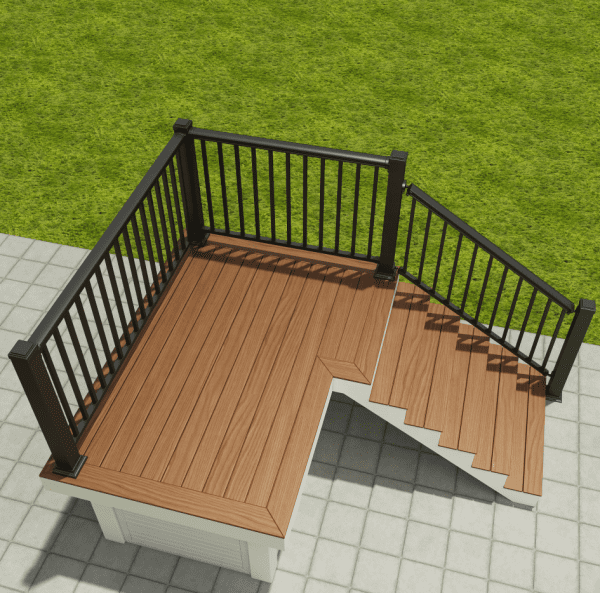
Most stair railing kit mistakes start with a single missing dimension. The angle feels straightforward until the rail length, post spacing, and landing condition interact. Measure the total rise from the lower finished floor to the upper finished floor. Measure the total run horizontally. Calculate the angle from those two numbers, or use a digital angle finder on the existing stringer. Record the distance along the stair nose from the first post center to the last post center, because that is the rail length the factory needs. Confirm the post mounting surface, whether it is concrete, wood frame, or steel, since the anchor package changes accordingly. Send all four values with the order: rise, run, rail length, and mounting surface.
| Measurement | What to verify | Common error |
|---|---|---|
| Total rise | Finished floor to finished floor | Measuring only the exposed rise |
| Total run | Horizontal distance between floor lines | Taking the stringer length instead |
| Rail length | Post center to post center along the incline | Ordering the flat floor dimension |
| Mounting surface | Wood, concrete, or steel substrate | Confirming anchors after rails are cut |
| Pitch angle | Digital reading or calculated angle | Rounding the angle to the nearest 5 degrees |
These five values let the engineering team confirm bracket angle, baluster spacing, and anchor type before anything ships.
Factory Verification Prevents Costly Rework on Angled Stairs
A dimensional mismatch shows up late: after the rails are on site, after the first post is set, and after the installer has already committed to the layout. Factory verification moves that discovery earlier. We confirm the pitch against the bracket’s adjustment range, check the cut length against the measured post centers, and verify the anchor type before production. If the stair run includes a landing, a winder, or a transition into a level balcony section, the kit configuration should be reviewed against a simple sketch. Most field rework on stair railings comes from handling those transitions as an afterthought. If your angled stair enters a landing or changes pitch partway, send the rise, run, rail length, and a photo or sketch to sales01@yulongkeji-ch.com before finalizing the order. Our engineers will return the corrected bracket angle and rail set the same day.
The Right Aluminum Stair Railing Kit Depends on Verified Measurements
Most buyers can narrow the kit selection to three variables: the stair pitch, the rail length, and the mounting substrate. Once those are confirmed, the remaining choices are finish color, infill style, and post type. A verified kit carries fewer extra parts than a loose material order because the factory pre-selects the correct bracket geometry. The most frequent reason an installation stalls is not a missing rail but a bracket set that was ordered for a different angle class. State the angle class and post centers in the inquiry, and the factory can match the product to the measured stair instead of asking the installer to adapt on site. Send your rise, run, total rail length, post configuration, and finish code to sales01@yulongkeji-ch.com or call +8619086315193. Our team at Hubei Yulong will return a complete aluminum stair railing kit configuration with matched angles, cut lengths, and mounting hardware.
Buyers Ask These Questions About Aluminum Stair Railing Kits
Can an adjustable angle kit match a very steep staircase?
Yes, provided the staircase falls inside the kit’s designed pitch range. Adjustable brackets rotate through a set arc, typically the common residential stair range, but a spiral or extremely steep utility stair may exceed that arc. For a steep run, the bracket geometry and baluster length must be confirmed together because the rail height measured along the incline changes as the pitch increases. If the angle is outside the standard range, a custom bracket set or a different post layout is often the answer rather than field drilling.
Do I need to weld or cut aluminum stair railing kit components?
This is a misconception that keeps many buyers away from aluminum railing systems. A correctly matched kit requires neither welding nor cutting. The rails arrive at final length, the brackets pivot to the measured angle, and the balusters fasten through pre-set slots or screws. The only site work is drilling post anchors and driving screws. Cutting becomes necessary only when the as-built dimensions differ from the ordered dimensions, which is why the measurement step matters more than the assembly step. In our production sequence, the metal is cut, formed, and coated before packing, so the installer never has to repair a cut edge.
How does the powder coated finish hold up on an outdoor stair?
Outdoor performance depends on exposure and edge preparation more than the coating alone. Aluminum resists red rust on its own, but the powder layer carries color and surface protection. On a shaded inland stair, a standard architectural finish performs for many years. On an oceanfront balcony or a stair in strong sun, we specify marine grade pretreatment to reduce pitting under the film. Hand contact zones may show wear, and touch up paint can conceal small chips. The structural life of the aluminum itself is why these railings remain in service long after lighter steel parts begin to corrode.
What information should I have before requesting a quote?
This is the question our engineering team prefers because it pushes the project toward a clean first round response. Bring the total rise, total run, rail length from post center to post center, mounting surface, and preferred finish. A photo of the stair and any landing transition is more useful than a long description. If you are ordering for multiple buildings or repeated stair types, group the dimensions by repeating condition rather than sending every individual measurement piecemeal. Share your measured stair values and finish preference with us at sales01@yulongkeji-ch.com or call +8619086315193 and we will confirm the kit match and pricing basis in the first reply.
If you’re interested, check out these related articles:
Wrought Iron vs Ornamental Steel Fence: Cost & Alternatives
Steel Fence Gauge: Optimal Thickness for Perimeter Security