
Salt air, pool chemicals, and direct UV combine to punish a railing faster than almost any other exterior assembly. On waterfront properties, the failure mode is rarely a broken baluster; it is corrosion at fasteners, fading at cut edges, and a barrier that no longer meets code after a few seasons. Pool deck railing code requirements are straightforward on paper, but material and coating decisions determine whether the railing still passes inspection years later. Our approach at Hubei Yulong treats code-compliant pool deck railing as a structural baseline, not a style ceiling, and that changes the specification process.
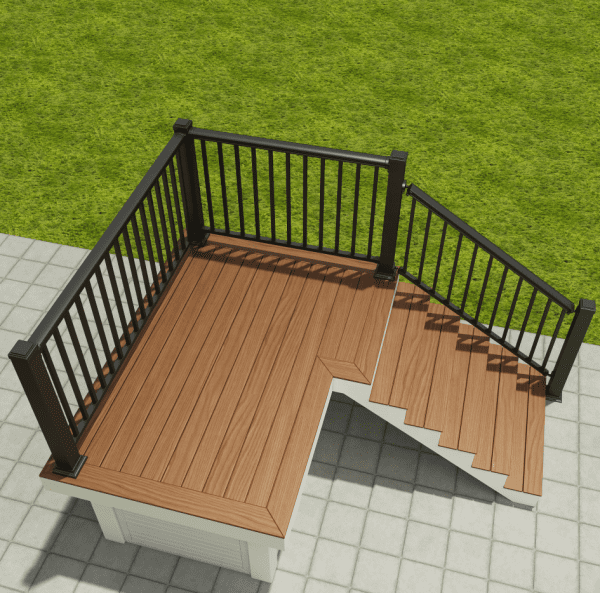
Material Choices for Waterfront Pool Deck Railing
Most standard pool deck railing discussions start with barrier height and spacing, but waterfront sites force the material decision earlier. A railing system that performs well in a suburban backyard can fail quickly where the deck is within a few hundred meters of breaking water. Salt mist settles on every surface. UV exposure stays intense. Pool splash adds chlorinated water to the same assembly. Steel with a basic wet-spray coating can show rust blooming at welds and hardware within the first year. Aluminum with a properly applied polyester or PVDF powder coating tends to resist that combination far longer because the substrate does not depend on a single paint film for its corrosion resistance. In our engineering reviews, we specify 6063-T5 or 6061-T6 aluminum profiles with stainless steel fasteners for most waterfront pool decks. The aluminum itself does not rust, and the coating is the wear layer, not the only line of defense.
This does not mean aluminum is the only choice. Heavy-duty stainless steel balusters and top rails earn their cost on commercial waterfront decks where impact resistance matters as much as corrosion resistance. The real specification line is not aluminum versus steel. It is sealed system versus field-built assembly. When holes are drilled on site and fasteners are mixed across grades, even the best base metal will show early trouble at exactly those points. We have seen stainless steel fasteners seated in aluminum without isolation washers create galvanic corrosion around the hole edges after only a few months. The fix is not a different base metal. It is a matched system with factory-finished components and isolation details at every contact point.
Code Requirements for Pool Deck Railing Height and Spacing
Pool deck railing code requirements vary by application, but the underlying safety concepts stay consistent: a guard must be high enough to prevent a fall, stiff enough to resist a concentrated load, and closed enough that a child cannot pass through or climb over. On residential decks in the US, a guard height of 36 inches is the common baseline. On commercial or public pool decks, 42 inches is more typical, and local jurisdictions may add specific barrier requirements for the pool enclosure. A pool deck railing that stands at the right height but fails the opening test is not a compliant barrier.
| Application | Minimum Guard Height | Infill Requirement |
|---|---|---|
| Residential pool deck | 36 in | 4 in sphere cannot pass |
| Commercial pool deck | 42 in | 4 in sphere cannot pass |
| Pool barrier perimeter | 48 in or local code | Non-climbable, no horizontal rails |
Local codes matter more on waterfront properties because the structure often sits on piers, elevated decks, or stepped terraces with changing floor elevations. A guard height measured from the walking surface must be maintained at every point where the surface steps down. That seems obvious, but we have reviewed deck plans where a continuous top rail was level while the deck surface dropped by six inches at a seating platform. The result was a guard that measured compliant at one end and failed at the other.
Height and Barrier Geometry for Pool Deck Railings
Residential pool deck railing height starts at 36 inches from the deck surface. When the deck serves a public pool or a commercial recreation area, the minimum guard height usually moves to 42 inches. The pool barrier itself, if it doubles as the deck guard, may need to be tested as a barrier rather than only a railing. That distinction changes baluster orientation, horizontal rail placement, and gate hardware. Asking the local authority whether the railing is also the pool barrier is the first code question, not the last.
Baluster Spacing and the Four-Inch Sphere Test
The four-inch sphere test governs most infill. A sphere four inches in diameter must not pass through any opening in the guard at any point, including at the bottom rail, posts, and gate. With cable systems, this means cables must be tensioned under a specific load and spaced so deflection under load does not create an opening wider than the allowable limit. With vertical balusters, the clear space between balusters must be measured at the widest point. We often see contract drawings call for baluster centerlines without accounting for profile width; that small difference can produce a spacing violation after installation.
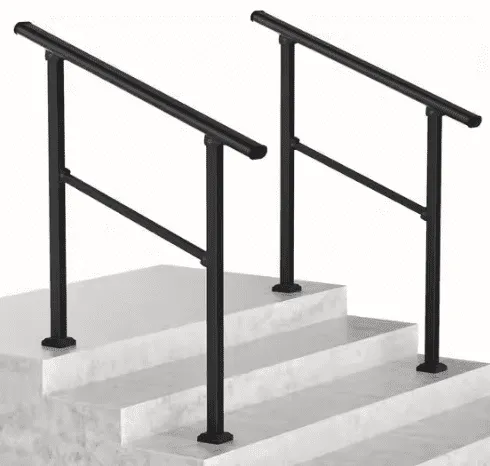
Style and Sightline Options That Keep Pool Deck Railing Safe
Waterfront owners usually ask for a railing that disappears from the view. That desire creates pressure toward glass, cable, or very thin vertical profiles. Code still applies, but the right system can meet the four-inch sphere test without turning the deck into a metal cage. Aluminum vertical bar railing with a dark powder coat reads as a light grid against water. It also gives predictable baluster spacing and does not require the same tension maintenance as cable. Framed glass panels give an uninterrupted sightline and can be specified with tempered glass, but they require more precise post anchoring because the panel acts as a large wind sail on exposed decks.
Cable Railings and Horizontal Infill on Waterfront Decks
Cable railing can work around a pool deck, but the specification must be treated as a tensioned structural system, not a visual detail. Stainless steel cable, Type 316 for salt exposure, must be tensioned high enough that lateral deflection cannot open gaps beyond code. Horizontal cables also face a stricter interpretation in some pool barrier codes because a child can climb them like a ladder. If the railing is also the pool barrier, vertical balusters or a non-climbable panel may be the safer path. When the railing is a deck guard only and the pool barrier is separate, horizontal cable becomes easier to justify.
On waterfront projects, the line between deck guard and pool barrier is where we see the most specification errors. If your deck layout includes a built-in spa, a raised pool edge, or stepped levels, it is worth confirming barrier classification before finalizing baluster orientation. Send your deck section and railing span to sales01@yulongkeji-ch.com and we can confirm the configuration that fits both the view and the local code.
Coating Strategies for Salt Air and UV Exposure
Coating is the first thing to fail on a waterfront pool deck railing, and the failure often begins before installation. Field-drilled holes, cut ends, and scratched surfaces create unprotected edges where moisture and chlorides enter. A factory-applied powder coat covers the entire profile before cutting and drilling. Once the installer drills on site, that edge protection is gone unless it is re-sealed. We specify a minimum of 60 microns of powder coat on all aluminum railing components for coastal work, and we prefer polyester or PVDF coatings over standard epoxy on exterior surfaces because they hold color longer under strong UV.
Aluminum does not rust, but it can corrode in a galvanic cell when it touches a more noble metal in the presence of salt water. Stainless steel fasteners are generally compatible with powder-coated aluminum when the coating is intact, but a scratch that exposes bare aluminum against a stainless fastener under salt spray will still produce white oxide around the contact point. We have seen this happen on coastal balcony projects where installers used stainless screws without nylon washers or isolating bushings. The visible corrosion was not a material failure of the aluminum; it was a detailing failure at the connection.
Specifying a Waterfront Pool Deck Railing System That Lasts
A waterfront pool deck railing is not a one-season decision. The wrong material or an underspecified coating shows up quickly as rust at fasteners, chalked powder coat, loose cables, or a guard that fails re-inspection. Our recommendation is to standardize on a sealed aluminum system with marine-grade stainless hardware, verify the local barrier classification, and never leave field-cut edges unsealed. If you are currently specifying or quoting a waterfront deck, send your deck elevation, required guard height, and preferred baluster profile to sales01@yulongkeji-ch.com or call +8619086315193. We can confirm wind load assumptions, powder coat specification, and the exact railing configuration before you commit to a purchase order.
Common Questions About Waterfront Pool Deck Railing
What is the safest material for a pool deck railing on a saltwater property?
Aluminum with a high-performance powder coat and Type 316 stainless hardware is the safest practical choice for most saltwater pool decks. Aluminum does not rust, and the powder coat acts as the UV and moisture wear layer. Stainless steel is also strong, but heavier and more expensive for the same visual openness. The key is not the base metal alone; it is the sealed connection detail. Any railing with unprotected field cuts or mixed hardware can corrode at the edges, so the specification should include sealed cut ends and compatible fasteners from the start.
Does a pool deck railing need to be higher than a standard deck railing?
Many people assume pool deck railings automatically require a taller guard, but the minimum height depends on occupancy. A residential pool deck guard often starts at 36 inches, the same baseline as a standard deck guard in many US jurisdictions. Commercial and public pool decks move to 42 inches. The real difference is the pool barrier requirement. If the railing also functions as the pool enclosure, extra rules for non-climbability and gate self-closing hardware may apply even if the height stays the same. Confirm whether your deck rail is also your pool barrier.
Can I use cable railing around a waterfront pool deck?
It depends on whether the cable railing is the deck guard only or also the pool barrier. As a deck guard, Type 316 stainless cable can work well around a waterfront pool deck when it is tensioned properly and spaced to pass the four-inch sphere test under load. As a pool barrier, horizontal cables often fail the non-climbable requirement because they can be climbed like a ladder. In that case, vertical balusters or a glass panel system are usually the safer route. Coastal decks should also use marine-grade hardware and sealed fittings to keep the system from losing tension or showing rust.
How much maintenance does a powder coated aluminum pool deck railing need?
In coastal projects we have watched powder coated aluminum railings stay stable for years with little more than periodic washing. The maintenance load is low, not zero. Rinse the rail every few months with fresh water to remove salt film, inspect cut ends and fasteners each spring, and touch up deep scratches with a matching coating. Do not use abrasive pads or harsh cleaners. If the system includes cable, check tension once a year. Most early corrosion traces back to skipped edge sealing. If your deck is in a high-salt zone or the railing must function as a pool barrier, share site photos at sales01@yulongkeji-ch.com and we can confirm what needs attention.
If you’re interested, check out these related articles:
Ornamental Steel Fence: Design, Quality, & Direct Pricing
Freestanding Outdoor Privacy Screens: Patio & Balcony Solutions