
Zero-formaldehyde WPC fence systems close a gap that most residential product discussions overlook: the emission risk that comes from placing treated materials in direct contact with gardens, play areas, and patios. Over twelve years of evaluating fencing specifications, I have seen a growing demand for outdoor products that meet indoor safety expectations, and the difference lies in the adhesive chemistry. Most homeowners treat a fence as a durable structure, not a chemical source, but temperature and UV exposure can accelerate off-gassing from materials that still rely on traditional bonding agents. This article explains how zero-formaldehyde wood-plastic composite is manufactured, which health risks you avoid by choosing it, and what evidence actually verifies the claim.
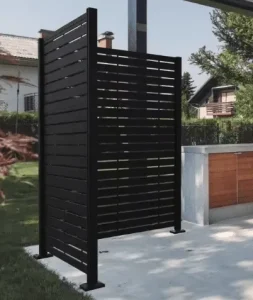
The Hidden Formaldehyde Risk in Outdoor Fencing
Formaldehyde is a common volatile organic compound used in adhesives, wood treatments, and composite binders. Indoor emission limits are well established through regulations like CARB Phase 2 and E0/E1 standards, but outdoor fencing has long been treated as if ambient airflow makes those standards irrelevant. In practice, a fence line along a garden bed or immediately adjacent to a patio is not fully ventilated at the breathing zone of a child or a seated adult. Warm days drive the release rate higher, and because formaldehyde is heavier than air, concentration can linger in sheltered spaces even outdoors.
The average homeowner does not notice the exposure because it is invisible and odor thresholds are inconsistent. More important is the cumulative effect: children playing near the fence, families eating on the deck next to it, or gardeners working close to the panels every week all spend significant time within the proximity where concentration is highest. A fence that runs along a property line for 30 meters creates a consistent source, not an occasional one. When I review material specifications for residential projects, I look at the emission certification the same way I would for a product installed in a living room—because the proximity and duration of exposure are comparable.
How Zero-Formaldehyde WPC Is Manufactured
Standard wood-plastic composite panels combine wood fiber or flour with a thermoplastic matrix, typically polyethylene or polypropylene. The formaldehyde risk comes from the binding agents used to improve adhesion between the hydrophilic wood particles and the hydrophobic plastic. Urea-formaldehyde and phenol-formaldehyde resins are economical and widely used, but they continuously release formaldehyde after production, with rates peaking in warm conditions.
Zero-formaldehyde WPC replaces those resins with alternative bonding systems. The most reliable approach is an isocyanate-based adhesive that reacts to form a stable polyurethane bond without generating formaldehyde as a byproduct. A second pathway uses co-extrusion technology where the core layer is encapsulated by a polymer-rich outer shell that physically locks the wood content and eliminates the need for emission-prone adhesives altogether. Both methods change the cost structure of the panel, but they change the exposure profile to zero. The material itself—wood fibers and recycled thermoplastics—is the same feed stock; the difference is entirely in the chemistry of how those components are held together.
From an engineering standpoint, the practical requirement is that the manufacturer maintains a supply chain that eliminates formaldehyde-containing additives at every stage. That includes the wood flour, which must not come from treated lumber, and the lubricants and processing aids used during extrusion, which can carry formaldehyde if not specified correctly. It is one thing to claim a product is eco-friendly; it is a separate discipline to prove that no emission source was introduced at any step.
How Zero-Formaldehyde WPC Compares to Treated Wood and Standard Composite
The three most common residential fence materials—pressure-treated wood, standard wood-plastic composite, and zero-formaldehyde WPC—differ not just in maintenance requirements but in what they release into the yard.
| Material | Formaldehyde Source | Long-Term Emission Profile | Cost (Relative) |
|---|---|---|---|
| Pressure-treated wood | Treatment chemicals (not always formaldehyde) | Depends on preservative type | Lowest |
| Standard WPC | Urea-formaldehyde or phenol-formaldehyde resin | Increases with heat, declines slowly over years | Mid |
| Zero-formaldehyde WPC | None, by design | No emission after initial off-gassing of processing oils | Higher |
Pressure-treated wood is the baseline cost option, but the chemicals infused into the cellulose—while often effective against rot and insects—introduce a different exposure concern. Some modern treatments are copper-based and avoid formaldehyde, but many consumers cannot distinguish them at the point of purchase.
Standard WPC carries the emission risk I described earlier, and the rate is not constant. A panel in full afternoon sun can reach surface temperatures above 60°C in summer; at that temperature, formaldehyde release from a urea-formaldehyde bonded composite increases significantly. The decay curve is gentle, meaning the panel still emits measurable formaldehyde several years after installation, just at a lower rate.
Zero-formaldehyde WPC eliminates that curve entirely. There is no residual formaldehyde to release at any temperature. The upfront material cost is usually 15–25% higher than standard WPC, but over a 15–20 year fence life the per-year premium is negligible when you factor in zero emission risk and equivalent durability. These panels typically use a capped co-extrusion that also improves stain resistance and UV color stability, so the investment is partly an emission decision and partly a longevity one.
If your residential project involves a long fence line that encloses a frequently used garden or pool area, it is worth confirming the specific bonding chemistry of the WPC you are considering. A quick email to sales01@yulongkeji-ch.com with the product specification can make the difference between an assumption of safety and a documented choice.
Certifications That Prove a WPC Fence Is Formaldehyde-Free
A manufacturer’s word is the weakest form of verification. The only reliable evidence is a third-party test report that measures formaldehyde emission under a recognized standard, and the standard matters because test conditions affect results.
For wood-based panels, the most referenced standards are the European E0 classification (≤0.5 mg/L) and the Japanese F★★★★ rating (≤0.3 mg/L). These apply primarily to interior products, but they are the best benchmarks available for composite fence panels because no dedicated outdoor emission standard exists that accounts for the full temperature range. A WPC panel that meets E0 at room temperature may still emit at a higher rate when hot, but a panel that registers undetectable levels at 25°C is inherently safer than one that just meets the E1 threshold.
Look for a test report that specifies the chamber method (EN 717-1 or ASTM D6007) and the formaldehyde concentration in mg/m³, not just a pass/fail certificate. A serious manufacturer will submit samples for testing at more than one temperature, and they will provide the actual measured value, not a compliance confirmation. I have seen certificates that simply state “E0 compliant” without showing the test result, and that is not sufficient. A numeric result below 0.01 mg/m³ gives confidence; a certificate that omits the number does not.
Additional credibility comes from factory quality system certifications like ISO 14001 or ISO 9001, which indicate process control rather than product performance, but together with the emission test they form a coherent evidence package. When I assess supplier documentation for clients, I treat any emission claim that lacks a specific test report as unverified, regardless of how many assurance sentences accompany it.
Why Zero-Formaldehyde WPC Holds Value Over a Decade and Beyond
A fence is one of the few residential improvements that stays in contact with people at ground level for decades. Painting or sealing a wooden fence every few years is a recurring cost and a recurring chemical exposure during application. Standard WPC reduces the maintenance cycle but adds a passive emission profile that the homeowner may not know to evaluate.
Zero-formaldehyde WPC offers a simpler total cost of ownership because there are no ongoing treatments required and no chemical off-gassing to factor into family health decisions. The polymer cap layer resists fading, so the color stays stable without repainting, and the material does not splinter or rot in ground contact. From a structural perspective, the co-extruded shell also protects the wood fiber core from moisture cycling, which is the primary cause of warping and cracking in lower-grade composites.
The real value shows up at the point of sale. When a prospective home buyer notices a fence that looks new after ten years and the seller can point to a formaldehyde-free test report, that documentation becomes part of the property’s health and maintenance narrative. It is a small detail in a real estate transaction, but it is exactly the kind of detail that shifts buyer confidence in a competitive market.
What Homeowners Often Ask About Zero-Formaldehyde WPC Fencing
Is zero-formaldehyde WPC fence really necessary for outdoor use when ventilation is high?
The ventilation assumption breaks down in common residential layouts. A fence that runs along a narrow side yard, encloses a courtyard, or sits directly beside a raised vegetable bed does not benefit from unlimited airflow. The concentration at a child’s height close to the panel surface can be meaningfully higher than ambient levels, and because exposure is daily and seasonal, the cumulative dose matters. A material that emits nothing removes that variable entirely.
Does zero-formaldehyde WPC cost significantly more than standard composite?
The per-linear-foot premium typically ranges from 15% to 25% depending on the profile and cap thickness. For a 50-linear-foot fence project, the additional cost might amount to a few hundred dollars spread across a 15-year lifespan. When you deduct the avoided cost of sealers, stains, and the time spent on annual maintenance, the difference shrinks further. I have rarely seen a case where the health benefit was not worth the incremental cost for a family with children or a household that gardens intensively along the fence line.
Can a zero-formaldehyde WPC fence still emit other VOCs from the plastic content?
The polyethylene or polypropylene used in WPC is inherently low-VOC, and in the absence of formaldehyde-based adhesives, the remaining volatile compounds are trace processing aids that off-gas almost completely during the first few weeks after extrusion. A well-manufactured panel typically reaches negligible VOC levels within a month of outdoor exposure. If you are concerned about a specific product, the manufacturer should be able to provide a full VOC emission test, not only a formaldehyde measurement. In my experience, we have seen consistently clean profiles from extrusion lines that run dedicated zero-formaldehyde recipes and purge the equipment between batches.
How do I verify that the zero-formaldehyde claim from a manufacturer is genuine?
Request the full test report, not a summary certificate, and check two things: the standard used (EN 717-1 or ASTM D6007 are acceptable) and the numeric emission result expressed as mg/m³ or mg/L. A result below 0.01 mg/m³ is effectively zero for practical purposes. Confirm that the test was performed on the same product specification you are ordering, not on a different formulation. If the manufacturer cannot provide a test report from an ISO 17025-accredited laboratory, treat the claim as marketing until proven otherwise. If your supplier offers you documentation that seems ambiguous, sending the spec sheet to sales01@yulongkeji-ch.com for a technical review can help you avoid importing a product that fails the standard.
Securing a Fence Investment That Protects More Than Boundaries
A zero-formaldehyde WPC fence does not announce itself visually; it looks like any well-made composite panel. The difference is in what it does not release into the places where your family spends time. After more than a decade of reviewing material specifications for residential projects, I recognize that the most valuable engineering decisions are often the invisible ones. Choosing a fence system that carries an accredited formaldehyde-free test report is one of those decisions.
If you are sourcing WPC fencing for a residential project and need to confirm zero-formaldehyde compliance before ordering, our team at Hubei Yulong can provide third-party test documentation and help you match the right panel configuration to your site conditions. Send your requirements and preferred dimensions to sales01@yulongkeji-ch.com or call +8619086315193 for a direct technical discussion. We will confirm the chemistry, not just the catalog description, so your investment starts with documented safety rather than a guess.
If you’re interested, check out these related articles:
Aluminum vs Wood Fence: Cost, Care, and Lifespan Compared
Wholesale Steel Garden Fence Panels: Distributor Pricing & Supply
Freestanding Outdoor Privacy Screens: Patio & Balcony Solutions