
In creating comfortable outdoor dining environments, restaurant owners face a double challenge: they need to shield guests from street-level distractions and passersby while keeping the open-air atmosphere that makes patio dining attractive. Aluminum blade fence systems answer that challenge by giving you control over sight-line privacy without sealing the space off. After working through multiple commercial fencing projects, I’ve seen how blade angle, post placement, and material choice directly determine whether a dining zone feels sheltered and welcoming or closed-in and heavy. Getting those three variables right makes the difference.
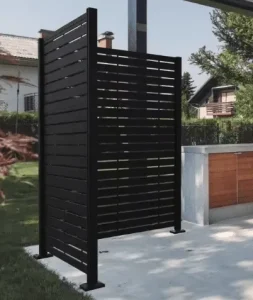
Why Restaurants Turn to Blade Fencing for Patio Privacy
Restaurant patios sit at the intersection of public street life and private guest experience. The fence has to do more than mark a boundary. It needs to filter out sidewalk traffic, reduce wind gusts that scatter napkins and chill food, and define the restaurant’s curb appeal, all while allowing enough transparency that the space doesn’t feel caged. Blade fencing achieves this by using vertical or horizontal airfoil-section blades set at a chosen angle inside a robust aluminum frame. When angled toward the street, the blades block sight lines from outside while still letting light and air pass through. The result is a physical privacy screen that doesn’t become a wind barrier or a visual wall. For restaurants in dense urban streets or strip mall settings where tables sit close to parking lots, that balance of enclosure and openness is often exactly what they need.
From a design standpoint, blade fence panels also offer the clean architectural lines that match modern restaurant facades much better than chain link or masonry walls. They accept the same high-durability powder coating we use on our standard aluminum railing systems, so colors can be matched to brand identity or local planning requirements without extra painting down the road.
How Blade Angle and Spacing Control Privacy, Light, and Air Movement
The core working principle in a blade fence is simple: altering blade tilt and the gap between blades determines what the diner sees and what air can do. I usually walk project managers through three broad setups.
| Blade Angle | Privacy Level | Airflow | Typical Light Transmission |
|---|---|---|---|
| 15°–30° | Low – passersby see through | High – wind passes easily | 80–90% |
| 45° | Medium – seated guests are screened | Moderate – wind slowed but not blocked | 60–70% |
| 75°–90° | High – near solid visual block | Low – acts as partial windbreak | 40–50% |
At 45 degrees, a person standing at the sidewalk sees oblong gaps between the blades, but seated guests at standard table height are effectively behind the wider face of each blade. This angle works well for most mid-block patios where the primary concern is visual privacy rather than wind. If the location catches crosswinds, pushing toward 60 to 75 degrees reduces wind through the fence while keeping sound and air movement from deadening entirely. Nobody enjoys eating in a still pocket of trapped heat, so I advise keeping at least 15 to 20 millimeters of air slot open even on high-privacy installations. Blade spacing below 10 millimeters between profiles starts to turn the fence into a wall, and that can create nuisance whistling in certain wind conditions.
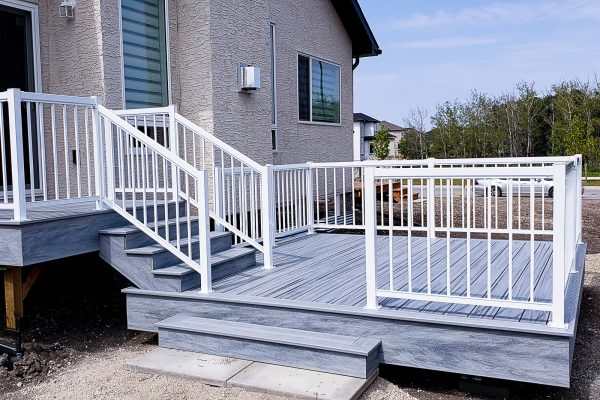
For spray from passing traffic or water runoff from adjacent buildings, the blade profile itself matters. A true airfoil shape with a drip edge at the lower lip directs water downward into the channel, away from the dining area. Flat-blade panels without that lip can allow water to track backward onto the patio surface. In restaurant applications where tables will be close to the fence line, this detail is worth confirming in the panel specification sheet.
Aluminum vs Steel Blade Fences for Commercial Food Service Environments
Both aluminum and galvanized steel can carry the blade design, but the operating realities of a restaurant shift the decision strongly toward aluminum. Kitchens, drink service, and outdoor cleaning all introduce moisture and mild acids, vinegar from salad dressing, citrus from cocktails, detergents from power washing, against the fence on a daily basis. Galvanized steel, while strong, requires a fully intact powder coat to resist that exposure over years. Any scratch or fastener penetration that reaches the zinc layer will eventually show red rust, especially in humid or coastal locations.
Aluminum does not rust. Its natural oxide layer reforms in milliseconds if the surface is scratched, so minor damage from chair backs, serving carts, or general wear doesn’t become a corrosion starting point. From a structural standpoint, 6063-T5 aluminum extrusions provide enough section strength for fence panels up to 2.2 meters in height, which covers most restaurant patio height limits. Only when you need unsupported spans beyond 2.5 meters in high-wind coastal zones might steel offer an advantage, and even then, a thicker aluminum post section usually resolves it without switching materials.
Weight also affects installation cost. An aluminum blade panel assembly weighs roughly 40 percent less than an equivalent steel unit, which means lighter handling, fewer personnel needed on-site, and simpler anchoring into wooden deck structures or concrete pavers. That directly lowers the total installed cost even if the material price per linear meter is somewhat higher.
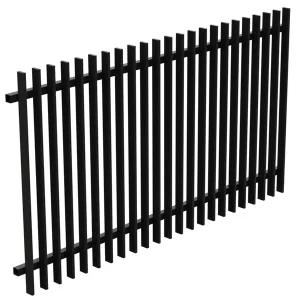
If the project is on a rooftop or a seaside promenade where wind speed regularly exceeds 35 kilometers per hour, it is worth confirming the blade profile and post schedule with the manufacturer before finalizing the layout. Reach us at sales01@yulongkeji-ch.com with your site location and target panel height, and we can run the wind load check against our section data.
Installation Planning for Restaurant Blade Fencing
Restaurant patios rarely follow a clean, empty rectangle. They wrap around existing columns, step up onto raised decking, or integrate with service gates that kitchen staff use throughout the day. Planning post positions around those constraints, not just the panel dimensions, determines how smoothly the install goes. I recommend marking all underground utilities and drainage lines before locking in post centres. Driving a post footing into a shared sewer lateral or a main electrical conduit can shut down service longer than any fence delay, and repair costs in commercial zones escalate quickly.
For deck-mounted patios, surface-mount post bases with through-bolts and backing plates distribute wind load without cutting into waterproofing membranes, which is usually preferred by building owners. Where the fence sits on grade, embedded post footings at 600 to 800 millimeters depth into a concrete pier provide the lateral resistance needed for tall blade panels. The exact depth depends on soil type and frost line, so pulling a local geotechnical report for the specific address is the right move, not assuming a generic depth.
Gate integration also needs early attention. A single-leaf service gate should match the fence panel height and blade style so the perimeter reads as continuous, but the frame wall thickness must increase to carry the hinge loads without sagging. We typically upgrade the gate stile from the standard panel frame profile to a heavier 3-millimeter wall extrusion with welded corner reinforcements for any gate above 1 meter in width.
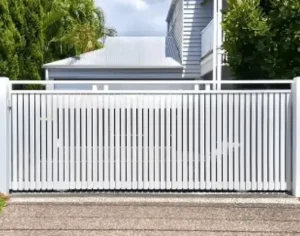
Specifying a Blade Fence System That Meets Local Wind and Safety Codes
Municipalities increasingly require engineered wind load calculations and structural sign-off for commercial outdoor structures, especially on rooftop terraces and raised platforms. A blade fence acts as a partially porous barrier, so wind loading isn’t the same as a solid wall, but it’s not zero either. The code official will want to see a design wind speed derived from the local building code, usually ASCE 7 in North America or the corresponding Eurocode in Europe, applied to the projected solid area of the fence. I have seen project approvals held up simply because the submitted drawings used a solid-wall wind pressure instead of the adjusted porous load, which led to oversized footings that the structural reviewer questioned.
The blade angle and spacing determined in the design phase now reappear as numbers in the wind calculation: a 45-degree blade with 25-millimeter air slot has a different solidity ratio than a 75-degree blade with 10-millimeter slot. When we prepare a project-specific shop drawing for a restaurant order, we include that calculation along with post size, embedment depth, and concrete pier dimensions. Having the full package ready for the local engineer’s review typically cuts one to two rounds of back-and-forth off the permitting timeline.
Handrail loading where the fence sits within 1.5 meters of a stepped surface also falls under commercial guardrail requirements, often 0.74 kilonewtons per meter of concentrated load at the top. Blade fence panels originally designed as privacy screens do not always meet that top-rail push load without a continuous structural top cap. If the patio has any elevation change, confirm early whether guardrail loading applies and specify the reinforced top rail version.
For restaurant owners managing tight project timelines, ordering a custom blade fence system that arrives pre-assembled with all posts, brackets, and fasteners in one shipment reduces the coordination work and keeps the site schedule predictable. Send your patio dimensions and your preferred blade finish to sales01@yulongkeji-ch.com, and we will provide a quotation with lead time. You can also call +8619086315193 to walk through the specification step by step.
Common Questions About Aluminum Blade Fencing for Restaurants
Can blade fence panels be cut to fit an irregular site layout?
Cutting on-site is possible with a carbide-tipped blade and a steady guide track, but I prefer to factory-precut panels to the exact widths shown on the site survey. Factory cuts produce clean, square ends with the cut edge fully sealed by the original powder coating, whereas field cuts expose raw aluminum that will oxidize and leave a visible line if not touched up carefully. For sites with complex angles, sending a detailed measured sketch to the factory and receiving shop-cut panels with matching touch-up paint bottles usually works out more cleanly than field modifications.
What powder coating colors are available for restaurant blade fences?
We run standard RAL and anodized-look finishes, with custom color matching available for orders meeting the minimum batch quantity. Black and dark bronze are the most popular choices for restaurant patios because they hold their appearance through multiple seasons and don’t compete visually with signage or landscaping. Light colors like white or silver show road film and fingerprints more readily, so they require more frequent cleaning to maintain the same look. If your restaurant brand uses a specific Pantone or RAL reference, share that with us and we will confirm whether it falls within our powder supplier’s standard range or requires a custom batch.
How does blade fencing compare to glass windscreens in a restaurant setting?
Glass panels give an uninterrupted view and excellent wind blocking, but they demand near-daily cleaning to keep up with fingerprints, rain spots, and kitchen exhaust residue. Aluminum blade fences hide that accumulation much better and clean with a simple pressure wash every few weeks. Glass also reflects sound back into the dining area, whereas the air gaps in a blade panel allow some acoustic energy to pass through, which often produces a more natural-feeling ambient environment. For restaurants where the view beyond is not the main draw and where lower maintenance equates to lower operating cost, blade fencing almost always wins on total cost of ownership.
What is the typical lead time for a custom blade fence order?
Standard panel sizes with popular finishes ship within four to six weeks from drawing approval. Full custom projects that involve non-standard blade profiles, custom color batches, or complex gate configurations typically add two to three weeks to that timeline. Freight transit time to the destination port varies by region. To lock in a calendar spot and avoid delays during peak spring construction season, sending your rough dimensions early is the simplest way to keep everything on track. If you have a hard opening date, share your timeline with us and we will confirm what production and shipping slot can meet it.
If you’re interested, check out these related articles:
Decorative Aluminum Gate Panels: Modern Home Design Solutions
Steel Pool Fence Codes: Essential Safety & Supplier Selection Guide
Source Steel Fencing from China: An Expert Import Guide
Custom Chain Link Fence: Gauges, Heights, Gates & Bulk Guide
Steel Fence Coating: Epoxy, Polyester, PVC for Longevity