
Importers who skip the weight calculation step when sourcing aluminum fencing often discover that a cheaper per-unit price does not mean a lower landed cost. Panel weight determines how many units fit into a container and what the freight charge comes to, and those two numbers can swing a project budget by several thousand dollars. Aluminum fence panel weight varies considerably across panel styles, heights, and alloy grades, and knowing the real figures before you commit to an order separates accurate cost forecasting from expensive guesswork. I have seen too many buyers focus entirely on the ex-works price, only to find their freight bill erased every dollar they thought they saved.
How Much Do Aluminum Fence Panels Actually Weigh
Aluminum fence panels are lighter than steel, but the word “lighter” does not help a procurement manager who needs to calculate a container load. Actual weights depend on the extrusion profile, the alloy specification, the panel dimensions, and whether the panel is assembled or welded.
A standard residential aluminum fence panel measuring 6 feet wide by 4 feet tall typically weighs between 18 and 28 pounds. Commercial grade panels of the same dimensions but with thicker extrusions and additional horizontal rails can reach 35 to 45 pounds. The difference comes down to wall thickness and profile complexity. A basic two-rail panel with hollow pickets weighs far less than a four-rail panel with solid infill bars and a welded frame.
The alloy grade matters here too. Most outdoor aluminum fencing uses 6063-T5 or 6063-T6 alloy, which offers a good balance of extrudability, strength, and weight. Some manufacturers use 6061 alloy for heavy duty applications, and while 6061 is stronger, the density difference between 6061 and 6063 is negligible for shipping weight calculations. The real weight drivers are the extrusion profile design and the wall thickness, not the alloy number.
Weight Per Panel by Style and Size
Different fence styles produce very different weight profiles, and a buyer who assumes all aluminum panels weigh roughly the same will be wrong by a margin that matters.
| Panel Style | Typical Weight (6ft × 4ft) | Weight Driver |
|---|---|---|
| Two-rail residential | 18–24 lb | Hollow pickets, minimal rails |
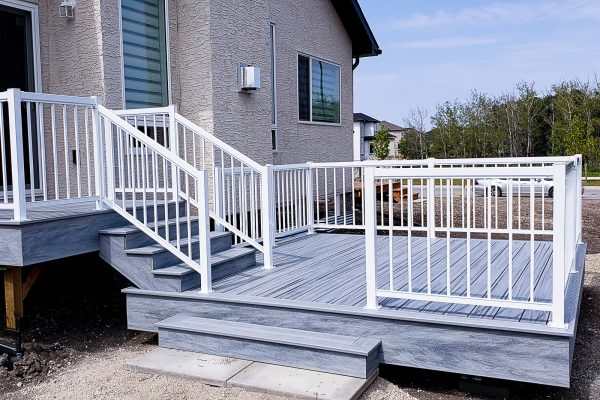
| Three-rail ornamental | 25–35 lb | Additional rail, thicker pickets |
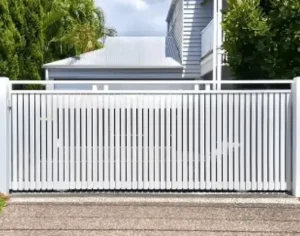
| Vertical slat privacy | 40–55 lb | Solid slats, full coverage |
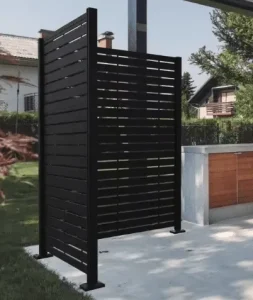
| Blade/louvered panel | 30–45 lb | Angled blades, frame weight |
| Welded security panel | 35–50 lb | Reinforced frame, thicker sections |
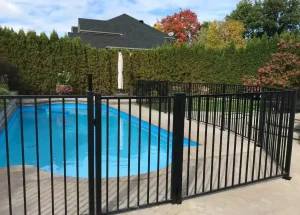
| Pool code panel | 22–30 lb | Narrow picket spacing, mid-rail |
Height changes the weight almost linearly. An 8 foot tall panel of the same style and width will weigh roughly 60 to 70 percent more than its 4 foot counterpart because every vertical member grows longer and the frame extends. Width matters too, though most standard panels are manufactured in 6 foot widths. Custom widths up to 8 feet are available, and these naturally push the per-panel weight higher.
Gates complicate the weight picture further. A single walk gate in aluminum may weigh 30 to 50 pounds, but a double driveway gate with welded frame, infill panels, and hardware can weigh 120 to 180 pounds per leaf. When calculating a mixed container order that includes gates, the heavy items pull the average per-unit weight up quickly. Plan the container load with gates distributed across the floor and lighter panels stacked above them.
How Panel Weight Affects Container Capacity and Freight Cost
Freight cost on international shipments is driven by two constraints: weight and volume. For aluminum fencing, volume almost always limits the container before weight does, but weight still matters because it determines how the freight forwarder classifies the shipment and what rate tier applies.
A 20 foot container can hold roughly 22,000 to 24,000 pounds of cargo before hitting weight limits, but aluminum fencing products will fill the container’s volume long before reaching that threshold. A typical 20 foot container loaded with aluminum fence panels holds between 400 and 600 panels depending on panel thickness and packaging configuration. At an average panel weight of 30 pounds, 500 panels weigh 15,000 pounds, well within the container’s weight capacity.
Where weight becomes a real line item is in less than container load shipments and in regions where inland trucking charges are calculated by weight. A shipment of 100 panels at 30 pounds each travels at 3,000 pounds. The same number of steel panels would weigh close to 7,500 pounds, more than doubling the inland freight cost in markets where trucking rates are weight based.
For full container loads, the panel weight per unit determines how many panels fit before the container reaches either its volume or weight limit. Aluminum’s advantage is that the volume limit is almost always the binding constraint, meaning every cubic foot of container space can be used. With heavier steel panels, some container loads hit the weight ceiling before the container is full, leaving wasted space and raising the per-unit shipping cost.
If your program involves mixed fencing materials or non-standard panel dimensions, it is worth confirming the container loading layout with the manufacturer before finalizing your bill of materials. Send your part numbers and quantities to sales01@yulongkeji-ch.com and we will model the container configuration.
Aluminum vs Steel: The Real Weight and Shipping Cost Difference
The density of aluminum is roughly one third that of steel, and this ratio carries through to fence panel weights with surprising consistency. A steel panel of identical dimensions to an aluminum panel will weigh approximately three times as much, though the actual ratio varies slightly depending on the steel gauge and the aluminum extrusion profile.
Consider a practical comparison. A three-rail ornamental aluminum fence panel at 6 feet by 5 feet weighs about 30 pounds. The equivalent panel in galvanized steel with similar aesthetic proportions weighs 80 to 90 pounds. For an order of 400 panels, the aluminum shipment weighs 12,000 pounds while the steel shipment weighs 34,000 pounds. Both fit in a 20 foot container by volume, but the steel load pushes against the container’s weight limit.
| Factor | Aluminum Panel (30 lb avg) | Steel Panel (85 lb avg) |
|---|---|---|
| Weight per 500 panels | 15,000 lb | 42,500 lb |
| 20ft container fit | 500–550 panels | 280–300 panels (weight-limited) |
| Approx. sea freight to USWC | $2,800–$3,500 | $3,500–$4,500 |
| Inland trucking surcharge | None typically | Possible overweight fees |
The cost difference grows when inland transportation enters the calculation. A flatbed truck carrying aluminum panels rarely triggers weight surcharges. The same truck loaded with steel panels may require overweight permits or a second truck depending on the order size and the destination state’s axle weight limits. These costs do not appear on the supplier’s invoice, but they show up on the freight forwarder’s bill and the customs broker’s entry summary.
Powder coating adds a marginal weight to each panel, typically less than half a pound per panel for standard architectural finishes. Hot dip galvanizing on steel panels adds more, roughly 3 to 5 percent of the base steel weight, further widening the shipping weight gap between aluminum and steel.
How to Optimize Your Order for Lower Shipping Costs
Panel weight cannot be changed after the product is manufactured, but the order configuration and packaging choices made before production starts can reduce the per-unit freight cost significantly.
Packaging density is the first lever. Panels packed flat and nested together with protective interleaving occupy less volume than panels packed individually in cartons. Every inch of container height saved allows another layer of panels. The best export packaging uses palletized stacks with custom steel frames that prevent movement during transit while keeping the stack profile as compact as possible.
Mixed container loads are the second lever. If your project requires both lightweight residential panels and heavier commercial panels or gates, the loading plan should balance the heavy items across the container floor with lighter items stacked above. An unbalanced load where all heavy items sit on one side of the container creates stability problems and may force the freight forwarder to refuse the load or charge a reworking fee.
Order quantity matters for per-unit freight cost in ways that are not obvious from the unit price alone. A full 20 foot container order amortizes the fixed costs of customs clearance, port charges, and documentation across more panels than a partial load. The difference between ordering 400 panels and 500 panels may add only 25 percent to the product invoice but spread the same roughly $1,200 in fixed destination charges across more units, lowering the per-panel landed cost.
Panel dimensions that match standard container widths eliminate wasted space. A 20 foot container has an internal width of approximately 7.7 feet. Panels designed at 6 feet wide leave almost 2 feet of dead space across the container width unless the loading plan uses that space for posts, gate leaves, or accessory cartons. Some manufacturers offer panels in 7.5 foot widths specifically to maximize container fill, and for large orders this dimension change can increase the per-container panel count by 15 to 20 percent.
When you are ready to calculate your order’s shipping weight and container configuration, share your panel specifications and quantities. Reach Zhang Wei and the engineering team at +8619086315193 or sales01@yulongkeji-ch.com with your project requirements, and we will provide a weight breakdown and container loading estimate before you commit to production.
Common Questions About Aluminum Panel Weight and Shipping
How accurate are manufacturer panel weights before production?
Panel weights quoted before production are calculated from the extrusion profile, alloy density, and cut length. For standard profiles with known sections, these calculations are typically within 5 percent of the actual finished panel weight. Powder coating adds a negligible amount. The largest variable is the gate and post hardware package, which can add 3 to 8 pounds per assembly depending on the hinge and latch specification.
Does thicker aluminum always mean better quality?
Not in a straightforward way. Wall thickness contributes to stiffness and impact resistance, but the extrusion profile design matters more than raw thickness for structural performance. A well-engineered profile at 1.8 mm wall thickness can outperform a basic profile at 2.5 mm. For shipping cost purposes, every millimeter of wall thickness adds weight without necessarily adding proportional strength unless the profile is designed to use the material efficiently.
Can I reduce shipping costs by ordering panels unassembled?
Yes, and this is a standard practice for large volume importers. Knock-down panels packed flat reduce the packaged volume by 30 to 50 percent compared to assembled panels depending on the style. The trade-off is assembly labor at the destination, and the savings need to exceed the local labor cost to make sense. For ornamental styles with multiple pickets and rails, knock-down shipping almost always wins on total landed cost when local assembly labor runs under $25 per hour.
What is the lightest aluminum fence option for the lowest shipping cost?
Two-rail residential panels with hollow pickets and minimal infill produce the lowest per-panel weight, typically 16 to 22 pounds for a 6 foot by 4 foot panel. However, the lightest panel is not always the best value. Thinner extrusions save weight but reduce the panel’s wind load resistance and long term rigidity. For most projects, the weight sweet spot is a panel with a proven extrusion profile that meets the structural requirements of the site rather than the absolute minimum weight option. Share your wind load and code requirements at sales01@yulongkeji-ch.com and we will match the panel specification to both your structural needs and your shipping budget.
If you’re interested, check out these related articles:
Decorative Aluminum Gate Panels: Modern Home Design Solutions
Source Steel Fencing from China: An Expert Import Guide