
When a distributor commits to a container-load order for aluminum panel fencing, the difference between a smooth project rollout and a logistical tangle rarely comes down to the product catalog. It comes down to how the factory handles the invisible part of the order: the engineering checks, the batch sequencing, and the documentation that keeps a distributor’s receiving team from having to solve puzzles on their end. Over twelve years of managing aluminum and steel fencing projects, I have seen that the factories which treat large orders as a separate production discipline, rather than just a bigger version of a small order, are the ones distributors stick with. At YLOONG, that distinction is built into how we plan, not something we improvise under pressure.
How Large Volume Panel Fence Orders Are Structured from the Start
A single large order is not one giant production run bolted together. It breaks into logical segments that allow for parallel processing. When I receive a bulk aluminum panel fence PO, the first thing we map is which panel configurations repeat and which are unique. An order might contain 200 residential privacy panels at 1.8 meters, another 150 at 1.2 meters for a different area, and 50 custom-width panels for gate infills. These groups become distinct production batches, each with its own extrusion schedule, surface treatment batch, and assembly routing.
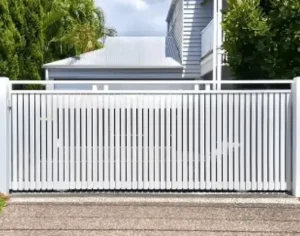
The benefit of this segmentation is not speed alone. It prevents cross-contamination of profiles at the assembly station, which is the most common cause of mismatched hardware in mixed-panel shipments. For a distributor, this means pallet B-12 contains exactly the panel configuration listed on the packing list, and B-13 contains something different but equally well-documented.
How Our Extrusion and Coating Lines Scale for Bulk Orders
The throughput constraint in aluminum panel fencing is rarely the raw material. It is the coating line, where every frame and slat must pass through pretreatment, drying, powder application, and curing in a continuous sequence. With an automated electrostatic powder coating line, we can maintain consistent film thickness across thousands of meters of aluminum profile because the line speed, gun voltage, and oven temperature are digitally controlled, not dependent on operator feel.
A distributor who has received panels with thin or uneven coating, especially at edges, knows what inconsistent application looks like. It is usually a sign of manual spraying where the operator compensated for a backlog by speeding through the rack. Our process locks those parameters for each job. For a high-volume order, we batch profiles by geometry so the powder cloud wraps uniformly. A 100 mm slat and a 40 mm rail do not go through the booth together, even if they share the same color code.
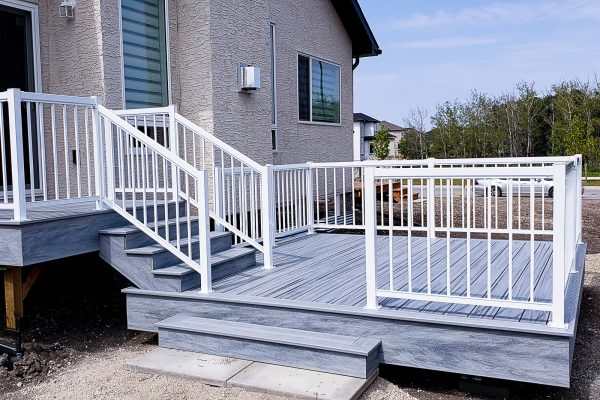
We also do something that engineers notice: for orders exceeding 500 panels, we pull coated samples at the start, middle, and end of the run for film thickness measurement and a cross-hatch adhesion test. If a mid-run sample starts drifting, we stop and correct, rather than coating the remaining 300 panels with a substandard finish and hoping the distributor does not catch it. These physical test records are available to the customer upon request, not just the standard certificates.
Quality Control Gates That Catch Problems Before Palletizing
Large orders magnify small problems. A single die that starts creating a 0.3 mm dimensional drift can turn into 300 panels that do not sit flush in their posts. Catching that is the job of multiple QC gates, not just a final visual glance.
Every new profile run gets a first-piece dimensional check against the engineering drawing. Slat width, rail wall thickness, and punch-hole positions are measured, and no production continues until the first piece is signed off. During assembly, every 50th panel goes through a full dimensional check again. It sounds excessive until you recall that a 0.5 mm variance in slat slot width changes the force needed to insert the slat, and a distributor’s installation crew will feel that as inconsistent assembly effort across pallets.
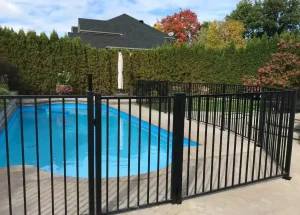
Welded gate frames go through a separate gate: each weld joint is visually inspected and a sample from each batch is cut for cross-section evaluation. The internal weld bead matters because a porous weld creates a moisture ingress point that will blister the powder coating within months, not years. On a residential gate that sits in a garden, it is an annoyance. On a 50-piece gate order for a commercial development, it is a liability.
If your program involves gates mixed with panels in the same container, it is worth confirming whether the factory separates the gate QC flow from the panel QC flow. They are different disciplines and sharing a single inspector usually means gates get panel-level scrutiny, which is not enough.
Packaging and Loading for an Unscathed Arrival
The best fence panel means nothing if it arrives looking like it has been through a demolition exercise. Panel-on-panel abrasion is the most common shipping damage for aluminum slat and blade fence panels, and it is almost entirely preventable with the right separator strategy inside the crate.
For panel fence orders, we use a combination of EPE foam sheet between panels, reinforced steel edge protectors, and fumigated plywood crating that is built to the exact pallet footprint. The crates are not standard sizes. For an order with multiple panel heights, taller panel bundles get heavier cross-bracing because the leverage on a tall, narrow crate during forklift handling is higher than a short, squat one. Many container damage claims originate from a mismatch: the crate was strong enough for the weight but not the aspect ratio.
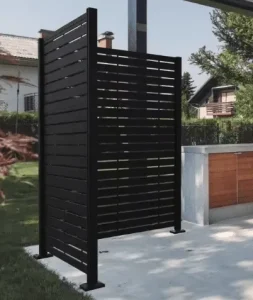
Loading sequence inside the container matters as well. Heavy items, like post bundles and gate frames, go in first and are blocked and braced. Panel crates follow, and we ensure no crate overhangs its pallet by more than a margin we have tested against container wall flex. Finally, the loading process is photographed at key stages and the photos are included in the shipping document package. This gives the distributor’s logistics team visual evidence of condition at loading, which simplifies insurance claims if a container ever gets rough handling at sea.
What Information to Send When You Order
Speed in processing a large panel fence order depends heavily on the completeness of the initial inquiry. A one-line email asking for “a container of aluminum slat fence” starts a chain of clarification emails that can take a week. A thorough spec would list the panel style or a drawing reference, height and width for each variant, post size and anchoring preference, color code, gate dimensions and swing direction, and the preferred shipment mode. It helps to include the destination port and whether the order is under a particular project specification.
The table below shows the typical lead time impact for different order states.
| Request Quality | Lead Time Impact | Notes |
|---|---|---|
| Complete drawing & BOM attached | Baseline 15 to 25 days | Design review is immediate and production planning starts within a day |
| Clear written spec without drawings | Plus 2 to 4 days | Our team creates the shop drawings for customer approval before production, and revisions add time |
| Partial spec with missing dimensions, color, or post preference | Plus 5 to 10 days | Multiple clarification rounds and revised quotations required |
| Standard product selection from our catalog | Baseline 15 to 20 days | Some standard configurations are kept in semi-finished inventory and can ship faster |
We have designed the engineering and QC workflow so that what many factories treat as a large order exception is a standard production discipline. That impacts timeline reliability for a distributor’s own project commitments.
Common Questions About Large Volume Fence Panel Production
Can I mix slat, blade, and screen fence panels in the same container?
You can, and we do it regularly. The production challenge is not the mixing, it is keeping the coating batch the same across panel types if color consistency matters. When we receive a mixed order, we plan the coating sequence so all components from the same color family, regardless of panel type, go through the powder line as a continuous group. For extreme color-sensitive projects, request a bonded sample before production starts.
How do you maintain consistent color across a batch of 1000 black panels?
Color drift usually comes from two sources: powder lot variation and curing oven temperature fluctuation. We require our powder supplier to certify each lot’s colorimetric values, and we keep one production run to one powder lot whenever practical. On the line, the oven zone temperatures are continuously logged, and the data for each production shift is attached to the batch record. For a 1000-panel order, the realistic color match between the first and last panel is within a Delta E of 0.8, which is below the detection threshold for most viewers.
My project is in a coastal area. Is the standard powder coating enough?
For installations within 500 meters of salt water, we recommend specifying a powder coat system with marine-grade pretreatment, typically a chrome-free conversion coating followed by a primer coat before the topcoat. Standard architectural powder coating performs well inland but a salt-laden atmosphere accelerates filiform corrosion at cut edges and fastener points. The only reliable long-term solution is a multi-coat system, not a thicker single coat.
What happens if some panels arrive damaged despite the packaging?
Freight damage is uncommon with our crating approach, but it can happen. In that case, the loading photographs I mentioned earlier become the reference point. If the damage is confirmed to have occurred in transit, we work with the distributor to provide replacement panels, often air-freighted for a small quantity, while the larger replacement runs through the next production slot. If your project has a hard installation deadline, it is worth confirming the replacement timeline and cost responsibility before the order ships. Share your destination port and project timeline with us, and we will confirm the exact procedure that applies to your shipment. Reach out at +8619086315193 or sales01@yulongkeji-ch.com with your requirements and we will map the production schedule to your project deadlines.
If you’re interested, check out these related articles:
YLOONG Factory Tour: Aluminum Fence Manufacturing Excellence
Frameless Glass Balustrade: Designs for Stairs, Pools & Balconies
Custom Chain Link Fence: Gauges, Heights, Gates & Bulk Guide
Freestanding Outdoor Privacy Screens: Patio & Balcony Solutions