
When selecting aluminum slat fence panels, the decision between horizontal and vertical orientation often gets reduced to a question of looks. But after more than a decade of engineering fencing systems, I’ve seen that orientation directly determines how your fence withstands wind, handles rain, and holds up over time. This article moves beyond pure aesthetics to compare horizontal vs vertical slat fence panels on structural integrity, water management, and maintenance — so you can choose the orientation that fits your project’s real-world conditions.
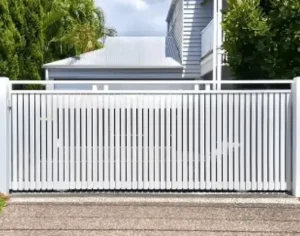
Slat Orientation and First Impressions
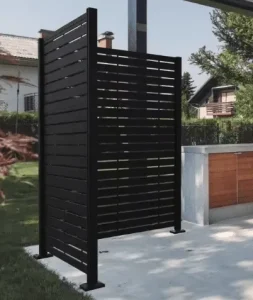
Horizontal slats create a wide, continuous sight line that can make a short or long fence feel expansive. That’s why they appeal to designers aiming for a contemporary, ground‑hugging look. Vertical slats, on the other hand, emphasize height and can make a fence appear taller, which works well for properties that want a more traditional or architectural presence without blocking the view entirely.
Privacy depends more on slat profile and spacing than on direction. A vertical blade fence with tight spacing can match the seclusion of a horizontal panel. What matters in the long run is not which style photographs better, but which orientation handles the forces your site will throw at it.
How Orientation Affects Structural Stability
A fence panel’s orientation changes how wind loads are distributed across posts and rails. Vertical slats act as short columns between the top and bottom rails. Because the slat span is short — typically 600 mm to 900 mm — each slat resists bending effectively. Horizontal slats, however, run from post to post as slender beams, sometimes spanning 1.8 m or more. That longer unsupported length makes horizontal slats more vulnerable to deflection under wind pressure unless the panel includes a center rail or thicker extrusions.
On projects I’ve reviewed, a horizontal slat fence facing sustained 80 km/h winds required either 3 mm wall profiles with intermediate stiffeners, or reduced post spacing to 1.5 m. A vertical slat fence with comparable aesthetics handled the same wind with standard 2 m post spacing and 1.6 mm wall slats. This isn’t marginal — it affects the entire project cost.
| Factor | Vertical Slat Fence | Horizontal Slat Fence |
|---|---|---|
| Wind load path | Slats transfer load to top and bottom rails; short span limits deflection | Slats act as horizontal beams; longer span increases deflection risk |
| Typical slat span between supports | 600–900 mm | 1.5–1.8 m (post to post or center rail to center rail) |
| Post spacing flexibility | 1.8–2.4 m feasible | Often requires 1.5–1.8 m for same wind rating |
| Sag resistance | Minimal sag due to short vertical span | Potential for gradual sag without center rail reinforcement |
| Material efficiency | Thinner slats (1.6–2.0 mm) often sufficient | May require 2.5–3.0 mm slats or additional rails |
Water Runoff, Drainage, and Ongoing Maintenance
Rainfall behavior differs sharply between orientations. Vertical slats shed water downward, with almost no flat surface for water to pool. Horizontal slats present a top edge that traps water, dust, and organic debris. Over repeated wet‑dry cycles, that accumulation can stain the powder coating and, in coastal or industrial zones, accelerate localized corrosion if the coating is already compromised.
Cleaning follows the same logic. You can spray down a vertical slat fence from either side, and water carries dirt off the slat faces. A horizontal fence requires you to wipe or brush each slat’s top edge to remove built‑up grime — a maintenance burden that adds up across 100 linear meters of fence line.
For buyers in regions with high rainfall or heavy silt, I consistently recommend vertical orientation. It isn’t a hard rule — horizontal works if the design demands it — but the maintenance equation tips solidly toward vertical for sites where steady rain or sea spray is a daily reality.
Installation Complexity: What Contractors Need to Know
Vertical slat panels typically arrive as pre‑assembled sections with slats already fixed to the top and bottom rails. The contractor aligns the panel between posts, bolts through the rail brackets, and moves on. Horizontal slat systems usually ship as loose components: posts, rails, individual slats, and sometimes clips or channel inserts that must be leveled slat by slat. That on‑site alignment adds labor hours and multiplies the chance of visual misalignment.
Post‑anchoring requirements also shift. Because horizontal fences catch more wind, posts must be set deeper or use larger embedment brackets to resist overturning. We supply both configurations, and when a client is torn between the clean lines of horizontal and the ease of vertical, I ask one question: “What does your installation crew prefer?” The answer often settles the decision.
Procuring High‑Quality Aluminum Slat Fence Panels
Whether you choose horizontal or vertical, the panel material and coating system are what keep the fence standing and looking good for years. Look for 6063‑T5 or 6063‑T6 extrusions with wall thickness matched to the slat span and local wind loads. A high‑grade polyester powder coating meeting AAMA 2604 gives at least 10 years of color and gloss retention away from the coast; for seafront projects, specify AAMA 2605 fluoropolymer finishes.
As a direct manufacturer, we fabricate vertical slat fence panels in standard and custom sizes, with punch‑out rail connections that simplify assembly. Horizontal slat systems can be ordered with integrated center rails and pre‑drilled slats to cut site time. For step‑by‑step guidance on ordering from a Chinese factory, see our guide on how to order custom aluminum fencing from China.
Get Expert Guidance on Your Slat Fence Project
Choosing between horizontal and vertical slat fence panels means weighing wind performance, water drainage, cleaning effort, and installation cost against the aesthetic you want. Most buyers walk into the decision focused only on looks, and it isn’t until the first rainy season or windstorm that the practical differences become obvious.
We help distributors, contractors, and developers pre‑solve these problems before the order ships. Tell us your site conditions, wind zone, and design preference, and we’ll recommend a configuration that balances appearance with long‑term reliability. Reach our engineering team at sales01@yulongkeji-ch.com or call +8619086315193 to discuss your project.
Common Questions About Aluminum Slat Fence Orientation
Do vertical slat fences provide more privacy than horizontal slats?
Privacy depends on slat profile, not orientation. A vertical fence with overlap‑style blades or tight spacing blocks sight lines just as effectively as a horizontal layout. We’ve manufactured both designs for residential communities where seclusion was the top requirement, and the deciding factor is usually the client’s design intent and wind load, not privacy alone.
Will a horizontal slat fence sag over time?
Horizontal slats can sag if they span more than about 1.5 meters without a center rail. Using thicker extrusions (2.5–3.0 mm wall) or adding intermediate supports eliminates sag. In projects we’ve supplied, horizontal panels with a center stiffener rail have held their alignment for years, even in exposed locations.
Which slat orientation works best for coastal environments?
Vertical slat fences are generally safer near salt water because they shed rain and spray faster, reducing the contact time that accelerates coating breakdown. If the spec calls for horizontal, we upgrade the coating to AAMA 2605 and recommend a thorough rinse schedule. For both orientations, specifying marine‑grade aluminum alloy and high‑grade powder coat is non‑negotiable.
Can I mix horizontal and vertical sections?
Yes, as long as each section is structurally calculated independently. A common approach is to use horizontal slats for feature sections and vertical for long runs, but you must match post depths and reinforcement to the more demanding orientation in each stretch. Share your layout and we’ll confirm the design — reach us at sales01@yulongkeji-ch.com.
If you’re interested, check out these related articles:
High-Security Steel Fencing: Protecting Government & Military Assets
Chain Link Pool Fence: Codes, Heights, Gates & Pricing Guide