
Restaurant patio screen fences do more than create privacy. They shape the entire outdoor dining experience by controlling sight lines, reducing wind, and adding a visual signature that differentiates a venue from its neighbors. In a commercial setting, the fence must withstand constant exposure to sun, rain, food spills, and cleaning chemicals without corroding or losing its finished appearance. From my experience specifying architectural metal products, I have found that powder-coated aluminum screen fences deliver that balance because they offer structural integrity, design flexibility, and low maintenance in one system, factors that directly influence a restaurant’s long-term operating costs and curb appeal.
Why Screen Fences Transform Restaurant Patios
A restaurant patio that feels exposed to the street or adjacent buildings rarely becomes a destination. Diners value a sense of enclosure, a space that feels distinct from the parking lot or sidewalk traffic. Screen fences create that boundary while preserving the outdoor character. Unlike solid walls, a screen fence maintains sight lines and airflow, keeping the space from feeling claustrophobic. For restaurant operators, this means a patio that works mechanically (wind control, partial noise reduction) and commercially (atmosphere, perceived privacy). The investment pays back through higher table turnover on a space that would otherwise be underused. I have visited sites where a simple aluminum slat fence turned an empty side yard into the most requested seating area, simply because it delivered a combination of partial separation and style.
Material Selection: Why Aluminum Leads for Commercial Patios
Restaurant owners often ask which metal holds up best outdoors. Steel and wrought iron are strong, but they bring corrosion and maintenance challenges that aluminum avoids entirely.
What about steel and wrought iron?
Steel and wrought iron fences can look substantial at first, but in a restaurant environment they face accelerated degradation. Condensation from cold drinks, occasional food spills, and daily cleaning with water and mild detergents create conditions that promote rust on any scratch or cut edge. Galvanized steel delays rust but eventually yields at joints or fabrication points. Wrought iron, while classic, requires regular sanding and repainting to stay presentable, a recurring cost and labor burden. In contrast, aluminum forms a self-protecting oxide layer and never rusts. A powder-coated aluminum screen fence maintains its appearance for a decade or more with only basic cleaning. For a commercial operator, that difference means a fixed upfront cost versus an ongoing maintenance line item.
How does aluminum stand up to food and weather exposure?
Aluminum alloy 6063-T5, the grade most architectural screen fences are extruded from, combines decent tensile strength with excellent corrosion resistance. When coated with a polyester or PVDF powder layer at 60-80 microns thickness, the assembly becomes impervious to UV, salt spray, and mild acids. I have specified aluminum railings and fences for coastal restaurants where sea mist coats everything in salt; the powder-coated surfaces looked nearly new after five years with only an annual rinse. This level of durability is difficult to achieve with painted steel, where micro-cracks in the paint film allow moisture to work underneath.
Design Options for Privacy, Airflow, and Visual Appeal
Privacy and airflow are not opposing forces. A well-designed screen fence delivers both by manipulating panel geometry, blade angle, and perforation patterns.
Can a screen fence provide privacy without blocking the breeze?
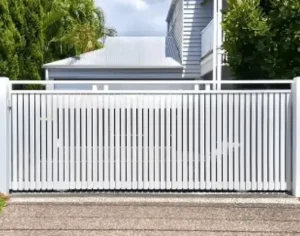
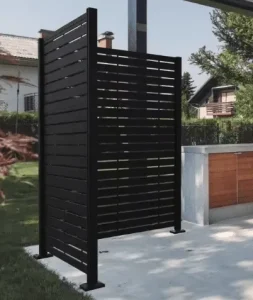
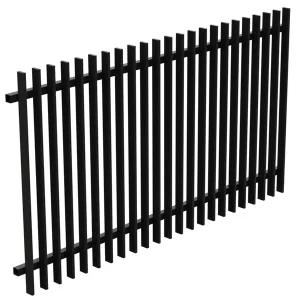
Yes, and the key is the blade or louver angle. Horizontal blades tilted downward block the line of sight from a standing person outside while allowing air to pass through the gaps. Vertical slats spaced 20-30 mm apart create a similar effect: the offset between slats obscures straight viewing while open channels behind permit cross-ventilation. Laser-cut panels with perforation ratios above 30% achieve privacy through pattern density rather than solid mass; the right pattern makes the patio readable but not fully transparent. A restaurant patio in a hot climate benefits significantly from this configuration because airflow reduces the need for cooling.
Which styles work best for restaurant branding?
Three configurations dominate commercial restaurant applications:
| Style | Privacy Level | Airflow | Branding Potential |
|---|---|---|---|
| Horizontal louvered panels | Directional, dependent on blade angle | Good with open gaps | Subtle, through color and spacing |
| Vertical slat panels | Moderate, 20-30 mm spacing | Good | Color blocking, slat rhythm |
| Laser-cut custom panels | High with dense pattern, low with large voids | Moderate, depends on open area | Highest, logos and artistic patterns possible |
Vertical slat panels suit modern, minimalist venues. Louvered panels lean industrial-chic. Laser-cut panels become the visual centerpiece, with the fence acting as both boundary and signage. In a rebranding project I supported, a chain replaced generic wire mesh with aluminum panels carrying a subtle leaf pattern that matched their new logo direction. The fence became part of the identity package without shouting.
If your patio configuration includes tight corners or a curved layout, it is worth confirming early whether your chosen panel style can accommodate those geometries without visual breaks, a detail our engineering team can check quickly at sales01@yulongkeji-ch.com.
What Commercial Installers Need to Know About Structural Requirements
A restaurant patio screen fence is a permanent structure and must meet building code for wind load, occupant safety, and sometimes fire egress.
Are there code requirements for patio fences?
Most jurisdictions treat a patio fence the same as a property boundary fence if it encloses an outdoor dining area with fixed seating. The fence typically must not exceed a height that obstructs required sight triangles for vehicle exits. In wind-prone regions, a structural engineer may need to verify that posts and panel connections can resist uplift and lateral loads. I have seen projects delayed because the owner assumed a freestanding aluminum fence could use lightweight surface-mounted shoes; the AHJ required embedded posts or heavy base plates complying with a specific wind speed design. Always check the local building official early, and share any stamped engineering letters if available. A reputable manufacturer can provide section properties and moment capacities to support the permit process.
How are screen fence posts anchored on an existing concrete patio?
On an existing slab, core-drilled and epoxy-set anchors are the standard. The post base plate is bolted to the concrete using stainless steel expansion anchors or chemical anchors. The slab must have adequate thickness and reinforcement to handle the overturning moment, especially at gate posts or corners where wind load concentrates. If the concrete is thin or in poor condition, we sometimes specify an external post shoe welded to a larger base plate to spread the load. These are details a supplier should be able to help with during submittal preparation.
Keeping the Fence Clean and Durable Over Years
Commercial patio furniture and surfaces take a beating. A screen fence, however, requires surprisingly little attention if the material and coating are correct.
How often does an aluminum screen fence need maintenance?
A powder-coated aluminum screen fence needs a rinse with a garden hose or damp cloth every one to three months to remove dust, pollen, and airborne grease. In a kitchen-facing area where cooking oils drift, quarterly washing with mild soap and water prevents sticky buildup. No repainting, no rust treatment, no re-tensioning of cables or slats. The only moving parts that might need attention are gate hinges and latches, which should be stainless steel and lubricated annually. This minimal maintenance burden is one reason I always return to aluminum for food-service settings where cleanliness audits are routine. The coating we apply at Hubei Yulong is engineered to withstand pH-neutral cleaners and common sanitizers without fading or chalking, a specification worth verifying with any supplier before purchase.
Custom Branding and Color Matching for Restaurant Identity
A screen fence is not a generic commodity product. The color, pattern, and panel design can be matched to the restaurant’s brand palette and logo.
Can I get a fence with my restaurant’s logo?
Yes, with laser-cut aluminum panels. A digital design file (vector format) is converted to a cutting path, and a CNC laser burns the pattern through the sheet before it goes to powder coating. This allows complex logos, filigree, or directional graphics to appear as negative space or a contrasting metal finish. The cost depends on the complexity of the cut and the open area ratio, but the impact is significant: a branded fence turns a functional barrier into a marketing asset that works 24/7. I have seen restaurants use this technique to display the brand mark subtly across an entire patio boundary, creating a premium, custom-built feel that guests notice and photograph.
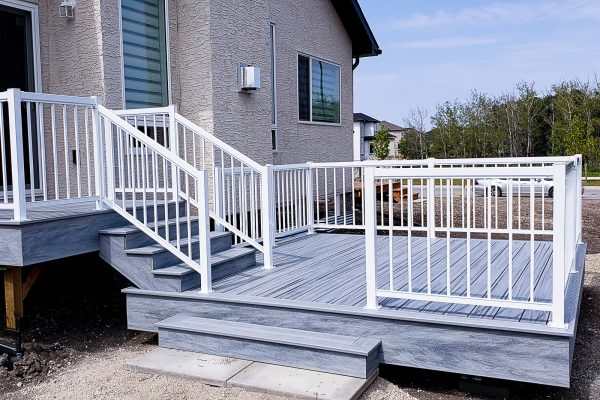
A note on color: powder coating comes in standard RAL colors or custom matched shades. If your brand identity relies on a specific Pantone or RAL hue, confirm that the manufacturer can apply and cure that color consistently across all panels and posts. At Hubei Yulong, we support custom color matching with spectrophotometer verification on each production batch, a detail that prevents visible variation between panels installed side by side.
Common Questions from Restaurant Operators and Designers
How much does a restaurant patio screen fence cost per linear foot?
The price varies with height, panel style, and customization. A 4-foot tall aluminum slat screen fence in standard RAL powder coat might start near USD 45-60 per linear foot for materials, excluding installation. Add laser-cut branding or thicker post systems and the cost moves upward. Freight and import duties also factor in. The best approach is to send a sketch and desired panel type to a manufacturer for a firm project quotation.
How long does it take to manufacture and install custom screen panels?
Standard designs can ship in four to six weeks from deposit. Laser-cut custom panels require an additional two to three weeks for design confirmation and CNC programming. On-site installation typically takes one to two days for a typical 100-linear-foot patio, assuming existing concrete is ready to accept anchors.
Can the fence be relocated if the patio layout changes?
Panelized aluminum screen fences are modular by design. Posts can be unbolted from the base plates and moved to a new layout. The main challenge is drilling new anchor holes in the slab and patching the old ones, but the fence itself is reusable. I have supported projects where a restaurant expanded its patio after two years, and the original fence was reconfigured with minimal modification.
What wind rating can these fences withstand?
With properly engineered post sections and base connections, aluminum screen fences can resist wind speeds up to 90 mph or more, depending on the panel solidity ratio and post spacing. The design must account for the specific site wind zone per ASCE 7 or local code. A manufacturer can provide calculations for submittal if the project requires a stamped structural review.
Is powder coating available in any RAL color?
Yes, almost any RAL Classic or RAL Design shade can be formulated. Custom colors matching brand standards require a color chip or digital reference and may incur a minimum lot charge. The coating should be applied in a controlled powder line with proper pretreatment to ensure adhesion and color uniformity. Share your color specification when requesting a quotation, and we can confirm feasibility and sample lead times at sales01@yulongkeji-ch.com or by calling +8619086315193.
If you’re interested, check out these related articles:
Assembled vs Welded Aluminum Gates: Performance, Cost, & Use Cases
Custom Aluminum Gates: OEM & ODM Solutions for Global Projects