
Choosing a cattle fencing system is a structural decision with long-term consequences. A fence that fails under animal pressure or rusts out within a few seasons creates recurring costs and liability. I work with ranchers and agricultural buyers daily, and the most common mistake I see is selecting materials based on upfront price alone, without factoring in the mechanical loads cattle apply and the environmental degradation the fence will endure. This article walks through a technical evaluation framework: matching fence design to livestock behavior, comparing material durability, specifying components that prevent failure, and weighing lifetime cost against the initial quote.
What Makes Livestock Fencing Different From Standard Perimeter Fence
Cattle fencing is a load-bearing system. Unlike a residential boundary that encounters incidental contact, a herd exerts consistent pressure through rubbing, pushing, and leaning. We have observed that a 600-kg cow can apply a lateral force exceeding 200 kg when scratching against a post. That concentrated load, repeated daily, deteriorates connections and loosens posts that were not engineered for animal contact.
Height requirements also scale with breed and disposition. For most beef cattle, a minimum height of 1.2 m (48 inches) is sufficient. For Brahman or other heat-tolerant breeds with a higher jump radius, we recommend 1.4 m (54 inches). For rotational grazing, temporary electric fences can be lower because the psychological barrier compensates for the physical one, but they still require adequate post spacing and tension to maintain the deterrent.
Finally, consider corridor width. A fenced lane for moving cattle between paddocks should be at least 3.6 m (12 feet) wide to prevent crowding and fence damage. Narrowings below that dimension generate side pressure that collapses wire and bends posts over time.
Wire, Steel, and Aluminum: A Material Comparison for Cattle Enclosures
Most cattle operations default to barbed wire or high-tensile smooth wire because the per-foot cost is low. However, material selection must account for the full envelope: mechanical strength, corrosion resistance in agricultural environments (ammonia from manure, fertilizers, and high humidity), and maintenance frequency.
| Material | Typical Lifespan | Maintenance Interval | Corrosion Resistance | Upfront Cost |
|---|---|---|---|---|
| Barbed wire (galvanized) | 10–15 years | Annual retensioning, rust check | Moderate | Low |
| High-tensile smooth wire | 15–25 years | Bi-annual tension check | Moderate (Class 3 galvanizing) | Low |
| Steel fence panels (hot-dip galvanized) | 25–35 years | Decade-long intervals | High (zinc coating ≥ 80 µm) | Moderate |
| Aluminum fence (powder-coated) | 30+ years | Minimal | Very high (inherent rust-free) | Higher |
For operations in coastal regions, aluminum fencing eliminates rust entirely, which makes it our preferred recommendation for salt-prone environments. Our heavy-duty aluminum horse fence uses 6063-T6 alloy extrusions with a 60–80 µm polyester powder coat, and we have seen panels remain structurally unchanged after a decade of exposure on a Queensland cattle property.
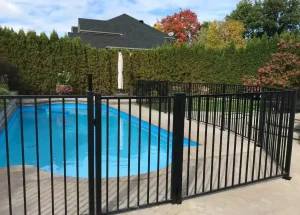
Steel horse fence, particularly when hot-dip galvanized to ISO 1461 with a zinc coating of at least 610 g/m², offers higher impact resistance for aggressive breeds of cattle. Our heavy-duty steel horse fence is designed with through-welded tube connections that withstand direct ramming without post deformation. I generally specify steel over aluminum only when the herd includes bulls or when the fence line faces high wind loads that demand greater section modulus.
Traditional wire systems remain viable for large-acreage operations where perimeter fencing is measured in kilometers, but the tension maintenance burden should not be underestimated. A 400-meter high-tensile fence requires a strainer post assembly at each end capable of withstanding 1,000 kg of tension. Cutting corners on end posts is the most frequent failure root cause I encounter.
If your operation requires custom post spacing or mixed-material systems to balance cost and durability, confirming the structural load path with your supplier before ordering is the most reliable way to avoid field rework. Reach out to us at sales01@yulongkeji-ch.com with your layout, and we will check the tensioner requirements.
Engineering Specifications That Prevent Mechanical Failure
A fence fails when any component—wire, knot, post, or foundation—reaches its yield point. To prevent this, each element must be sized for the expected force.
Wire gauge directly correlates to break strength. For cattle, use at least 12.5-gauge (2.5 mm) high-tensile wire with a minimum tensile strength of 700 MPa. Standard barbed wire at 15.5-gauge (1.7 mm) fails too easily under lateral load, and re-splicing a break is time lost from grazing management.
Post spacing is another critical variable. We specify wood or steel posts at 3 m (10 ft) intervals for high-tensile wire, reducing to 2.4 m (8 ft) on slopes or curves where vector forces increase. Our farm wire mesh fence uses a 4 mm galvanized steel wire panel with a 50×100 mm mesh, which we see as a better alternative to knotted wire where predators or calving safety is a concern, because the welded intersections distribute impact energy across multiple wires.
Post embedment depth must reach below the frost line and resist overturning moment. For a 1.4 m high fence post under 200 kg lateral load, a concrete footing of 300×300×600 mm is the minimum for sandy loam soils. In clay, direct embedment with tamped aggregate often suffices, but we always verify the soil bearing capacity first. One project in southern Brazil had to be re-driven because the contractor used the same embedment depth for lateritic soil as a nearby sand-based project; the posts rotated and lost wire tension within months.
Selecting the right combination of gauge, spacing, and embedment is a site-specific calculation. If your site has mixed soil, send your soil report along with a sketch, and we can recommend the post foundation specification at no cost.
Coating Technologies: How Protective Layers Determine Lifespan
Agricultural environments accelerate corrosion: ammonia and methane from manure lower local pH, and condensed moisture on metal surfaces stays wet longer due to high humidity inside barns and under tree lines. The coating system must act as a barrier and, in the case of zinc, a sacrificial anode.
For steel fences, hot-dip galvanizing (batch or continuous) provides far better protection than electro-galvanizing or pre-galvanized sheet. The zinc-iron alloy layers formed during hot dipping are metallurgically bonded and resist peeling. We require a minimum average coating thickness of 85 µm (610 g/m²) for any steel component used in livestock fencing. Our powder-coating line for aluminum parts applies a chromate-free pretreatment that enhances adhesion, then a TGIC-free polyester powder baked at 200°C for 10 minutes, achieving a cross-hatch adhesion rating of 0 (no removal) per ISO 2409.
The lifecycle difference is measurable. A powder-coated aluminum panel will outlast a high-tensile wire fence by 2–3 times in humid conditions, not because the aluminum is intrinsically stronger, but because maintenance labor accumulates: re-tensioning, cutting out rusted sections, and repainting wire costs add up. I have seen operations save 20–30% on total fence ownership over 15 years by investing in coated aluminum for core handling yards while using wire for outer paddocks.
Lifetime Cost: Balancing Investment With Operational Reliability
Upfront material cost rarely tells the whole story. A barbed wire fence might cost $1.50–$2.50 per linear foot installed, while an aluminum fence system can run $12–$18 per linear foot. But factoring in the labor for annual tensioning, post replacement, and animal escapes can shift the preference toward a permanent system.
Consider a 1,000-foot holding pen. A barbed wire fence with wooden posts requires approximately 6–8 hours of annual maintenance (re-tensioning, replacing broken insulators, checking gate hinges). Over 20 years, that is 120–160 hours, which at a skilled labor rate of $30/hour adds $3,600–$4,800. Add the cost of replacing 20% of the wire and 10% of the posts after 10 years, and the total cost over 20 years approaches the initial investment of a powder-coated aluminum fence that requires no annual tensioning.
In my experience, the threshold where a permanent metal system becomes financially preferable is around 1,500 linear feet for high-traffic corral areas, or any perimeter that must remain stock-proof with zero tolerance for failure. For extensive pasture perimeters, the wire economies still prevail. The key is to triage: permanent metal for high-use zones, wire for remote boundaries. If you are unsure how to allocate budget across zones, send us your site map with animal flow patterns, and we can mark up a cost-optimized layout.
Working With a Fence Manufacturer to Get the Right System Delivered
Sourcing from a direct manufacturer rather than a distributor eliminates channel markups and allows specification control. However, the manufacturer must demonstrate process control over coating quality, alloy traceability, and structural testing. We maintain lot-specific records for every batch of aluminum extrusion, including chemical composition and tensile test results per EN 755-2. Our galvanizing subcontractors provide a certificate of conformance for coating mass per sample.
When importing, confirm the manufacturer can supply installation guides, post spacing diagrams, and base plate templates. I joined a call with a South African buyer last year who had received fence panels without the correct gate post connectors because the distributor had mixed inventory from two factories. We resolved it by sending the full hardware kit directly, but it delayed their project by three weeks. A single-source manufacturer with engineering support prevents that type of error.
Bulk orders typically carry an MOQ of 100 panels or 500 linear feet, with lead times of 4–6 weeks for standard configurations. We can advise on optimal container loading to minimize freight cost per panel. If you are ready to get a firm quote, send your lineal footage and fence style preference to sales01@yulongkeji-ch.com or call +8619086315193, and we will return a detailed bill of materials within two working days.
Common Questions About Cattle Fence Selection
What fence height keeps cattle in but does not look like a prison?
Beef cattle generally respect a 1.2 m (4 ft) barrier, but a double-rail system at 0.6 m and 1.2 m with smooth wire provides a clear visual barrier without creating a solid wall. For dairy cattle, we often add a third rail at 1.4 m because Holsteins are more likely to test barriers. The goal is not height alone but a continuous top line: cattle judge barriers by the top edge, so a sagging wire at 1.2 m is perceived as a lower obstacle and invites challenge.
How do I protect the fence bottom from rust when it sits in manure or wet grass?
Post bases embedded in concrete should be sealed at the concrete-to-post interface with a polyurethane sealant to prevent capillary water ingress. For steel posts, specify hot-dip galvanizing with an additional passivation layer. For aluminum posts, ensure the concrete is neutralized after curing (pH < 9) because high-alkaline concrete can degrade the oxide layer over time. We have found that a HDPE sleeve around the embedded portion further inhibits poultice corrosion in highly alkaline soils.
Is electric wire fence safe for calves?
A properly energized electric fence with a low-impedance energizer delivering 5–6 kV open-circuit and at least 2.5 kV under 500 ohm load is safe for calves and highly effective. Calves learn the boundary quickly because their thin nose skin receives a sharper sensation. However, grounding must be robust: at least three 2 m ground rods spaced 3 m apart, connected with insulated lead-out wire. A poor ground reduces pulse energy to the point where cattle ignore it, teaching them that the fence is harmless—the exact opposite of what we want.
When should I replace an old fence instead of repairing it?
Replace when post corrosion exceeds 25% of the original cross-section, when more than 15% of wires have splices, or when tension has decayed below 50% of design value and cannot be restored without breaking. A good field test: if you can deflect a corner post 50 mm by hand, the embedment has failed and a repair will not restore full strength. At that point, a new post and foundation are cheaper than repeated tensioning and eventual catastrophic failure. If you are unsure about your existing fence condition, share a few photos and we can give you a technical opinion on whether a repair is still a sound investment.
If you’re interested, check out these related articles:
Round Aluminum & Galvanized Steel Fence Posts: Ultimate Guide
Aluminum Fences: School & Playground Safety Compliance
Source Steel Fencing from China: An Expert Import Guide
Frameless Glass Balustrade: Designs for Stairs, Pools & Balconies