
Custom chain link fences handle security demands that standard off-the-shelf options simply cannot meet. The difference between a fence that holds up for fifteen years and one that fails in three often comes down to specifications most buyers never think to ask about—wire thickness, coating chemistry, gate mechanics. Getting these details right matters more for municipal infrastructure and industrial perimeters than anywhere else, where replacement costs and security gaps create real problems.
Wire Gauge and Height Specifications That Actually Affect Security
Wire gauge and fence height determine whether a chain link fence provides genuine security or just visual deterrence. These two specifications control impact resistance, cutting difficulty, and how well the structure handles wind loads and attempted breaches over time.
Wire gauge uses a counterintuitive numbering system—lower numbers mean thicker, stronger wire. A 9-gauge wire measures 0.148 inches in diameter, roughly 30% thicker than 11-gauge wire at 0.113 inches. That thickness difference translates directly into how much force the fence absorbs before deforming and how long someone with bolt cutters needs to create an opening.
Gauge Selection for High-Security Applications
High-security custom chain link fence installations typically require 9-gauge wire at minimum. Critical infrastructure protection—water treatment facilities, power substations, data centers—often specifies 6-gauge wire at 0.192 inches diameter. The heavier wire resists cutting tools more effectively and maintains structural integrity under repeated impact.
| Gauge | Wire Diameter (inches) | Typical Application |
|---|---|---|
| 11.5 | 0.113 | Residential, temporary fencing |
| 9 | 0.148 | Commercial, industrial, general security |
| 6 | 0.192 | High-security, heavy-duty industrial |
Height selection follows security requirements and local code restrictions. Standard commercial installations run 6 to 8 feet. Industrial perimeters and correctional facilities often extend to 10 or 12 feet, sometimes with additional anti-climb features at the top. Municipal projects need to balance security needs against zoning ordinances that may cap fence heights in certain areas.
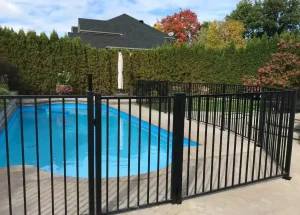
Gate Systems for Access Control and High-Traffic Operations
Gates represent the most vulnerable point in any perimeter fence system. A custom chain link fence gate needs to match the security level of the fence itself while handling daily operational demands—vehicle traffic, pedestrian access, emergency egress requirements.
Sliding gates work well for wide openings where swing clearance is limited. They require a clear track path along the fence line but eliminate the arc of space that swing gates need. For industrial entrances handling truck traffic, sliding gates typically provide better security because they can span wider openings without the structural compromises that large swing gates require.
Swing gates cost less and operate more simply, making them practical for pedestrian entrances and lighter-duty vehicle access. The trade-off is swing clearance and reduced security for openings beyond about 20 feet.
| Gate Type | Pros | Cons |
|---|---|---|
| Sliding Gate | Space-efficient, secure for wide openings | Requires linear space, complex installation |
| Swing Gate | Cost-effective, simple operation | Requires swing clearance, less secure for wide openings |
Automated gate systems add access control integration—card readers, keypads, remote operation. The automation hardware needs to match the gate weight and cycle frequency. A gate that opens fifty times daily requires different actuators than one opening five times daily.
If you’re interested, check 《YLOONG Solutions: Engineered for Security, Designed for Performance》
Bulk Procurement for Large-Scale Fence Projects
Large custom chain link fence orders—municipal infrastructure, industrial park perimeters, multi-site commercial deployments—require procurement strategies that account for manufacturing capacity, quality consistency, and logistics coordination.
Manufacturing capability matters more than price per linear foot when ordering thousands of feet of fencing. Automated production lines maintain consistent wire tension and mesh uniformity across large runs. Manual or semi-automated facilities often show quality variation between batches, which creates problems during installation when panels do not align properly.
Quality control documentation becomes essential for projects with inspection requirements. Municipal contracts typically require material certifications, coating thickness verification, and tensile strength testing. Requesting these documents before finalizing orders prevents delays during project acceptance.
Customization Options for Industrial Applications
Custom chain link fence specifications extend well beyond gauge and height. Material composition, coating systems, and integration with supplementary security features all affect performance in specific environments.
Galvanized chain link fence wire provides baseline corrosion protection through zinc coating applied before or after weaving. Hot-dip galvanization after weaving offers better coverage at weld points and cut ends. Pre-galvanized wire costs less but leaves exposed steel at mesh intersections.
Vinyl-coated chain link fence options add a polymer layer over galvanized wire. The coating improves corrosion resistance in coastal or industrial environments with chemical exposure. Color options allow aesthetic integration with surrounding architecture—useful for commercial properties where appearance affects property values.
Corrosion-resistant custom chain link fence systems for chemical plants or marine environments may require specialized alloys or additional coating layers beyond standard galvanization.
Material Selection and Surface Treatment Technology
Long-term fence performance depends on material choice and surface treatment quality. The difference between a fence lasting ten years and one lasting twenty-five often comes down to coating thickness and application method.
Aluminum fencing offers excellent corrosion resistance without additional coatings. The material forms a protective oxide layer naturally, making it suitable for coastal installations and environments with high humidity. Weight savings simplify installation but reduce impact resistance compared to steel.
Zinc steel combines high strength with corrosion protection when properly galvanized. The galvanization process deposits a zinc layer that sacrificially protects the underlying steel—zinc corrodes preferentially, preserving the structural material. Coating thickness directly affects service life; specifications typically call for minimum zinc weights measured in ounces per square foot.
| Material | Advantages | Disadvantages |
|---|---|---|
| Aluminum | Lightweight, corrosion-resistant, low maintenance | Higher initial cost, less impact resistant than steel |
| Zinc Steel | High strength, cost-effective, good impact resistance | Heavier, requires robust galvanization for corrosion |
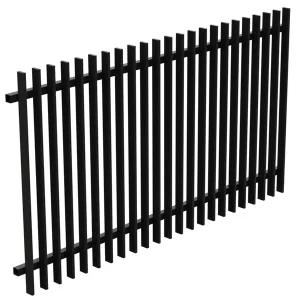
Multi-layer powder coating systems add color options and additional corrosion barriers. The process applies electrostatically charged powder that bonds to the metal surface, then cures under heat to form a durable finish. Quality powder coating resists UV degradation, maintains color stability, and provides a surface that sheds dirt more readily than bare metal.
Hubei Yulong Manufacturing Capabilities
Hubei Yulong Environmental Protection Building Materials Technology Co., Ltd. manufactures aluminum and zinc steel fencing systems with automated production lines designed for consistency across large orders. The facility handles custom chain link fence specifications for municipal infrastructure, residential developments, industrial perimeters, and commercial properties.
Production capabilities include residential and commercial fences, balcony railings, stair handrails, and gate systems in sliding and swing configurations. Surface treatment technology incorporates multi-layer powder coating for extended service life in demanding environments.
Products serve domestic municipal projects and residential communities while also reaching international markets through established export channels.
Contact Information
Reach Hubei Yulong Environmental Protection Building Materials Technology Co., Ltd. for project consultations and specifications review.
Email: yloongfence@gmail.com | Phone: +8619072006155
Frequently Asked Questions About Custom Chain Link Fencing
How do I determine the appropriate height for a commercial chain link fence?
Start with the security threat you need to address. A 6-foot fence deters casual trespass but will not stop determined intruders. An 8-foot fence with anti-climb features handles most commercial security needs. Heights above 10 feet typically require engineering review for wind load calculations and may trigger additional permitting requirements. Local zoning codes often cap fence heights in commercial districts—check these restrictions before finalizing specifications. Industrial zones usually allow taller installations than retail or office areas.
What are the advantages of choosing a vinyl-coated chain link fence for custom projects?
Vinyl coating adds a polymer barrier over galvanized wire that improves corrosion resistance in harsh environments. Coastal installations, chemical processing facilities, and areas with high humidity benefit most from the additional protection. The coating also provides color options—green, black, brown, and other shades—that help fencing blend with landscaping or match architectural elements. Service life typically extends several years beyond standard galvanized fence in equivalent conditions, offsetting the higher initial material cost.
What is the typical lead time for bulk custom chain link fence orders from Hubei Yulong?
Lead times vary with order volume, customization requirements, and production scheduling. Standard specifications in moderate quantities typically ship within four to six weeks. Highly customized orders or very large volumes may require eight to twelve weeks. Contact the sales team with specific project details—quantities, specifications, delivery location—for accurate scheduling. Expedited production is sometimes available for projects with tight timelines, though this may affect pricing.