
When evaluating modern aluminum fencing, the choice between blade fence vs slat fence often comes down to a trade-off: how much you value privacy against airflow and sightline control. Both systems use vertical aluminum members, but their profile shapes create very different performance characteristics. In my twelve years as a fencing systems engineer, I’ve found that blade fences offer a more versatile balance of ventilation and visual screening, while slat fences deliver maximum enclosed privacy for those who prioritize complete blocking. Understanding the five differences below will help you match the fence system to your project’s exact requirements.
| Feature | Blade Fence | Slat Fence |
|---|---|---|
| Profile | Angled, rotated louver blades | Flat, straight vertical slats |
| Privacy level | Moderate; see-through at oblique angles | High; near-complete blockage |
| Airflow | High; open gaps between blades | Low; solid surface blocks most wind |
| Typical use | Modern homes, offices, pool surrounds | High-privacy residential, perimeter fencing |
| Cost per linear foot | Slightly higher (complex extrusion) | Lower (simpler extrusion) |
How Do Blade and Slat Fences Differ in Privacy?
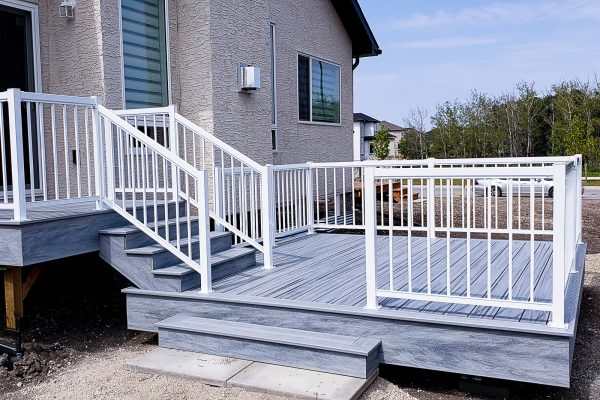
Privacy is where the difference between blade and slat fences is most immediately visible. Blade fences use horizontally oriented louver blades, set at a specific angle, typically between 30 and 45 degrees. This angled design means that when you stand directly in front of the fence, the overlapping blades create a nearly solid surface, blocking sightlines through the panel. However, if you move to the side and view the fence from an acute angle, you’ll see gaps between the blades. This semi-privacy effect can be a benefit in certain settings—it lets light and air pass while still limiting direct views.
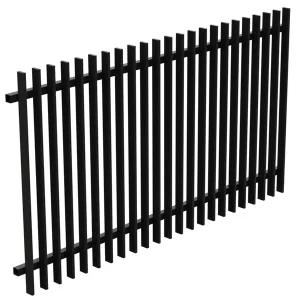
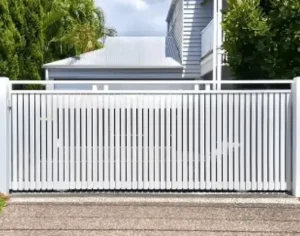
Slat fences, by contrast, consist of flat vertical slats placed edge-to-edge or with minimal spacing. They block sightlines from nearly every angle, making them the better choice when complete visual separation is the primary requirement. In our factory, we test sightline performance by placing a target behind the panel and checking visibility from 0, 30, and 60 degrees. A standard blade fence with 45-degree blades obscures the target entirely at 0 degrees, partially visible at 30, and nearly unobstructed at 60. Slat fences block at all angles unless there is a deliberate gap between slats.
How Do Airflow and Ventilation Compare Between Blade and Slat Fences?
Airflow is a critical differentiator that affects long-term fence performance and adjacent structures. The open channel between each blade in a blade fence allows wind to pass through with minimal resistance. This reduces the wind load on the fence and the supporting posts, which is a significant advantage in hurricane-prone or high-wind regions. I’ve consulted on coastal projects where a solid fence would have required deeper post footings and heavier gauge posts just to withstand wind pressure; the blade fence’s permeability kept the structural requirements simpler and more cost-effective. Additionally, the airflow keeps the area behind the fence cooler and drier, which helps prevent mildew on pool decks and garden walls.
Slat fences, with their flat, adjacent slats, act like a solid barrier. They may trap heat and moisture, and in windy conditions they subject the fence system to higher lateral loads. Some slat designs incorporate small gaps between slats for air movement, but the total ventilation is far less than a blade fence. For projects in hot, humid climates, the blade fence’s ability to keep air circulating is a tangible comfort benefit.
What Structural and Durability Differences Exist?
The structural design of blade and slat fences differs in extrusion profile, thickness, and installation method. Blade fences use a complex extrusion—a hollow or semi-hollow aluminum section with a built-in rotation channel. Because the blade must withstand twisting forces and support itself over long spans (up to 2 meters or more), the wall thickness is usually at least 1.8–2.0 mm. The angled shape also sheds water efficiently, reducing standing moisture and the risk of corrosion pitting.
Slat fences typically use a simpler rectangular extrusion with thinner walls, often 1.2–1.5 mm, because the flat slat is primarily in compression and bending along the short axis. However, this simplicity means slat fences rely more on the post-to-rail connections to resist sagging and warping. I’ve seen installations where thin slats bowed after a few temperature cycles because the aluminum expanded and contracted unevenly without enough support. Both systems at Yulong are fabricated from 6063-T5 aluminum alloy and finished with a polyester powder coat meeting AAMA 2603 standards. The combination gives them a 20+ year service life, but blade fences have an edge in structural resilience, especially in demanding environments.
If your project involves high wind zones or demanding environmental conditions, confirming the correct extrusion thickness and post specification is important before finalizing your bill of materials. Our engineering team can review your site parameters and recommend the most suitable fence profile. Contact us at sales01@yulongkeji-ch.com for a technical consultation.
Which Style Offers More Aesthetic Flexibility?
Architectural appeal is often the deciding factor for buyers, and here the two fence types diverge noticeably. Blade fences create a dynamic, contemporary look. The angled blades produce strong horizontal shadow lines that change with the sun, giving the facade a sense of depth and movement. This makes them a favorite for luxury residences, boutique hotels, and commercial lobbies where the fence is part of the architectural statement. Black powder-coated blade panels are particularly popular in 2025 because the dark color amplifies the shadow effect.
Slat fences deliver a cleaner, more minimalist appearance. Whether vertical or horizontal, they present a flat, unbroken plane that blends into the landscape or serves as a neutral backdrop. They work well in settings where the fence should not compete with other design elements, such as around large gardens or sports facilities. Both styles accept custom RAL colors, wood-grain finishes, and can be combined with gates and decorative post caps. Yulong offers both blade and slat systems in any custom color with a minimum order of 50 panels, making it easy to match your architectural palette precisely.
What Are the Cost and Long-Term Value Differences?
Upfront cost often pushes buyers toward slat fences, but long-term value can shift the calculus. A typical slat fence panel uses less aluminum and requires simpler tooling, so the material cost per linear foot is lower—often 15–20% less than a comparable-height blade panel. However, blade fences may reduce total project cost when wind load is factored in: because they let wind pass through, you can often use lighter posts and shallower footings, which offsets some of the panel premium.
Over a 20-year lifespan, blade fences also tend to require less straightening or adjustment because their angled profile is inherently more rigid. Maintenance costs are similar for both, limited to occasional cleaning. I advise buyers to request total installed cost estimates for both styles, including posts, hardware, and labor, rather than comparing panel prices alone. At Yulong, we provide a detailed cost breakdown that includes shipping and installation accessories, so you can see the full picture before ordering.
How to Decide Between Blade and Slat Fence Systems
Deciding between blade and slat fences rarely comes down to a single feature—it’s a balance of privacy, airflow, structural demands, aesthetics, and budget. In my experience, blade fences are the more versatile option for buyers who need to manage sightlines while keeping air moving and structural loads manageable. Slat fences are the right call when absolute privacy is non-negotiable and wind exposure is low.
To make the final choice with confidence, I recommend getting a side-by-side specification for your specific site conditions. Our engineering team can evaluate your project dimensions, wind data, and privacy requirements, then provide a technical comparison along with factory-direct pricing for both systems. Share your project plans at sales01@yulongkeji-ch.com or call +8619086315193, and we’ll prepare a tailored recommendation with sample panels for your review.
Common Questions About Blade and Slat Fence Systems
Which fence style holds up better in coastal environments?
It depends on the coating quality and alloy grade, but in general, blade fences have a slight advantage because their angled surface sheds water faster, reducing standing moisture that can accelerate corrosion. Both styles use 6063-T5 aluminum with a high-quality polyester powder coat; however, we typically specify blade fences for projects within 500 meters of saltwater because the rapid drainage limits pitting. If your site is directly on the coast, we add a thicker powder coat layer as a standard upgrade.
Can I install a blade fence myself, or do I need a professional?
Blade fence systems are more complex to install than slat fences because each blade must be set at the correct angle and secured within the frame, so professional installation is strongly recommended. Slat fences, with their simple vertical drop-in design, are more DIY-friendly if the posts are already set correctly. However, for the best structural performance and warranty validity, we always advise working with an experienced fencing contractor familiar with aluminum systems. Incorrect angle setting can permanently affect privacy and wind performance.
Do blade fences really offer enough privacy for a backyard pool area?
Many buyers assume blade fences are see-through and unsuitable for pool privacy, but that’s only partially true. When viewed head-on, the angled blades create a nearly solid visual barrier; the see-through effect occurs only at extreme side angles. For pool enclosures where sightlines from neighbors are perpendicular, blade fences provide excellent privacy while letting air circulate to reduce mold. If your pool is overlooked from a close, oblique angle, a slat fence may be more effective. We can model sightline diagrams for your layout.
How do I maintain the finish on blade and slat aluminum fences?
Maintenance is simpler than most buyers expect. Both fence types need only occasional cleaning with mild soap and water to remove dirt and prevent salt buildup. The powder-coated finish is UV-resistant and self-cleaning to a degree. One difference: blade fences, with their overlapping surfaces, can trap debris more than slat fences, so we recommend an annual rinse with a garden hose directed at the blade gaps. Touch-up paint is available for any deep scratches that expose bare aluminum. Keeping the weep holes clear is the most important routine task.
What is the lead time for custom blade or slat fence panels?
In our factory, standard RAL colors and 6‑foot panel sizes typically ship in 25–30 days after order confirmation. Custom colors or non-standard heights add about 10–15 days. For blade fences, the manufacturing time is slightly longer because the blade extrusions require precise angle cutting and assembly jigs. We always coordinate with your project schedule to confirm delivery aligns with your construction timeline. Send us your architectural drawings, and we’ll provide a production schedule, delivery estimate, and a formal quotation for your review.
If you’re interested, check out these related articles:
Importing Aluminum Fence from China: 5 Questions to Ask
Ornamental Steel Fence: Design, Quality, & Direct Pricing
Chain Link Pool Fence: Codes, Heights, Gates & Pricing Guide